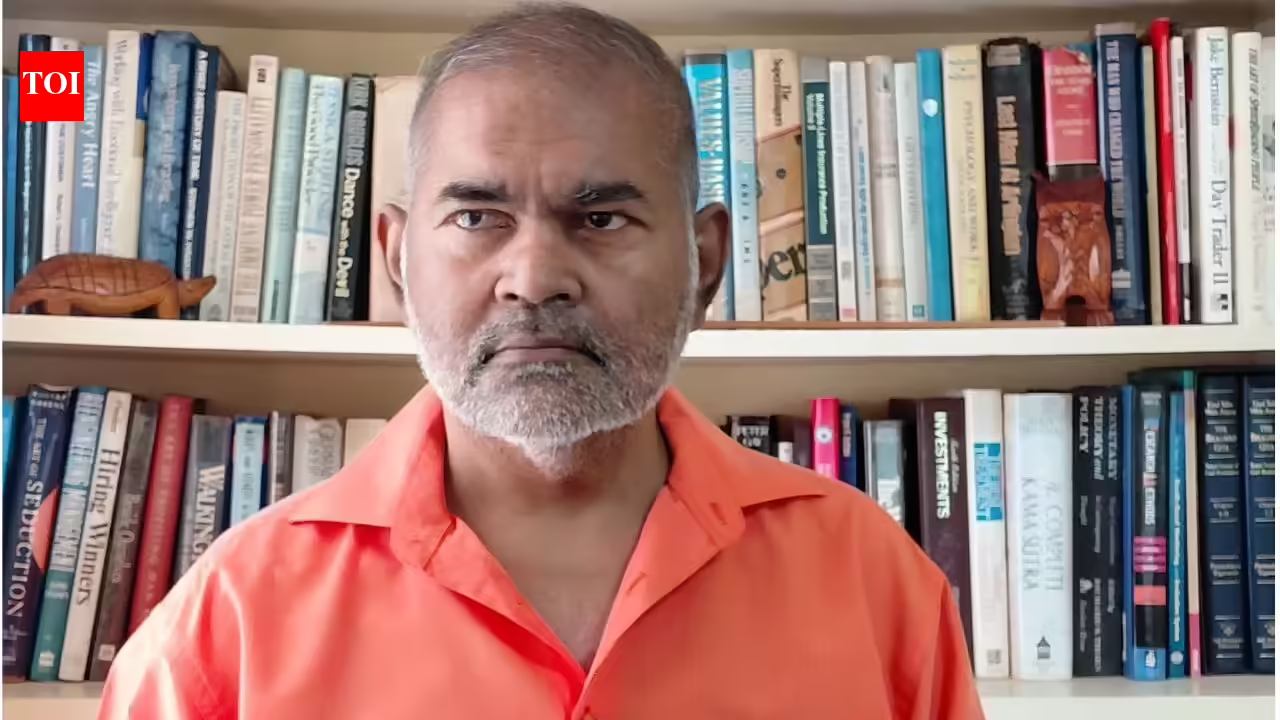
LITERARY magazine Granta has announced will no longer publish the winning entries of the annual Commonwealth Short Story prize after Trinidad and Tobago writer and 2026 Caribbean category winner Jamir Nazir drew widespread accusations of AI use.According to an article in The Guardian UK, the magazine said it would no longer be involved in “external publishing partnerships” in which it had no editorial control.In a statement to the Guardian, Granta said: “The 2026 selection of the regional winners of the Commonwealth prize caused a great deal of controversy, based on the speculation that one or more of the stories may have been at least partially AI-generated, accusations that were strongly rejected by the authors.“For the sake of our own editorial integrity, the Granta Trust board has now taken the decision that we will no longer engage in external publishing partnerships. We will keep the Commonwealth prize shortlisted stories on our website in the public interest, and wish our former partner, the Commonwealth Foundation, all the best in its work.”The article reported the Commonwealth prize did not respond to a request for comment.Nazir’s winning entry, The Serpent in the Grove, was hit with allegations of AI assistance both locally and internationally following publication on Granta. Trinidadian author and former Commonwealth Short Story Prize Overall Winner Kevin Jared Hosein, in a post in May, said the prize is “dead”, with the “first blow” being Nazir’s “AI-alleged” short story, and the second the Commonwealth Foundation which supported the writer and the judges who selected his story.Hosein has said of the winning selection, “the storytelling is quite poor, and none of his metaphor and simile serve the characters or the narrative”. He said while it was difficult to legally prove the use of AI tools, assisted writing “lacks intentionality behind the strangeness it evokes as ‘great’ literature”.He added that AI-assisted works usually presented “disappointing linguistic homogeneity that occurs and reoccurs if you read enough generated fiction”.The writer reiterated the “death” of the prize in a Facebook post yesterday responding to the Granta announcement.“I said it here first. For any serious writer: The Prize is Dead. This is such a terrible loss for emerging writers in so many regions. People who tried to defend the Serpent and criticise my stance on it ought to read the room. There is no appropriate response to this other than ferocious rejection,” he wrote.He continued: “Granta is correct to do this. It is still baffling to me how the Commonwealth Foundation, such a long-standing institution, let itself be routed by the likes of Zoongie (a character from Nazir’s story), ‘whose walking made benches become men’ and had ‘a smile like a sunrise over a sink’. At the very least, this is a very important lesson for any literary institution or competition going forward. This is what inaction and negligence leads to. RIP.”An online article from The Guardian UK in May also reported on the AI allegations against Nazir stating that shortly after publication, Ethan Mollick, a professor at the University of Pennsylvania, wrote on Bluesky that a “100% AI generated story just won the Commonwealth prize for the Caribbean region”.In the recent article, The Guardian UK wrote that Nazir’s story began to draw attention on X and Bluesky in mid-May, when critics claimed the story had “obvious markers” of AI-generated writing.The story features items arranged in threes and “not x, but y” constructions, which some regard as a sign of AI use. Critics also highlighted phrases such as “Sun on galvanise is a cruel instrument” and “She had the kind of walking that made benches become men”.Nazir has defended the originality of his work in the face of the AI allegations.Writer defendshis workIn a statement posted to LinkedIn in May, Nazir said the story was “entirely written” by him and based on his experiences growing up in rural Trinidad.“I am directly addressing the baseless claims regarding my Commonwealth story. To be pellucidly clear: this work was entirely written by me, drawn from childhood memories of growing up in rural Trinidad,” Nazir stated.Nazir had also challenged the credibility of AI detection tools, arguing that they often generate false positives when assessing polished writing.“My writing process is unusual,” Nazir told the Observer UK via e-mail in late May. “It is conducted entirely on an Android phone. This is a necessity driven by chronic health conditions which make sustained, desk-bound typing physically impossible. That is why I rely on speech-to-text to do my writing, followed by minimal keyboard editing, along with the same process of speech-to-text. I have used this in my professional life and also to produce my story for the Commonwealth competition.”The Commonwealth Foundation previously stated in a release that while it takes allegations of AI use seriously, it had reviewed the available evidence and continued to support the writers involved in the 2026 Commonwealth Short Story Prize.“The Commonwealth Foundation takes seriously the allegations of AI use towards several of the winning writers of the 2026 Commonwealth Short Story Prize,” the statement said.The Foundation added that it recognised “rapidly evolving challenges” posed by generative AI in literature and other creative fields and said it would undertake a full review of its judging process to address future concerns.In a statement on May 19, Commonwealth Foundation Director-General Razmi Farook said all shortlisted writers had confirmed that no AI was used in their submissions.“We place our confidence in the integrity of our contributors and the calibre and experience of the judges and Chair of the Judging panel, and stand by the assurances given by our authors as part of our process,” Farook stated.He also acknowledged that while AI detection tools are becoming more common, they are “not unfailing or infallible”.The Commonwealth Short Story Prize is an annual award for the best unpublished short fiction from Commonwealth countries. The prize awards £2,500 to each regional winner and £5,000 to the overall winner. The 2026 competition saw 7,806 entries-the second highest number in the prize’s history.According to the Commonwealth Foundation, The Serpent in the Grove is a story set in rural Trinidad about a struggling farmer, a silenced young wife and a grove that seems to remember what others try to bury. Caribbean region judge Sharma Taylor described it as ‘polished and confident, with a melodic voice that lingers long after the final line. Jamir Nazir’s prose pulses with a voice of restraint and quiet authority’.The other regional winners of the competition were T&T-born Lisa-Anne Julien (South Africa, Africa region); Sharon Aruparayil (India, Asia region); John Edward DeMicoli (Malta, Canada and Europe region); and Holly Ann Miller (New Zealand, Pacific region). The overall winner will be announced on June 30.
AI cloud over writing prize
LITERARY magazine Granta has announced will no longer publish the winning entries of the annual Commonwealth Short Story prize after Trinidad and Tobago writer and 2026 Caribbean category winner Jamir
1,105 words~5 min read