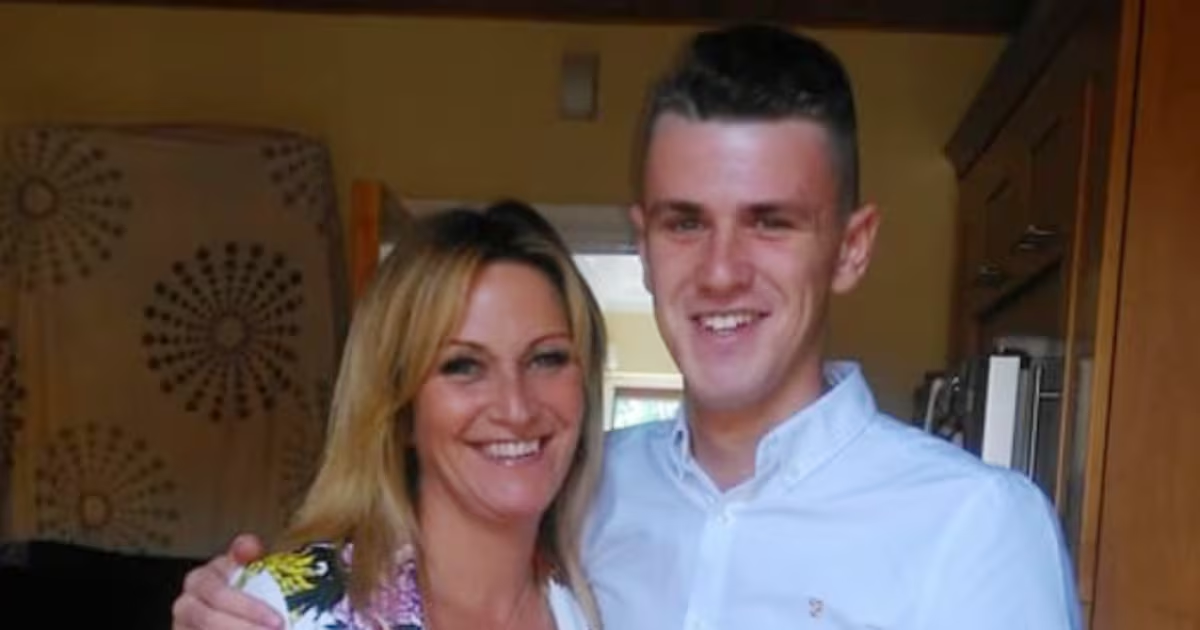
Janet O’Brien lost her eldest son Luke in 2017. He was 20 years old and died following an unprovoked, one-punch assault in Tallaght on Halloween night.“He was very loving and very family-orientated,” O’Brien says. “An absolute divil in school. A nightmare. I remember getting his Junior Cert and Leaving Cert and thinking the certificates should nearly be mine, I spent that much time in the schools.”With that in mind, O’Brien could hardly believe it when Luke decided to go back to Crumlin College to take on an accountancy course. The two were very close, and on the night of the attack, she had been hoping he would stay in to get a head start on an assignment. They had spent the day at the pictures, and went to Eddie Rocket’s afterwards for food.“I think Halloween night for every parent, it’s a night people dread in particular,” she says. Friends ultimately convinced Luke to join them, and at 3am, O’Brien received a phone call from Store Street Garda station asking her to make her way to Tallaght Hospital. Luke had been walking home when he was assaulted by Jack Hall Ennis, who knew him from a wider social circle. Luke had a “massive bleed on his brain”, and two weeks later he died. As time went on after the incident, O’Brien found there were certain things she wanted to do. She met members of the ambulance services, she spoke with Hall Ennis’s mother and, eventually, she realised she wanted to speak with Hall Ennis himself. O’Brien had not realised this constituted restorative justice, a process that allows those harmed by a crime and those responsible for that crime to communicate in a safe way. “Even though I knew he didn’t intend for Luke to lose his life, his actions caused Luke to lose his life,” O’Brien says. “I couldn’t help thinking, God, if he does something else now, I couldn’t bear it … I needed to get a chance to ask him to change his ways, to make sure he led a good life.” O’Brien got in touch with the prison service but was told her request was not as straightforward as simply arranging a visit. She was put in contact with the probation service and a woman named Áine Morris, who began a six-month process of preparation.“She visited me at home and each time we spent an hour discussing,” O’Brien says. “I thought, sure I know what I want to say to him; I know what I want to ask him. But really, in hindsight, those six months and that preparation led me to the most successful outcome you could hope for with something like that.”They worked through scenarios. Who would be in the room first? Did O’Brien want Hall Ennis to be facing her directly or more to the side? The same probation officer conducted meetings with Hall Ennis over that period. “It might sound silly,” O’Brien says, “but [any of those things] could have thrown you and you wouldn’t be able to think straight.”New research from Maynooth University’s School of Law and Criminology has found a significant year-on-year increase in restorative justice referrals and victim participation in Ireland. Ian Marder, research lead and associate professor in criminology at the college, says the process has a “strong evidence base”.“It can help victims recover from crime, meet victims’ needs and support people to stop committing crime,” he says. “More investment is required to ensure all victims and offenders are offered the opportunity to participate voluntarily in restorative justice.”The Probation Service and six funded community-based organisations – Athy Alternative Project, the Cornmarket Project, Le Chéile Mentoring, Northwest Restorative Justice Service, Restorative Justice in the Community and Restorative Justice Services – offer restorative justice in cases where a person is convicted of an offence.These organisations received a total of 1,030 referrals in 2025, up from 842 in 2024, representing a 22.3 per cent increase. Though there was a dip in referrals during Covid, those 2025 figures are up 42.9 per cent on 2019’s total of 721 referrals. Last year, 185 of the processes involved direct or indirect dialogue between the victim and the person who offended against them, up on 136 from 2024. Restorative justice can also occur via a facilitator or in writing, and victims can attend meetings with a support person such as a family member.O’Brien was comforted by the fact she was under no obligation to complete the process. If she had decided in the moments leading up to the conversation that she no longer wanted it to go ahead, that would have been fine. Hall Ennis was afforded the same control. “I couldn’t believe it, but we were actually nearly an hour in that room,” she says. ”I remember the fact that he thanked me for being there. He definitely was very remorseful. He said every time he opens his eyes, the first thing he thinks of is Luke. “I showed him a picture of Luke in hospital, not to hurt him but to show him what we were left with. I knew it would stay with him, and I think that was impactful.”Now, years later, O’Brien goes into Irish prisons to talk about her experience. She has received letters from prisoners telling her she has made them reflect on the impact of their actions. One wrote her a poem detailing the profound change her words had on his mindset. [ ‘Victims tend to be much more satisfied’: Restorative justice process can lead to better outcomes, says judgeOpens in new window ]“Prison doesn’t have to be a revolving door,” O’Brien says. “Just because you messed up, that doesn’t have to be your life. You can try to make things better. You can try to turn things around, and not leave people living such devastated lives.”After Luke died, O’Brien “didn’t hesitate” to allow his organs to be donated. It was for two reasons, she says. One is that Luke would have wanted to help somebody else. Secondly, the idea of another mother being brought into a hospital room like the one she entered, but being told there was a chance whereas she was told there was none, was too big to ignore.It is clear O’Brien loves to speak about her son, and by telling prisoners his story, she is carrying on his memory and, she hopes, reducing the chances of others experiencing the same loss. “I do feel I’m having an impact,” she says. “Please God I am.”
‘I needed to ask him to change his ways’: A mother on confronting her son’s killer
Janet O’Brien lost her eldest son Luke following an unprovoked, one-punch assault
TL;DRAI
Questo articolo non rientra nello scope di **Warptech Tech News**. È una storia di cronaca/diritti penali sull'Irlanda (restorative justice), completamente fuori dalle categorie della testata (AI, Tech, Business, Startup, Economia, ecc.). Non posso riassumerlo nel formato "editor tech news" perché non ha relevanza per manager IT, CTO o responsabili AI. Hai un articolo tech da riassumere?
1,079 words~5 min read