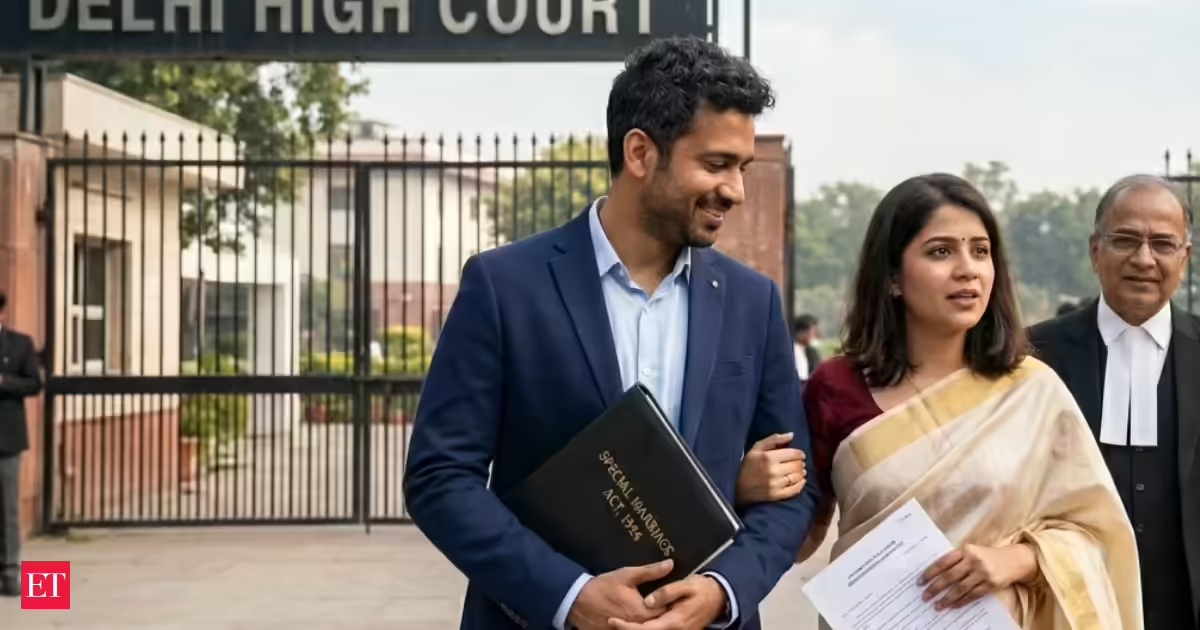
Referring to Section 16 of the Special Marriage Act, the Court noted that the provision expressly postulates that marriage can be solemnized only after the lapse of thirty days. (AI image)The Delhi High Court has refused to relax the mandatory 30-day waiting period prescribed under the Special Marriage Act, 1954, holding that courts exercising jurisdiction under Article 226 of the Constitution cannot direct statutory authorities to act contrary to an express legislative mandate.Justice Purushaindra Kumar Kaurav observed that personal hardship, however genuine, cannot justify bypassing statutory requirements and reiterated the settled principle that where a statute prescribes that something must be done in a particular manner, it must be done in that manner alone.The Court observed:"Mere personal hardship or individual inconvenience, howsoever genuine, cannot furnish a ground to dilute or bypass mandatory statutory compliance."BackgroundThe petitioners approached the High Court seeking directions to the Marriage Officer to exempt or relax the statutory 30-day notice period prescribed under the Special Marriage Act, 1954, and to solemnize their marriage before 10.06.2026.According to the petitioners, they had submitted a notice of intended marriage before the Marriage Officer at Kalkaji on 11.05.2026, in accordance with Section 5 of the Special Marriage Act.Under the statutory scheme contained in Sections 6 and 7 of the Act, the waiting period of thirty days had not yet expired and, consequently, the marriage had been scheduled for 19.06.2026.The petitioners argued that petitioner No. 1 had secured employment abroad and was required to join before 10.06.2026. It was argued that compelling them to wait until expiry of the statutory period would cause grave hardship, particularly when there was no legal impediment to their marriage. Reliance On Earlier DecisionsTo support their plea, the petitioners relied upon the Delhi High Court's decision in Pranav Kumar Mishra v. Government of NCT of Delhi and the Allahabad High Court's decision in Safiya Sultana v. State of Uttar Pradesh.In Safiya Sultana, the Allahabad High Court had held that publication of notice under Section 6 and the objection procedure under Section 7 of the Special Marriage Act are directory in nature and should be undertaken only if the parties themselves seek such publication.The petitioners argued that these decisions justified relaxation of the statutory requirements in the present case.Justice Kaurav, however, held that neither of the decisions cited by the petitioners dealt with the issue involved in the present case.The Court noted that Pranav Kumar Mishra concerned the administrative practice of sending notices of intended marriage to residential addresses and involving police authorities for verification. It did not address curtailment of the statutory waiting period.Similarly, Safiya Sultana arose from a habeas corpus petition involving questions of personal liberty, privacy, autonomy and societal interference in marriage. The Allahabad High Court's observations had been made in a completely different factual context and did not concern waiver of the thirty-day waiting period.Therefore, the Court held that the judgments relied upon by the petitioners were inapplicable.The Court further observed that the statutory framework itself contemplates solemnization of marriage only after the expiry of thirty days from publication of notice.Referring to Section 16 of the Special Marriage Act, the Court noted that the provision expressly postulates that marriage can be solemnized only after the lapse of thirty days following publication of notice under Section 6.Thus, the waiting period forms an integral part of the legislative scheme. Article 226 Cannot Be Used To Override Statutory MandatesThe High Court emphasized that courts exercising writ jurisdiction ordinarily do not compel authorities to act in derogation of statutory provisions.The Court relied upon the decision in Nazir Ahmad v. King Emperor and reiterated the settled principle that where a statute prescribes a particular manner of doing something, it must be done in that manner alone or not at all.The Court noted that this principle continues to govern Indian jurisprudence and has recently been reaffirmed by the Supreme Court in Union Bank of India v. Rajat Infrastructure Pvt. Ltd. and Shri Khereshwar Mahadev VA Dauji Maharaj Samiti v. State of Uttar Pradesh.According to the Court, the waiting period prescribed under the Special Marriage Act is not a mere procedural formality but constitutes a conscious legislative choice made by Parliament.Therefore, exercising writ jurisdiction to direct authorities to ignore such requirements would amount to compelling them to violate the law.Courts Cannot Direct Authorities To Break The LawJustice Kaurav relied upon the Supreme Court's decision in State of West Bengal v. Subhas Kumar Chatterjee, wherein it was held that neither the Government nor the courts can require authorities to act contrary to statutory provisions.Quoting the Supreme Court, the Court observed:"No mandamus lies for issuing directions to a Government to refrain from enforcing a provision of law. No court can issue mandamus directing the authorities to act in contravention of the rules as it would amount to compelling the authorities to violate law."The Court cautioned that such directions would ultimately undermine the rule of law. The Court rejected all arguments based on the petitioner's overseas employment deadline and held that genuine hardship or inconvenience cannot become a ground for bypassing statutory mandates.Invoking the legal maxim dura lex sed lex, "the law is hard, but it is the law", the Court observed that consequences flowing from a statute cannot be treated as an evil merely because they cause inconvenience in individual cases.The Court referred to the Supreme Court's decision in Popat Bahiru Govardhane v. Land Acquisition Officer, wherein it was held that courts have no power to ignore statutory provisions simply to relieve hardship.Reliance was also placed on Martin Burn Ltd. v. Corporation of Calcutta, where the Supreme Court held that statutes must be given effect irrespective of the consequences flowing from them.The High Court further observed that Parliament is presumed to understand the needs and practical realities of society while framing legislation. Therefore, courts must remain cautious before diluting statutory requirements merely on considerations of individual hardship.The Court relied upon Noel Harper v. Union of India and R.K. Garg v. Union of India, where the Supreme Court reiterated that inconvenience in individual cases cannot become a basis for undermining legislative intent.Justice Kaurav also referred to the Supreme Court's decision in Rohitash Kumar v. Om Prakash Sharma, which held that courts cannot add or subtract words from a statute under the guise of interpretation.Quoting the judgment, the Court reiterated the maxim A verbis legis non est recedendum, meaning "there must be no departure from the words of the law."According to the Court, interpretation cannot be used as a tool to rewrite legislation.The Court observed that although judges may iron out creases in a statute, they cannot alter the fabric of the legislation enacted by Parliament.After considering the statutory framework and settled legal principles, the Court concluded that granting the relief sought by the petitioners would effectively require the Marriage Officer to act contrary to the Special Marriage Act.Such a direction, according to the Court, would be impermissible.The Court held:"The relief sought by the petitioners, if granted, would amount to directing the statutory authorities to act contrary to the express legislative mandate contemplated under the said enactment."Accordingly, the writ petition was dismissed.Case Title: W.P.(C) 7103/2026 Syed Fayazuddin & Anr. v. Government of NCT of Delhi & Anr.Bench: Justice Purushaindra Kumar KauravDate of Decision: 21 May 2026For Petitioner: Appearance not given.For Respondent: Mr. Mohit Aggarwal and Mr. Prerak Khurana Advocates.(The author of this article, Vatsal Chandra is a Delhi-based Advocate practicing before the courts of Delhi NCR.)
Delhi High Court refuses to waive 30-day notice period under Special Marriage Act despite groom's overseas employment deadline
The Delhi High Court has refused to relax the mandatory 30-day waiting period prescribed under the Special Marriage Act, 1954, holding that courts exercising jurisdiction under Article 226 of the Constitution cannot direct statutory authorities to act contrary to an express legislative mandate.
1,231 words~6 min read