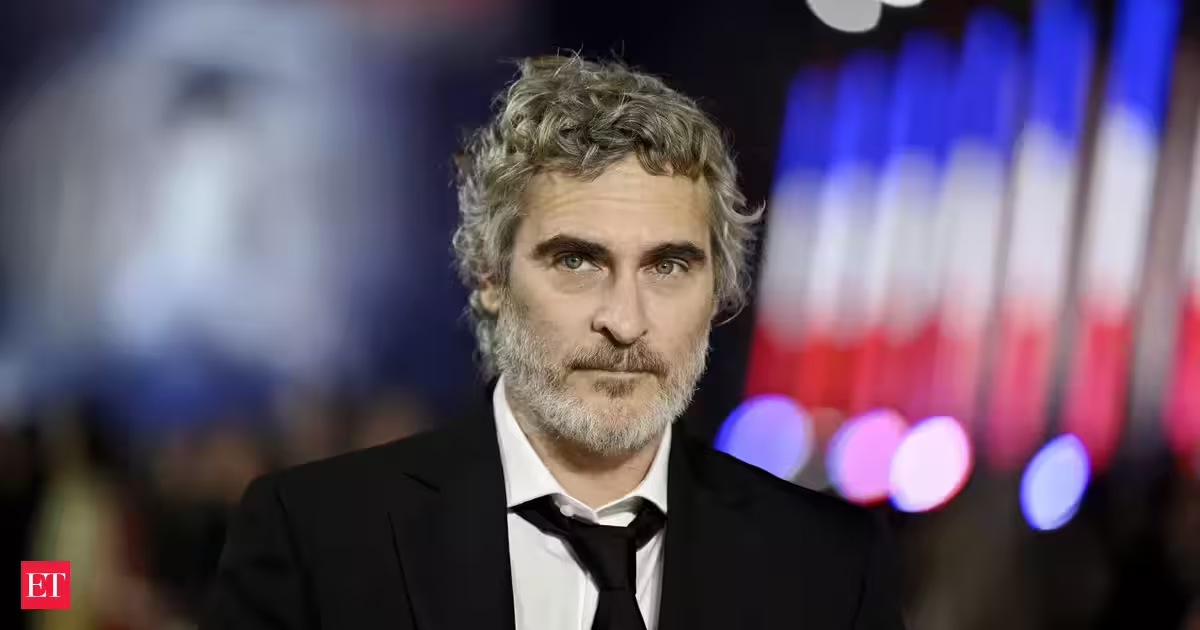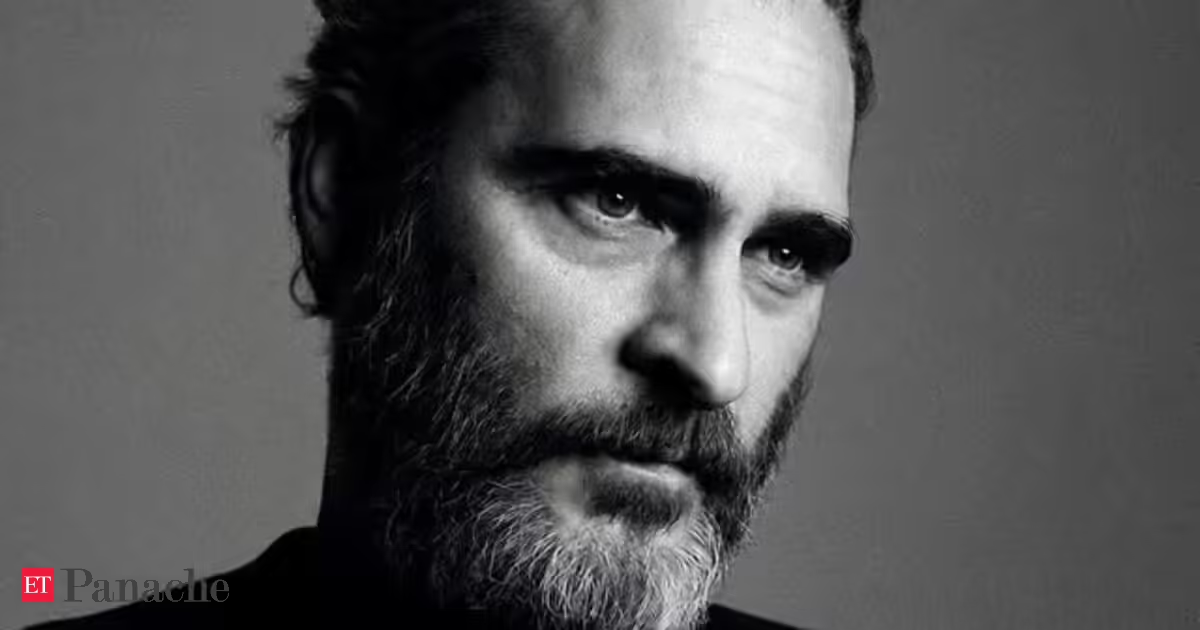
Few actors have built a career as unpredictable as Joaquin Phoenix. Whether playing the ruthless Commodus in Gladiator, the troubled Arthur Fleck in Joker, or the iconic Johnny Cash in Walk the Line, Phoenix has earned a reputation for taking risks that many stars would avoid. But one of the biggest gambles of his career came off-screen. In a 2020 interview with GQ, the Oscar-winning actor looked back at I'm Still Here, the controversial 2010 mockumentary that made many people believe he had abandoned acting altogether. Reflecting on that period, Phoenix shared a quote that continues to spark conversations about success, ambition, and the price of authenticity.The quote and what it really meansSpeaking to GQ in 2020, Joaquin Phoenix recalled the reaction to I'm Still Here and said:"I thought Casey and I had actually achieved ultimate success with I'm Still Here, if your definition of success is completely destroying your career, which was somewhat the intent."When you first read it, the statement sounds shocking. Why would a successful actor want to destroy his own career?The answer lies in the irony behind the quote. Phoenix was not celebrating failure. Instead, he was talking about how far he and filmmaker Casey Affleck were willing to go in pursuit of a creative experiment. The project was designed to blur the line between reality and performance, even if it came at the cost of his public image.His point was simple: success depends entirely on how you define it. If the goal was to create something fearless, unpredictable, and authentic, then the project succeeded. If the goal was popularity and universal approval, it clearly did not.The strange story behind I'm Still HereAccording to information about the film, I'm Still Here is a 2010 American mockumentary musical parody directed by Casey Affleck and written by Affleck and Joaquin Phoenix.The film followed Phoenix after he announced his retirement from acting. In the movie, he appears to abandon Hollywood and pursue a career as a hip-hop artist. What made the experiment unusual was that Phoenix remained in character even when cameras were not rolling. For months, public appearances, interviews, and media interactions were all part of the performance. Many people genuinely believed the actor had walked away from acting and was experiencing a personal crisis.The most famous example came during his appearance on Late Show with David Letterman. Phoenix appeared withdrawn, spoke very little, and behaved awkwardly throughout the interview. The appearance quickly became one of the most talked-about celebrity moments of that era, with viewers wondering whether the actor had suffered a breakdown.Years later, audiences learned that much of what they had witnessed was part of a carefully planned performance connected to I'm Still Here.Why Phoenix wanted to take such a huge riskDuring his conversation with GQ, Phoenix explained that he has always been interested in uncertainty as an actor.For him, acting is not simply about delivering lines or performing a role exactly as planned. He described it as chasing a feeling, something that cannot always be explained logically. He believes the most interesting moments happen when there is genuine uncertainty and when the outcome is not completely under control.That philosophy played a major role in I'm Still Here. The project created real consequences. People questioned his judgment, mocked him publicly, and speculated about his future. There was no guarantee that audiences would understand what he was trying to do.In many ways, that danger was precisely what attracted him to the experiment. The risks were not imaginary. Phoenix's public image took a significant hit during that period.Many fans and critics struggled to understand the project. The film itself received mixed reactions and failed commercially. According to Phoenix's later reflections, he even worried about the financial consequences and the possibility that he had invested too much in a project that audiences rejected.Even people close to the production reportedly questioned whether they were going too far. According to GQ, there were debates about how much of the joke should be revealed to the public.Yet despite the criticism and losses, Phoenix never viewed the experience as a mistake.How the experience changed himLooking back, Phoenix told GQ that the project was "unbelievably liberating." He said it helped him grow as an actor and gave him a deeper appreciation for performance.That may sound surprising considering the backlash the film received. But for Phoenix, the value of the experience was not measured by ticket sales, reviews, or public approval.Instead, he judged it by what he learned from it. The project forced him to confront fear, uncertainty, and failure in a very public way. It challenged him creatively and personally, which is why he continues to speak about it positively despite its reputation.The lesson behind the quoteWhat makes Phoenix's quote so compelling is that it challenges conventional ideas about achievement.Most people associate success with money, awards, popularity, or status. Phoenix's comments suggest another perspective: success can also mean staying true to a creative vision, even when doing so involves enormous risk.His career offers evidence of that idea. Rather than ending his future in Hollywood, I'm Still Here was followed by acclaimed performances in films such as The Master, Her, and eventually Joker, which earned him his first Academy Award.According to Variety, Phoenix is widely regarded as one of the finest actors of the 21st century. From Gladiator and Walk the Line to Napoleon and Beau Is Afraid, he has built a career around difficult, unconventional characters.That is why his quote continues to resonate years later. It is not really about destroying a career. It is about understanding what you value most, accepting the consequences of your choices, and recognising that the definition of success is often far more personal than the world expects it to be.
Quote of the day by Joaquin Phoenix: 'I thought I had achieved ultimate success. But if your definition of success is completely destroying your...' A powerful lesson on fame and ambition by Joker, Gladiator actor
Joaquin Phoenix once declared that his controversial 2010 mockumentary, I'm Still Here, was a success if 'destroying your career' was the goal. This bold statement, made with filmmaker Casey Affleck, aimed to blur reality and performance, risking his public image for a creative experiment. Read on to know how the experience became a life lesson.
TL;DRAI
Phoenix ha definito "successo definitivo" il mockumentary I'm Still Here (2010): esperimento che distruggeva intenzionalmente la carriera, rimanendo in personaggio nascosto per mesi, blurrando realtà e performance. Sfida la definizione convenzionale di successo (reddito/premi/popolarità) privilegiando autenticità creativa e rischio: paradigma per leader che definiscono KPI autonomamente.
952 words~4 min read