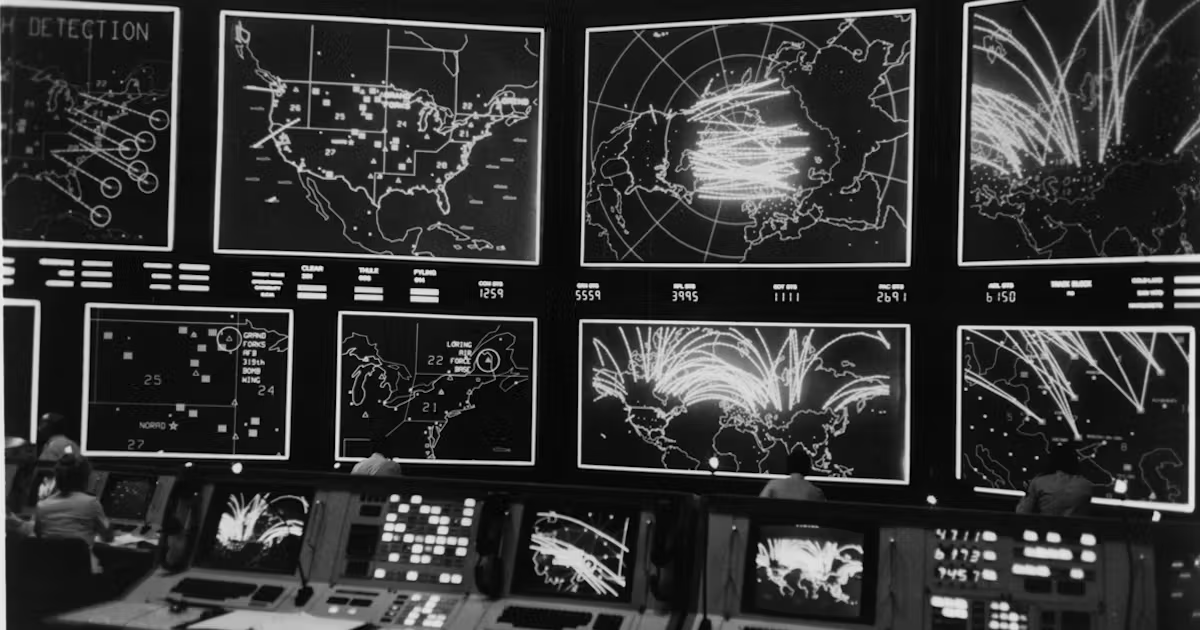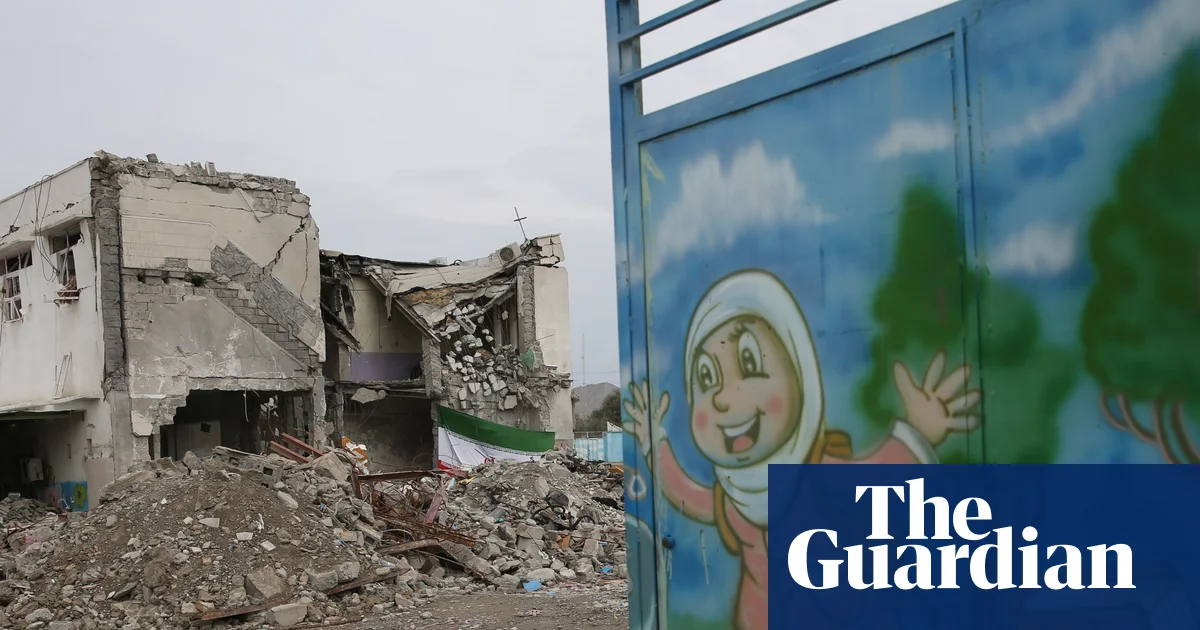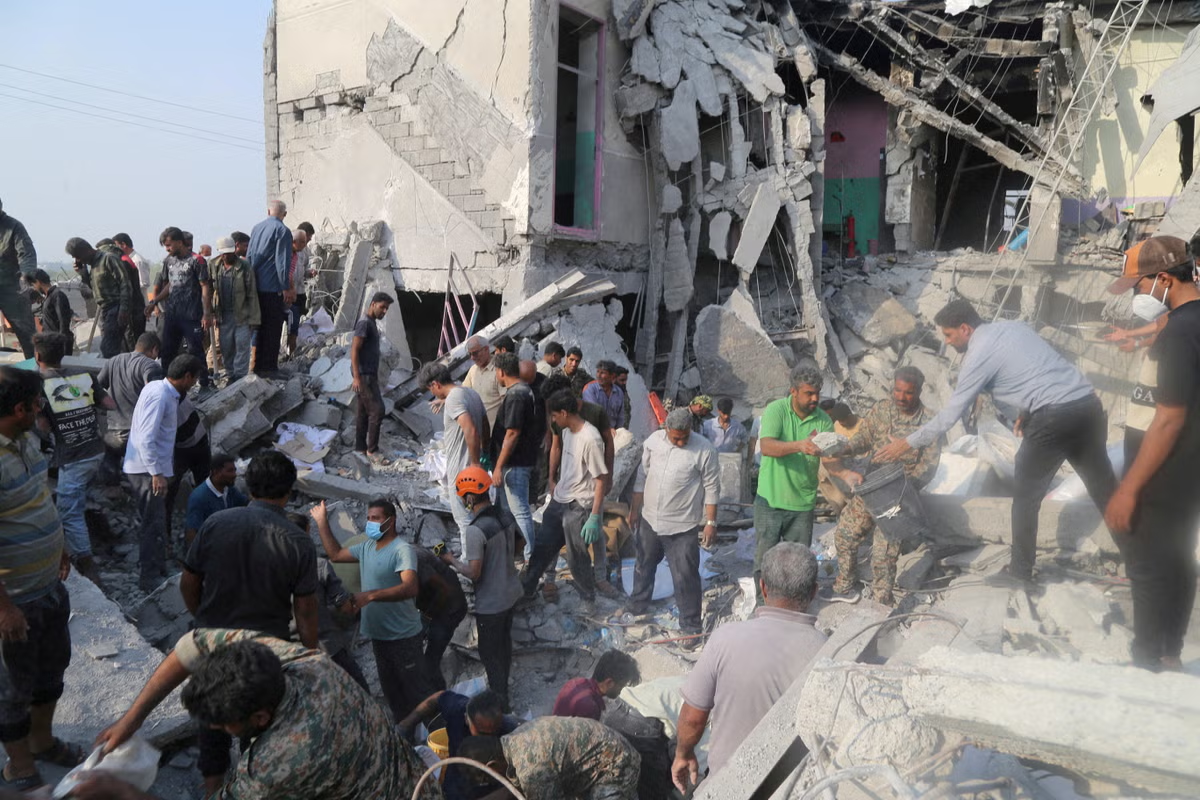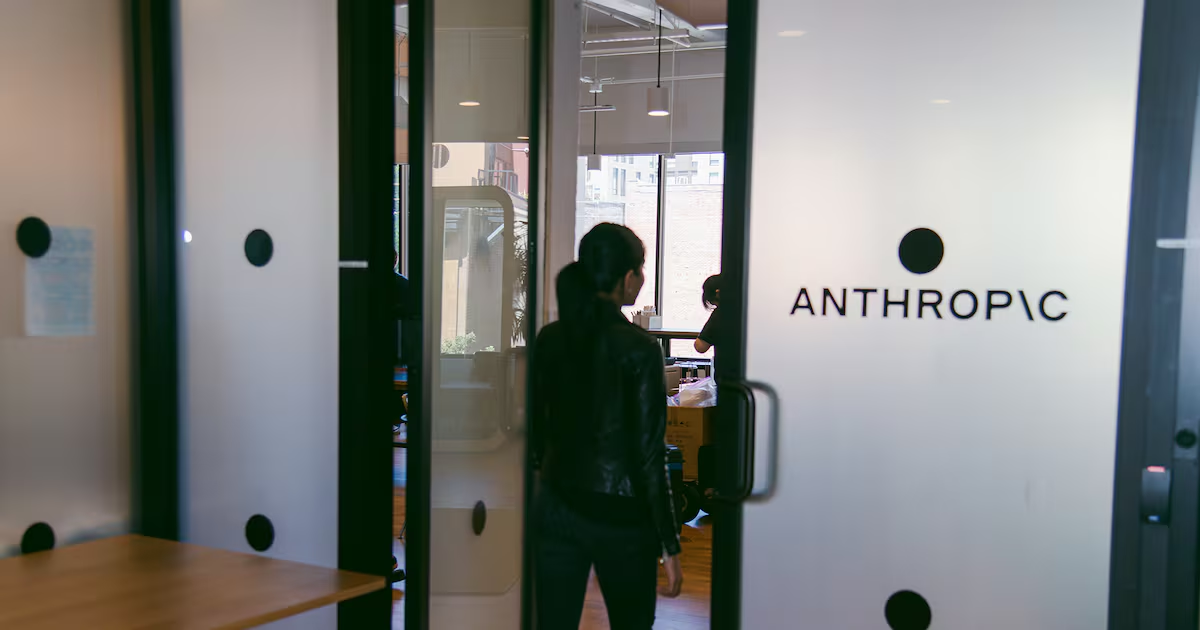
Anthropic calls itself an AI safety company. The children of Minab might disagree, if they were alive to do so.On the morning of February 28th, at the Shajareh Tayyebeh girls’ elementary school in southern Iran, children were in class when the war began. Shortly afterwards, a missile struck the building, collapsing the roof onto the students inside. Up to 168 people were killed, most of them schoolgirls.The school was beside a Revolutionary Guard installation, and investigations by Amnesty and others concluded the strike was likely by the US. The targets that morning were reported to have been generated by Palantir’s Maven system, which produced hundreds of strike co-ordinates in the campaign’s first day – which runs, in part, on Claude, Anthropic’s model. Whether Claude flagged that particular roof is unknown and is one of the things the Pentagon is likely to look at in its investigation. However, what seems probable is that the kill list was assembled by a system running on it.“Look, we don’t have access to, we don’t know exactly how these models were used,” Anthropic chief executive Dario Amodei told Bloomberg recently. “The principle that we have established, and I think the principle that was obeyed here, is a human makes the final decision.”This is the company that, the very same week, announced a major expansion in Dublin, to shamrock emojis and an IDA press release describing “the AI safety and research company”. The phrase is doing an enormous amount of work, and the months since have worn it threadbare. Last week, the White House demanded that Anthropic suspend access by foreign nationals to its latest tool over national security concerns.[ Should decisions about whether AI can be used in war be left to private companies?Opens in new window ]The issue is that defining what is and isn’t defence technology takes real expertise, because most of it is indistinguishable from research. For example, the military is the largest applied-research programme most states run. So the test of militarisation is not what a thing is, but what is done with it.Consider what the US government does with Anthropic’s technology. Not only does it rely on the product in its missile kill chain, but last week it placed the company’s most advanced models under national-security export controls, while preventing them from being used by every non-American national. Anthropic complied within hours, disabling the models worldwide. Is this a military technology, or just a research platform? Deciphering it is getting easier, as a government that deploys the product in war and controls its export like it does munitions has already done the classifying for Ireland.A self-described neutral country has, inadvertently, put a weapons-adjacent technology at the centre of its economyTwo immediate consequences follow Anthropic’s move into defence technology, and Ireland has reckoned with neither. The first is that the whole of Europe now sits inside a trap, in that the same country underwriting European security can now switch off European access to the technology that security increasingly runs on. And there has been strangely little discussion about the fact that Dublin is the European home of not only one increasingly militarised technology, but of nearly all of them. OpenAI, Google, Amazon Web Services and Microsoft all have enormous Pentagon contracts.[ Robots in the military: how the Defence Forces is using AI to cover shortfalls in resources and personnelOpens in new window ]A country that cannot keep Russia’s “research ships” off the cables in its own waters has made itself the European choke-point for the industry Washington is now weaponising, literally and figuratively.Ireland will not see the second consequence coming until it is too late. A self-described neutral country has, inadvertently, put a weapons-adjacent technology at the centre of its economy. And indeed, our neutrality is exactly what permits this, as taking no side is what lets us provide headquarters for every side. But the work Ireland holds itself above – even the guarding of our own waters – still has to be done by someone. And to the countries that do it, a neutral Ireland hosting militarised technology it cannot protect itself does not look neutral. It appears as a European weakness.We have done this before, with hardware instead of software.[ Ireland can offer hope as militarisation hastens climate catastropheOpens in new window ]After the 2022 sanctions, Irish exports of dual-use chips to Russia collapsed, as Brussels drew the line, and Ireland stood behind it. But toward Israel, there was no red line, and so the same technology still flows. Where Ireland has its own discretion, it has used it to approve: more than €97 million in dual-use exports since October 2023, some to Israeli state and security bodies, the details withheld due to “commercial sensitivity”. Aughinish is part of the same failure, as it refines alumina, not warheads. To Ireland that settles it – even though alumina is refined into aluminium, which is what warheads are made of.Ireland can classify military technology, it seems, only when someone else does the classification for us. And this is because we have never built the capacity to decide for ourselves, lacking an intelligence service and a basic definition of military technology. This incapacity is convenient, as a country that never looks under the bed never has to find the monsters. Taoiseach Micheál Martin said he was unaware of the military supply chain links to Aughinish, yet records show a briefing document on that question was prepared for him in 2023, when he was tánaiste and minister for Foreign Affairs.The children of Minab died because of a war, not because of Anthropic’s existence. The system that may have chosen their school runs on technology created by a company whose expansion Ireland celebrated that very weekIn July, Ireland takes over the presidency of the European Council, and for six months we will chair Europe’s discussions on AI in military targeting and on export control – the two questions we ironically cannot answer about our own largest source of foreign investment.Of course, a serious country would not turn the foreign direct investment away, as that would be economically destructive and strategically foolish. But perhaps we should treat this as a problem of sequencing. In the short term, we need to draw a clear line around strategically restricted FDI. In the longer term, we need to use that line to buy ourselves time for growing an indigenous industry that doesn’t hold our neutrality, however ill-defined, to ransom.This is not, I suppose, even an argument about neutrality – a word we use precisely because it spares us from defining ourselves. It is an argument about whether the State can decide anything at all. The children of Minab died because of a war, not because of Anthropic’s existence. The system that may have chosen their school runs on technology created by a company whose expansion Ireland celebrated that very week.We cannot hold the local Anthropic jobs and the dead children in the same hand and claim we are simply a neutral country making hard choices. We are an unserious one not making any choices at all.
Sineád O'Sullivan: Dublin-based firms are also part of the military complex
There’s been strangely little talk of the fact that Dublin is the European home of several increasingly militarised technologies
1,178 words~5 min read