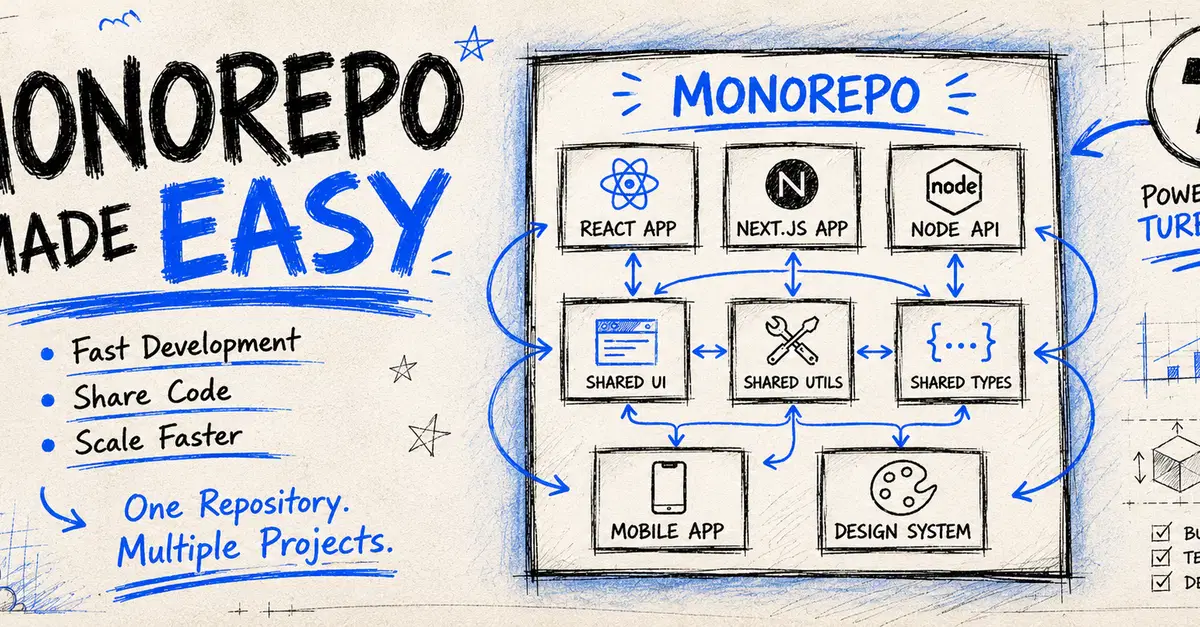
Have you ever built a full-stack application (without fullstack framework like NextJS), if yes so you might definitely know that you need to build two projects (frontend and backend) and need to write and build everything separately for both of them. But a monorepo allows to handle that development process more efficiently so that we do not need to build same utility everything, handle both project together not separately.
A monorepo is a single repository containing multiple distinct projects, with well-defined relationships. It is a standard method of using multiple projects in one repository or folder.
Companies like Google, Meta, Microsoft, and Uber uses monorepos to streamline software development across their diverse product suites. Modern companies often require a complex ecosystem of software, including web applications, APIs, Android and iOS apps, and testing suites. Managing these projects in isolation frequently leads to inefficiencies; teams often operate in isolation, unaware of redundant efforts pilling up or shared utility requirements. Furthermore, since frontend applications and APIs are inherently interdependent, a monorepo approach facilitates better integration, fosters code reuse, and significantly accelerates both development cycles and CI/CD pipelines.