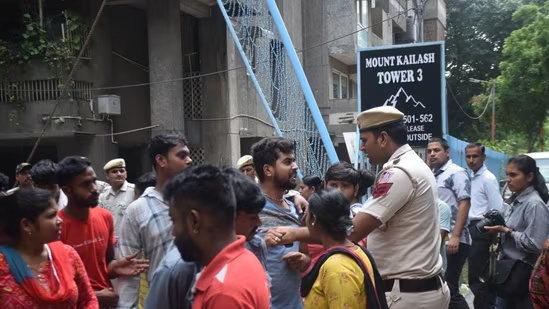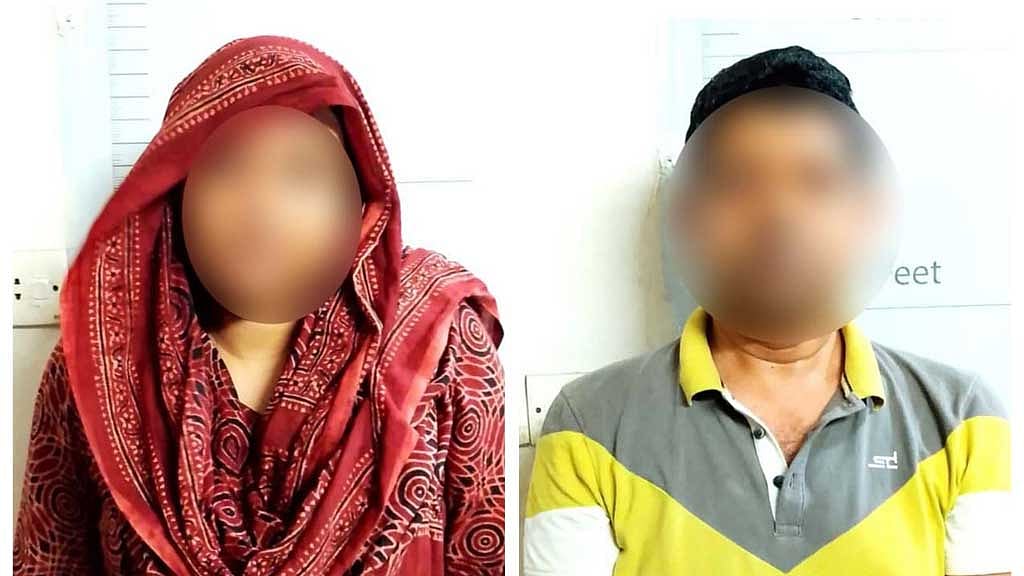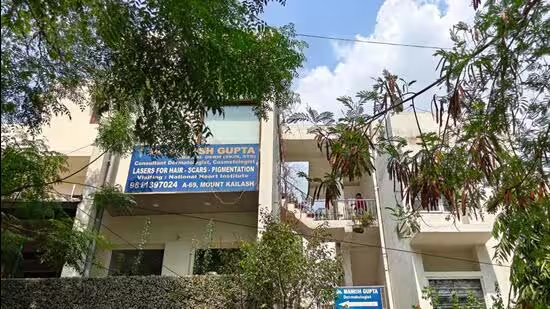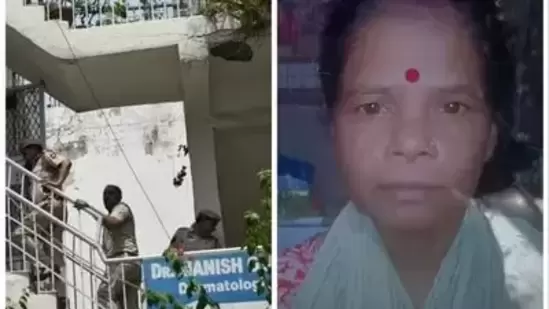
A domestic worker's murder raises questions about the value we place on the women who cook, clean, care for our families. Two days after International Domestic Workers Day, Manish Gupta, a 50-year-old dermatologist, reportedly frustrated by his wife’s refusal to sack their domestic worker for bringing “bad energy” to the house, took a bat to Meena Halder, knocked her unconscious and then allegedly stabbed her repeatedly with a knife.A horrific end to the life of Meena Halder (HT Photos)Found squatting near her body at his home in Delhi’s Kailash Hills, Gupta is said to have confessed to killing Meena Halder, a 45-year-old domestic worker from Kolkata who had worked with his family for over 10 years. It is reported that he was on anti-depressants.The crime, once again, focuses attention on the precarity of the lives of domestic workers in Delhi and across the country.What is the value and worth of a domestic worker’s life if it can be snuffed out for bringing “bad energy”?What guarantee does she have of her security and safety when she enters somebody else’s home to cook, clean and labour for less-than-minimum wage?Is there a contract that secures the terms of her employment—including paid time off, overtime, notice period and gratuity?Is she covered for an accident, or death, that takes place at her workplace?Domestic WorkersLabour laws do not formally recognise domestic workers as workers with rights or, for that matter, private homes as workplaces. An early effort to recognise rights was made in 1959, but the Domestic Workers (Conditions of Service) Bill was never passed. Subsequent efforts in 2008 and 2017 also failed to take off or were just plain inadequate. The Code on Social Security 2020 does include informal workers, but lacks the muscle for enforcement, says Samiksha Jha of the Martha Farrell Foundation (MFF), a non-profit that works for the advocacy of the rights of domestic workers.This lack of legislative intent displays an attitude that comes from the fact that not only are domestic workers overwhelmingly female but many come from marginalised backgrounds, Adivasis or Dalits. “Domestic workers clean homes, cook meals, care for children, the elderly, and the sick. Yet this labour continues to be viewed as an extension of women’s traditional household duties rather than as formal employment,” finds a 2025 report, Work Without Security by MFF.Moreover, points out Jha, the lead author of the report, those who make laws and provide for protections are from the employer class that depends on the low wages of domestic workers to keep their homes running and in order.Unless the violence is egregious, there is very little attention on the abuse of domestic workers. Exploitation is, of course, par for the course. On June 13, a 39-year-old woman from Birbhum district, West Bengal, was rescued from an apartment in Gurugram where she had been confined and forced to work for two years. Newspapers report that the woman, Bhadu Mandi had been placed in her job after a payment of ₹40,000 to a placement agency. Once there she was not allowed any contact with her family.No recognitionPolice forcibly remove a domestic worker protesting for her rights following an incidence of violence in Noida (PTI 2017)Fifteen years ago on June 16, millions of domestic workers worldwide gained a hugely belated recognition of their labour through the adoption of the Convention on Domestic Workers at the International Labour Conference in Geneva. For the first time, domestic workers were formally recognised as workers entitled to the same rights and protections as any other worker. The convention mandates daily and weekly rest hours, and minimum wage requirements.Although India was a signatory, we did not ratify the convention. This means India is not obliged to enforce the convention’s recommendations, including taking protective measures against violence against domestic workers.On January 29 this year, the Supreme Court refused to declare minimum wages for domestic workers a fundamental right under Article 23 of the Constitution. It was the job of state governments to review the issue and develop mechanisms for worker protection, the court said.The apex court was hearing a case brought by 10 trade unions and associations representing domestic workers from across India demanding minimum wage and wage protection frameworks. By warning that the demand for a mandatory minimum wage could lead to mass unemployment if families decided to stop hiring domestic help altogether, Chief justice Surya Kant appeared to acknowledge the reality of exploitative wages.The January judgement was also a dramatic turn-around from the Supreme Court’s own 1982 position where justice P.N. Bhagwati ruled that forcing a person to work at less than minimum wage due to that person’s poverty amounted to forced labour. The ruling came in the context of the case brought by the People’s Union of Democratic Rights which said the wages paid to construction workers for the Asiad Games amounted to forced labour.The recent growth of app-based domestic work platforms that offer services allowing households to hire domestic workers for a range of tasks from cooking to caregiving, once again raises the question of regulation and fair wages. Technology may have modernised the buying and selling of labour but the fact remains: There is no law to regulate the labour of domestic workers who sustain millions of Indian households.Putting a value to itHouseworkThe idea of putting a value to housework when it is performed by a homemaker received a massive boost by the Supreme Court last week. Adjudicating on a question of adequate compensation for the death of a homemaker in a car accident, the apex court acknowledged that unpaid contribution to running her home was immense—going so far as to call it nation-building—and placed a notional value of ₹30,000 a month on such work.The logical next question then must be, if a homemaker’s life is worth ₹30,000 a month what is the worth of the life of a domestic worker? Is the labour of a homemaker to be placed at a higher value than the work of a woman who bears the burden of unpaid care work in her own home, in addition to seeking employment in other homes? Or are we now at a point where we must recognise the labour of poorer women to be an essential enabler, “nation building”, to use the Supreme Court’s term, to women who go out and seek lucrative employment because they know their kids will be fed and looked after by the domestic workers they recruit?Domestic workers are among the workers most essential to India’s economy and urban middle-class lifestyles. Their labour enables millions of other people—especially professional women—to participate in paid work. It’s time we recognised their contribution and their right to fair wages and decent work.Namita Bhandare writes on gender and other social issues and has 35-plus years of experience in journalism. She has edited books and features in a documentary on sexual violence. She tweets as @namitabhandareRead More
Domestic workers, invisible rights
A domestic worker's murder raises questions about the value we place on the women who cook, clean, care for our families.
1,142 words~5 min read