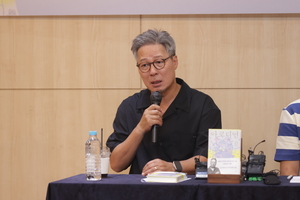
New novel on Korean War orphans reflects Cheon Myeong-kwan's search for humanity Cheon Myeong-kwan speaks during a press conference in Seoul on Wednesday. (Changbi Publishers) When Cheon Myeong-kwan was shortlisted for the International Booker Prize in 2023 for "Whale," judges praised the novel as "a magical and grotesque epic," highlighting its whirlwind narrative in which reality and fantasy, past and present, intertwine.His latest novel "Accordion" takes a different path."When I wrote 'Whale,' I didn't know exactly what I was writing," Cheon said at a press conference last week. "I let my imagination run free without trying to control it. This time, I did the opposite. I deliberately restrained it."The novel is Cheon's first in a decade, but the project stretches back much further. Originally serialized online in 2012, the work was put on hold before publication as Cheon turned his attention to his "old obsession" with filmmaking. Following extensive revisions over the past two years, it was trimmed by more than a third, with the writer completely reworking its structure and style."Rewriting it was much harder than writing it the first time," Cheon added. "I don't usually struggle with writing, but this may have been the most arduous process of any novel I've written."Set in Seoul in the 1950s, when the wounds of the Korean War remained raw, "Accordion" follows a group of homeless children struggling to survive in the war's aftermath.Its protagonist, Dong-yi, becomes an orphan after losing his grip on his mother's hand while fleeing the war. He eventually finds himself in a shantytown of child beggars controlled by Pastor Yang, whose professed charity masks exploitation.Finding solace in the accordion, Dong-yi befriends Yeon-yi, a blind girl with a remarkable singing voice, and Geobugi, a boy who cannot walk but possesses a keen understanding of the world. Together, the children struggle for survival on the brutal and unforgiving streets of postwar Seoul."I wanted to write about the Korean War. It is one of the great tragedies in human history and a defining event that continues to shape Korean society today."The novel also serves as an allegory about two opposing forces: the desire to dominate others and the human impulse to resist and break free."When we look at history, there has always been a desire to dominate others — to control and exploit. It's extraordinarily powerful and persistent," he said. "But there is also a counterforce: the will to be free from that power. Though the struggle is difficult, the human desire for freedom endures."Cheon said he was drawn to children and ordinary people who had been pushed to the margins of society."Literature and television dramas once told the stories of ordinary people, and through them we found empathy and a sense of shared humanity. Today, however, we live in an age defined by admiration for wealth, status and success."Referring to the recent frenzy surrounding global tech leaders in Seoul, Cheon said he was struck by how their every move was followed and livestreamed in real time."Admiration has always existed. I admired many things when I was young as well. But what concerns me is that empathy seems to have given way to admiration. It feels as though we're moving toward a society where people increasingly view one another with hostility. We've lost the connections that allow us to understand those who are different from us."Cheon said stories about people on the margins are increasingly disappearing from public discourse and are often replaced by portrayals that treat them as problems to be isolated or excluded."Ultimately, we have no choice but to empathize with one another and overcome difficulties together," Cheon said. "I think I'm a writer who can't help but confront the absurdities of reality. Inequality, social contradictions, injustice — those are the things that inevitably find their way into my work." Cheon Myeong-kwan's "Accordion" (Changbi Publishers)
'Whale' author worries society is losing its empathy
When Cheon Myeong-kwan was shortlisted for the International Booker Prize in 2023 for "Whale," judges praised the novel as "a magical and grotesque epic," highl
638 words~3 min read