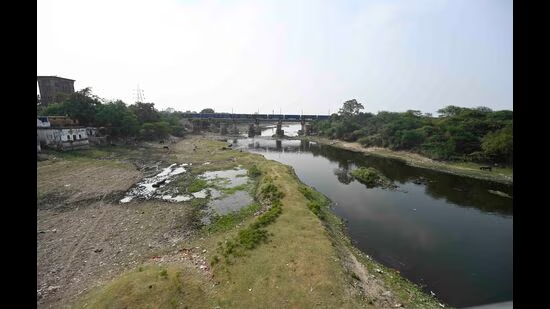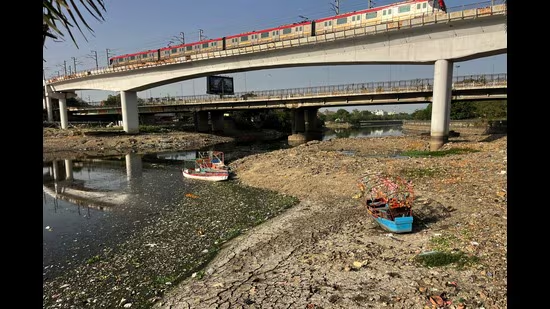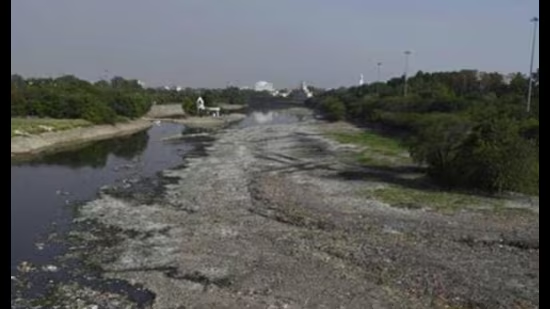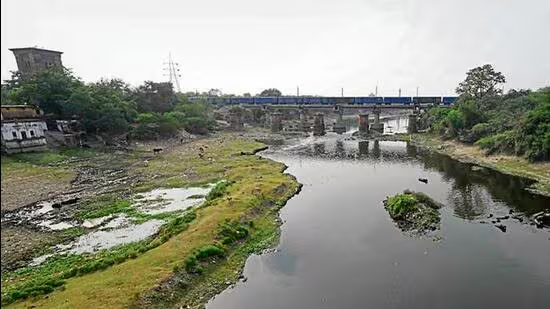
Nearly nine months after chief minister Yogi Adityanath directed authorities to accelerate efforts to clean and rejuvenate the Gomti, a dredging proposal involving a massive logistical operation is back in consideration after 25 years to restore the river’s ecological health.The Gomti near Pipraghat in Lucknow. (Deepak Gupta/HT)The move comes even as government agencies and experts work to meet a two-fold challenge – one on the surface of the river in the form of completely stopping sewage inflows and the other below it in the shape of millions of tonnes of accumulated silt, sludge and sediment below it. This accumulation has buried large stretches of the riverbed, weakening the river’s natural flow and recharge capacity.The Gomti Task Force’s dredging recommendation comes as the state government pushes ahead with the ambitious Gomti Revival Mission announced by the chief minister.Environmental experts have identified around 1.5 metres of silt and sludge deposited over the sand of Gomti riverbed.Initial estimates suggest that removal of the deposits could require transportation of more than 8,000 to 10,000 truckloads of dredged material, making it one of the largest river-cleaning operations undertaken in the city in recent decades.The Gomti Task Force, a group of environmentalists, river experts and government stakeholders involved in the ongoing river restoration exercise, has proposed scientific dredging along a 20-kilometre stretch of the river flowing through Lucknow. The recommendation was made to the state government. The last dredging exercise was conducted in 2001.Simultaneously, government agencies continue work to intercept drains and stop untreated sewage from entering the river in a bid to meet the challenge on the water surface.CM’s deadline for river rejuvenationAddressing a Chhath Puja gathering at Lakshman Mela Ghat in Lucknow in October last year, the chief minister announced that all drains and sewers carrying untreated wastewater into the Gomti would be tapped within one-and-a-half years.Calling the Gomti a symbol of Uttar Pradesh’s cultural consciousness, spiritual heritage and environmental identity, the chief minister emphasised that the river’s restoration would be treated as a priority mission involving multiple departments, including irrigation, urban development, municipal corporations and Jal Nigam. The first meeting of the GTF was chaired by the divisional commissioner last year.The hidden crisis underwaterWhile drain-tapping projects are visible on the surface, environmentalists say the more serious problem lies below the waterline.According to preliminary assessments by river experts, nearly 1.5 metres of silt, sludge and sediment has accumulated across several stretches of the Gomti riverbed in Lucknow. The deposits have built up gradually over decades due to continuous inflow of sewage, urban runoff, soil erosion and solid waste dumping.Professor Venkatesh Dutta, member of Gomti Task Force, said, “Recently, when the gates of Gomti Barrage were changed by the irrigation department, we took the samples of silt and sludge deposited on the riverbed, we found around 1.5 metres of silt was deposited on the riverbed, which needs to be cleaned immediately. Members of the Gomti Task Force have been raising the demand of cleaning the Gomti riverbed through dredging and every means.”The sediment layer has significantly reduced the river’s depth and carrying capacity. As a result, water movement has slowed, stagnant zones have increased, and the river’s natural ability to dilute and cleanse pollutants has weakened.Dutta, who has been associated with Gomti conservation efforts, said the accumulated silt has also affected groundwater recharge functions that are critical for sustaining water availability in the region.“The river has lost a substantial portion of its natural depth. Sediment accumulation has reduced storage capacity and affected groundwater interaction with the river system. Unless the deposits are scientifically removed, restoration efforts may remain incomplete,” he said.What is dredging?Dredging is the process of removing accumulated silt, sand, sludge and other sediments from the bottom of rivers, lakes or reservoirs using specialised machinery.The objective is to restore the original depth and carrying capacity of the water body. Dredging improves water flow, reduces stagnation, enhances oxygen levels and can help improve the ecological health of a river.For the Gomti, environmentalists believe dredging could improve river conditions substantially by restoring flow velocity and reducing stagnant zones where pollutants accumulate.Last dredging conducted in 2001The last major dredging operation on the Gomti was carried out in 2001, when authorities deployed dredging equipment to clean the stretch between Gau Ghat and Gomti Barrage in Lucknow.The month-long exercise removed large quantities of sand and silt from the riverbed at a reported cost of nearly ₹2 crore. Since then, no significant dredging activity has been undertaken.Ironically, experts point out that Lucknow in 2001 was a much smaller urban settlement compared to today. The city has expanded dramatically over the past two decades, resulting in higher sewage generation, increased surface runoff, greater encroachment pressures and a larger pollution load on the river.Environmentalists estimate that the amount of sediment currently accumulated inside the river is several times greater than what was removed during the 2001 operation.Can the removed silt be used?One of the questions being examined by authorities is whether the dredged material can be reused.Experts say that a significant portion of the sediment consists of sand and natural silt, which may potentially be used for land filling, low-lying area development, landscaping or construction-related filling purposes after proper testing.However, portions of the sludge contaminated by sewage and industrial pollutants may require scientific disposal to avoid environmental risks.Environmentalists have recommended detailed laboratory analysis before any reuse plan is implemented.Not the only solutionDespite progress in drain tapping, untreated wastewater remains a major concern.Lucknow generates nearly 700 million litres per day (MLD) of sewage, while treatment infrastructure currently handles only a portion of that volume. Authorities are expanding treatment capacity through upgrades and new sewage treatment plants.Environmental groups argue that dredging alone cannot revive the river unless sewage inflows are completely stopped.They have also called for installation of protective screens at drain outlets to prevent plastic waste and floating garbage from entering the river.According to river activists, nearly 10 metric tonnes of solid waste enters the Gomti every day through drains and direct dumping.Gomti Task Force reviews restoration planThe issue was discussed during a recent meeting of the Gomti Task Force, which is reviewing and finalising the action plan under the Gomti Revival Mission.The meeting, organised with the support of the Territorial Army, was attended by Major General Salil Seth, Brigadier Navtej Singh Sohal, Brigadier C Madhwal, Colonel Arvind S Prasad, Lieutenant Colonel Sachin Rana, Lieutenant Colonel Saurabh Mehrotra, Major K.S. Negi, environmental expert Dr. Venkatesh Dutta and other senior officials.The task force is expected to evaluate proposals relating to dredging, sewage interception, riverbank management, wetland restoration and public participation in conservation efforts.‘An opportunity to restore river’s natural flow’Upendra Singh, chief engineer, irrigation, said, “ We have repaired the gates of Gomti Barrage but Gomti needs to be cleaned. The dredging exercise is an opportunity to restore the Gomti’s natural depth and flow after nearly a quarter century. But it requires funds and machines for the same. The river’s revival will depend on a comprehensive approach combining dredging, complete sewage diversion, improved treatment infrastructure, restoration of wetlands and protection of floodplains. For that, the municipal corporation will have to play an important role.”However, Manoj Prabhat, chief engineer, rubbish removal, associated with cleaning the Gomti, said, “The expertise for dredging is with the irrigation department and last time dredging was performed by the irrigation department only. So this time if dredging is performed, then it should be by the irrigation department which has the expertise and manpower.”Mayor Sushma Kharkwal said the Gomti Revival Mission is now underway and dredging is under serious consideration for the first time in 25 years.Municipal commissioner Gaurav Kumar said, “The Municipal corporation has always done its bit to restore the Gomti’s purity. If directed, the municipal corporation will help the irrigation department in carrying out dredging and desilting of the river.”
Dredging back in consideration after 25 years, Gomti revival mission gets renewed push
Following CM’s strict directions to find a long term solution, efforts to improve the river’s ecological health are back in focus with Gomti Task Force recommending a massive dredging exercise to remove accumulated silt, sludge and sediment
1,291 words~6 min read