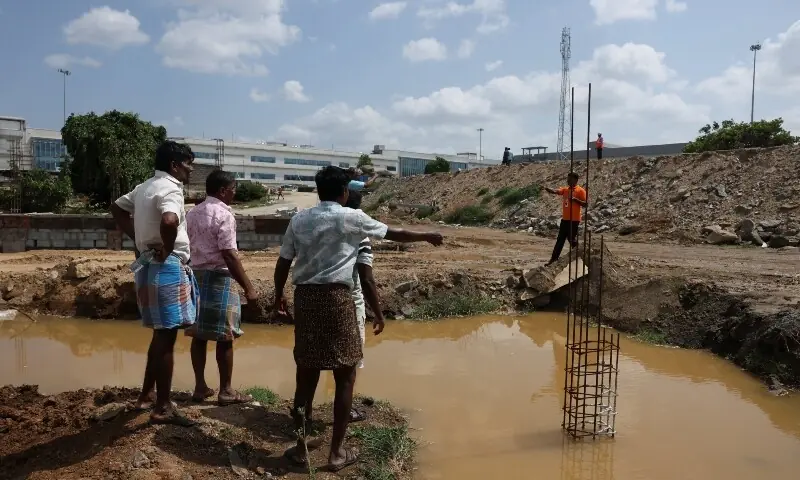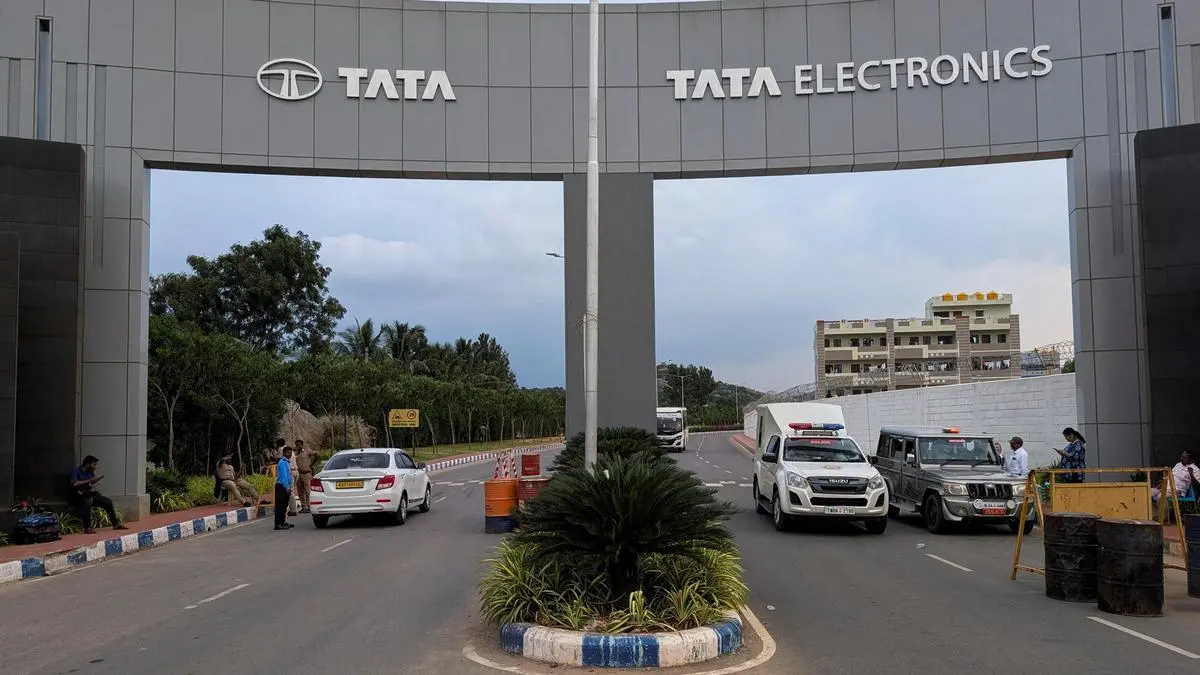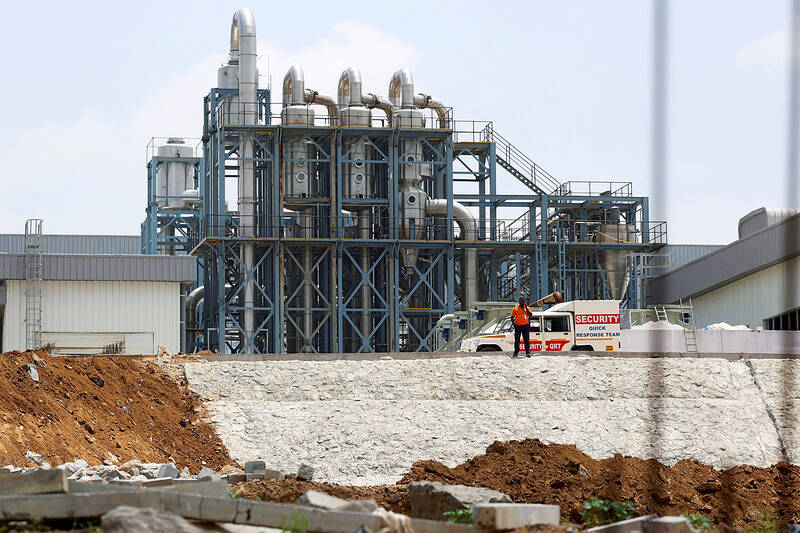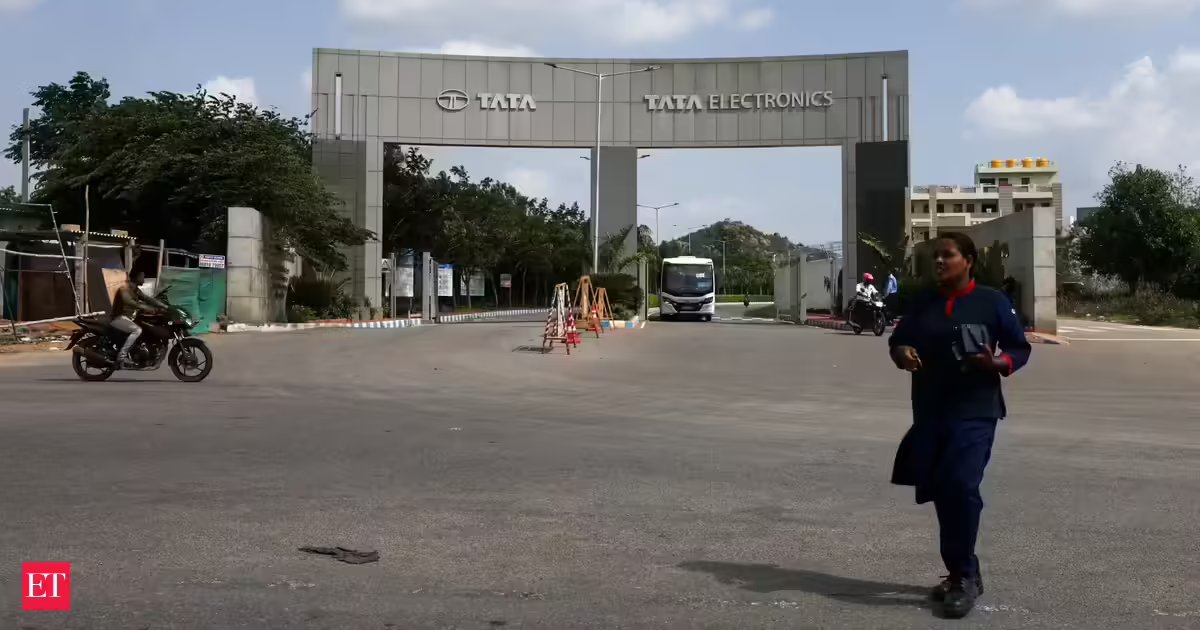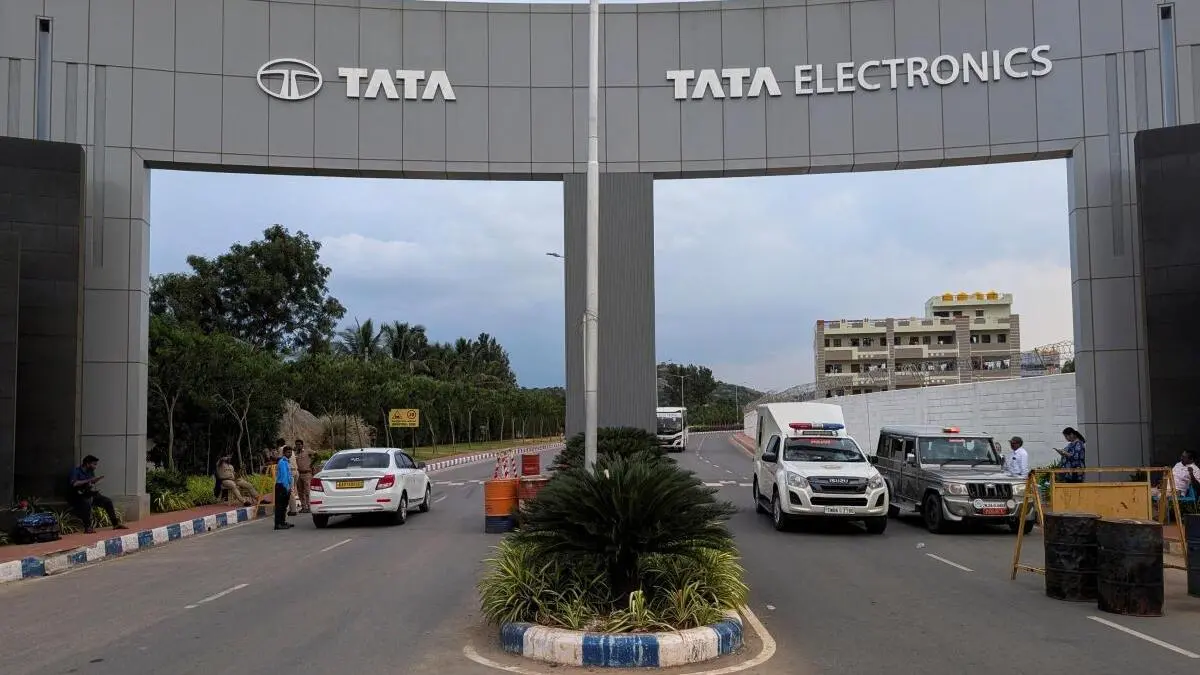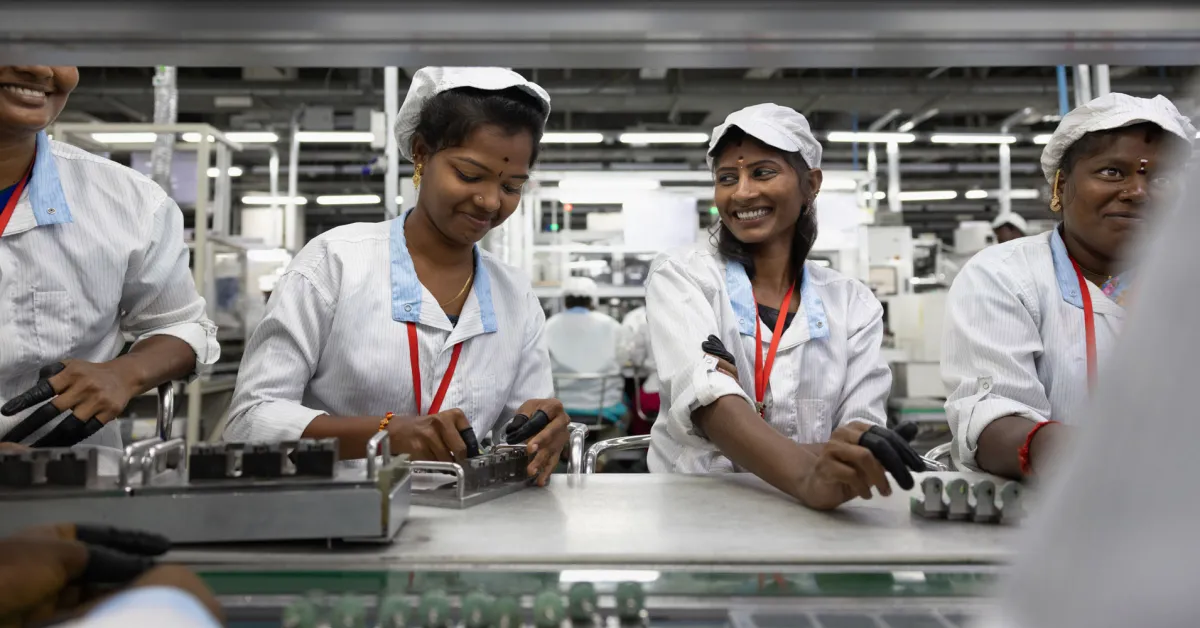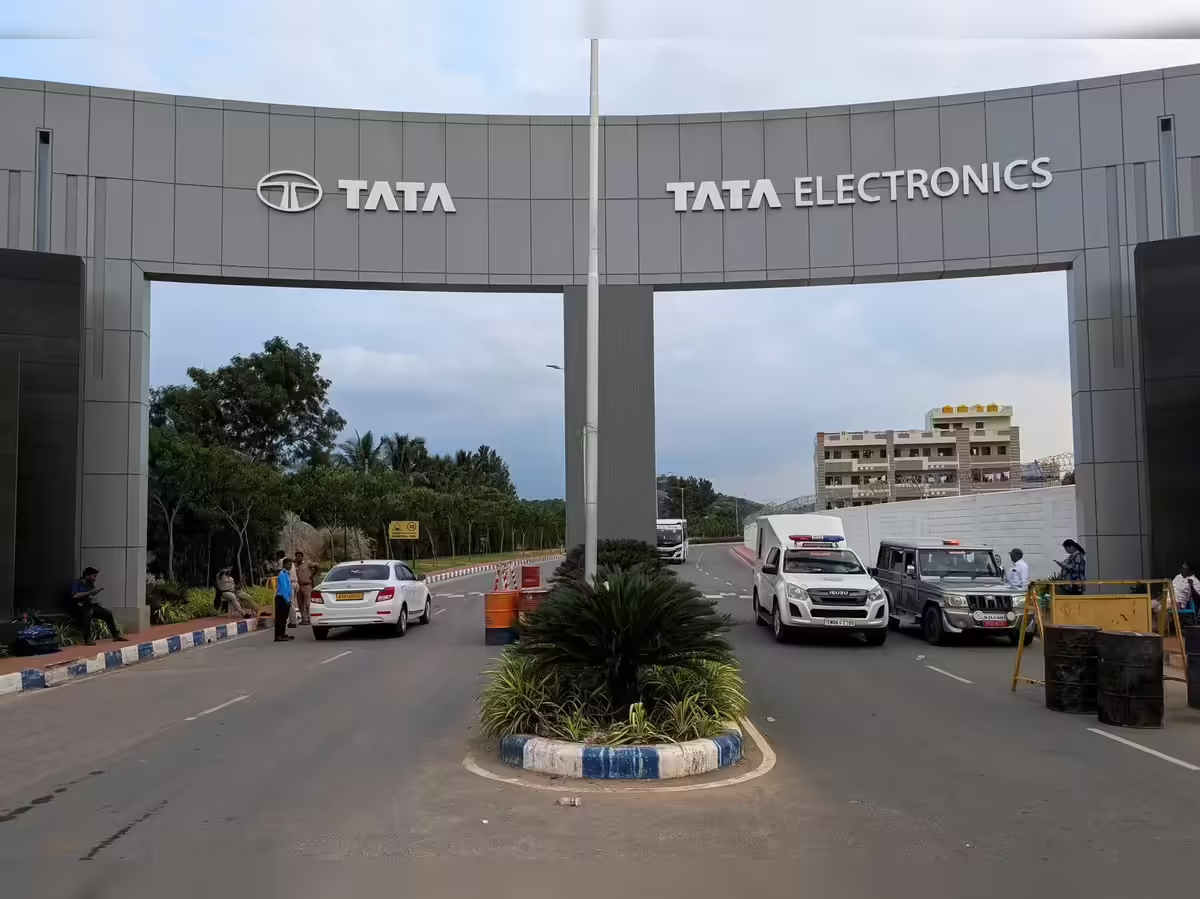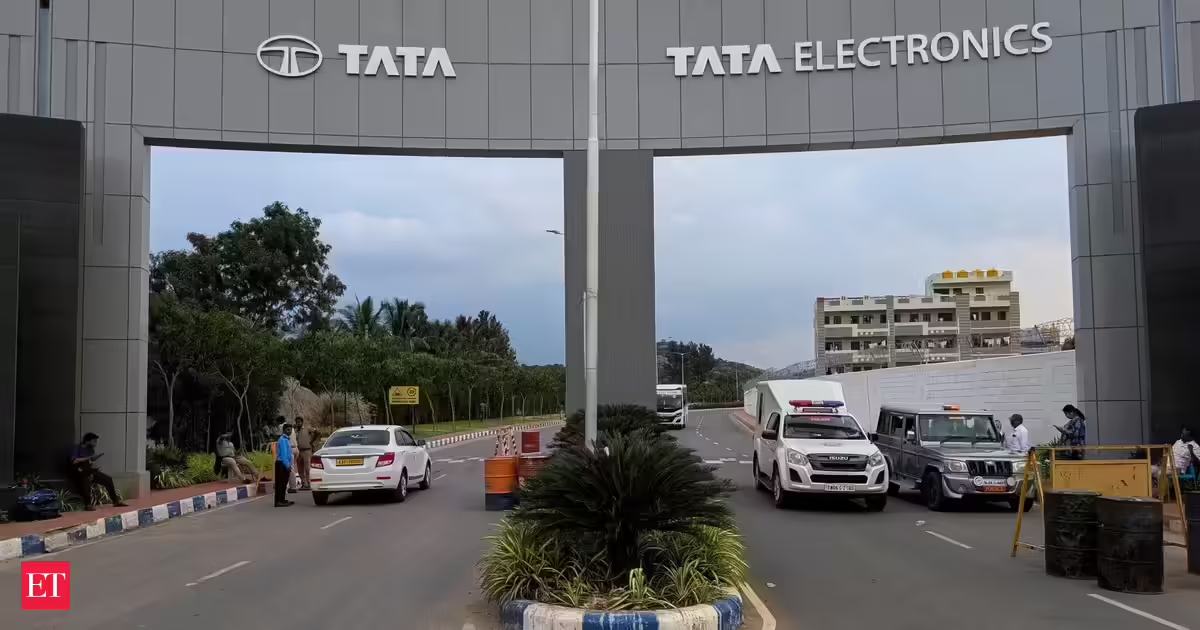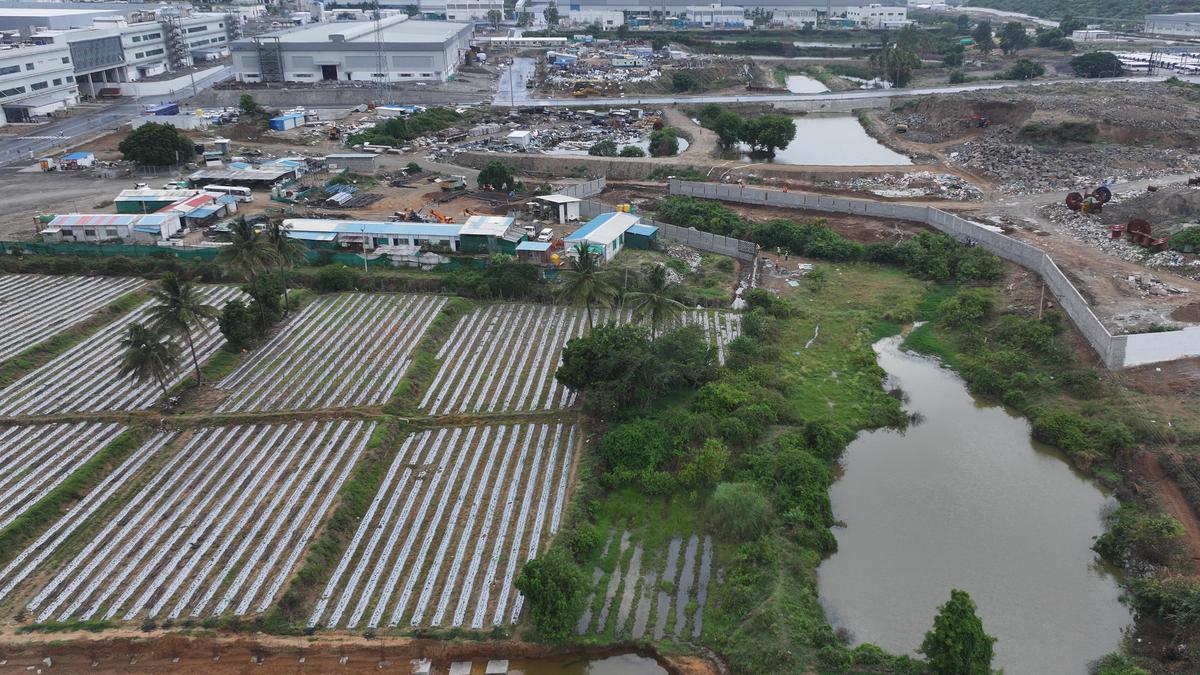
The farm wells of Ullukurukkai village in Thimjepalli panchayat of Krishnagiri district are filled to the brim in summer. It is time for paddy crop. Elsewhere in the district, nurseries are being raised and fields prepared to raise the crop. But the punjai lands (dry agricultural lands) of the village, close to the iPhone manufacturing plant of Tata Electronics Private Limited (TEPL), have fallen disquietingly silent. A hundred metres away, this jarring silence is interrupted by the sounds of construction activity. Workers are busy building a wall to demarcate the boundary of the TEPL plant from the adjoining farmlands. A steady flow of water discharges from under the plinth of the new boundary wall of the plant and into an exit channel running through the farmlands.A few metres inside the boundary wall, there are large embankments of sprawling rain-water-harvesting structures or percolation ponds of the plant. In the last week of May, acres of Ullukurukkai’s farmlands were flooded by the water that had reportedly overflowed from the plant’s percolation ponds. The company told officials then that it was only rainwater from the ponds. Collector C. Dinesh Kumar said, “There were two instances of breach [in the last few months] from the plant and both times, the rainfall recorded was 5 cm and 6.75 cm.” But the farmers insist it was not just rainwater, but “chemical water” that entered their fields from these ponds that overflowed.The Tamil Nadu Pollution Control Board (TNPCB) issued a show-cause notice to TEPL in May 2026. It flagged the TDS (total dissolved solids) range of 1,916 milligrams per litre (mg/L) to 2,450 mg/L (against the norm of under 500 ppm or not above 1,000 ppm for percolation ponds) in the water sample collected from the rainwater pond. It also flagged BOD, or Biological Oxygen Demand (dissolved oxygen needed for breakdown of organic matter), in the range of 12 mg/L to 78 mg/L and COD (Chemical Oxygen Demand indicating contamination) in the range of 48 mg/L to 160 mg/L — both values significantly exceeding permissible limits of under 30 mg/L. The TDS range was ascertained from samples collected on three occasions at three different points between December and May.Off to a promising startIt was in 2021 that TEPL chose Nagamangalam, near Hosur, to set up its iPhone component manufacturing unit. The move was seen as a big win for Tamil Nadu’s industrial portfolio and Hosur’s manufacturing ecosystem that was diversifying into electronics. The facility expanded with operations beginning at the Phase II plant last November. Farmers had rejoiced at the arrival of a “good corporate company” in their midst. “They say Tata is a good company. If they are giving jobs to so many people, they will only do good, we thought,” says Pushparaj, who now leads the farmers’ protests against the alleged effluent discharge. “Don’t we know what rainwater is? This is not rainwater,” Mr. Pushparaj says repeatedly. “We grew up on this soil and in this water.”One night in December 2025, the pumping system of the sewage treatment plant (STP) on the TEPL premises malfunctioned, two sources in the district administration told The Hindu. “The untreated water was discharged into the rainwater-harvesting pond. There were complaints from farmers then. When the water was collected, the stench was bad. But, if it was trade effluent, the TDS would be much higher. It cannot be said that it was completely untreated trade discharge, but definitely partially treated effluent,” said one of them.Trade effluentsTrade effluent is any liquid waste discharged from business, trade, or industrial premises. Conventional trade effluent treatment systems do not fix high TDS levels. TEPL is a Zero Liquid Discharge (ZLD) unit that uses Multiple Effect Evaporator (MEE) for its effluent treatment. Raw trade effluent is treated through the Reverse Osmosis (RO) process that returns low TDS water, which can be reused for gardening. The discharge from the RO process (RO reject) will, however, have a greater TDS concentrate. This RO reject then passes through a series of evaporators (MEE) and the water is condensed for reuse. The MEE reject, which again will have high TDS values, is finally passed through an Agitated Thin Film Dryer (ATFD) that turns the high-TDS reject into a powder. This makes TEPL a zero discharge plant, where no water or waste technically exits the plant.However, accounts of two witnesses at the plant echo the charges farmers make. They indicate that the ZLD environmental mandate may exist only on paper. According to them, trade effluents routinely bypass the ETP and enter collection ponds along with the STP discharge. When the production is high and effluent output outstrips the ETP capacity, the trade effluent from the anodizing process will be stored in tanks and discharged at night and during rain, claim two persons from the plant. “The incoming production effluent [trade effluent] will be highly acidic, with pH levels of 0-1. The pH value must be chemically boosted to reach neutral before the effluent is fed into the treatment line. But that is chemical intensive for high volumes, expensive, and time-consuming. The capacity of the ETP initially was only 60 kilolitres [60,000 litres], but the plant may sometimes generate up to 100 kilolitres of trade effluent, and the excess will reach the drain,” said a source, who had worked in the ETP. How often is sometimes? “Two or three times a week, but depending on production output,” said the other source. “The trade effluent will have very high TDS — 6,000 or even 10,000. But when linked with the STP line, which will have a higher volume but far less TDS, the final TDS numbers fall and are offset to permissible limits. The valves will be opened in the rain, with TDS diluted.”“We use caustic soda to boost the pH value. The production team will send a mail informing of the incoming effluent the next day. Either we receive it by dumping the effluent already filled up in tanks (pending treatment) into the drain or ask them to stop production. Production cannot be stopped or can be stopped only for a day or two. So the effluent would be sent into the drain and STP water poured over it.” But what of the metal residue? “There will be no metal residue, that will settle, but the TDS of the trade effluent will show up as high, and this is fixed when mixed with the STP water,” the source said.
Tales TDS tells
Farmers near Tata Electronics allege water contamination from the plant affects their crops and water quality, sparking protests.
1,895 words~9 min read