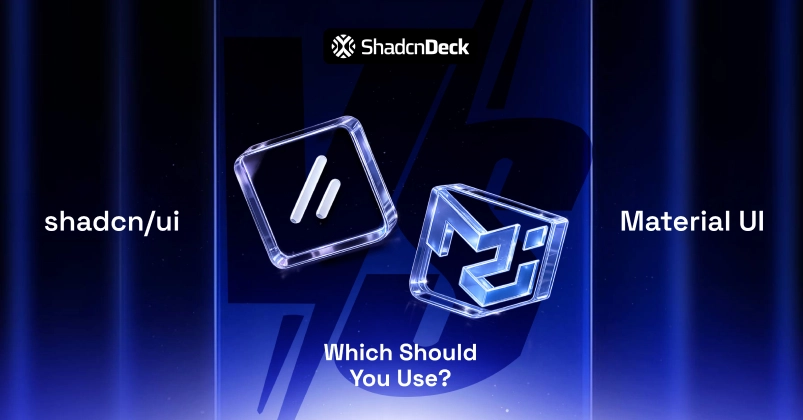
\shadcn/ui and Material UI optimise for opposite priorities. Choose shadcn/ui to own your component code, ship a near-zero runtime, and control every pixel; choose Material UI (MUI) for breadth — 90+ components and a paid data grid — behind Google's Material Design. shadcn/ui has ~116,000 GitHub stars and ships copy-paste components; MUI has ~98,000 stars and ~7.3M weekly npm downloads. Both are MIT-licensed and free for commercial use.
This guide covers the parts you only learn by shipping both: how each behaves in the Next.js App Router, the runtime cost, real theming and dark-mode code, forms, data tables, and migration mechanics.
What's the real difference between shadcn/ui and Material UI?
The difference is ownership, and it decides everything downstream. MUI is an npm dependency (@mui/material) you install and import from node_modules — you never touch the source. shadcn/ui is a copy-paste registry: you run a CLI, the component lands in your repo, and it is now your code. shadcn/ui is unstyled, built on Radix UI primitives and Tailwind CSS. MUI ships Material Design and an Emotion (CSS-in-JS) runtime.
With MUI you install and import: