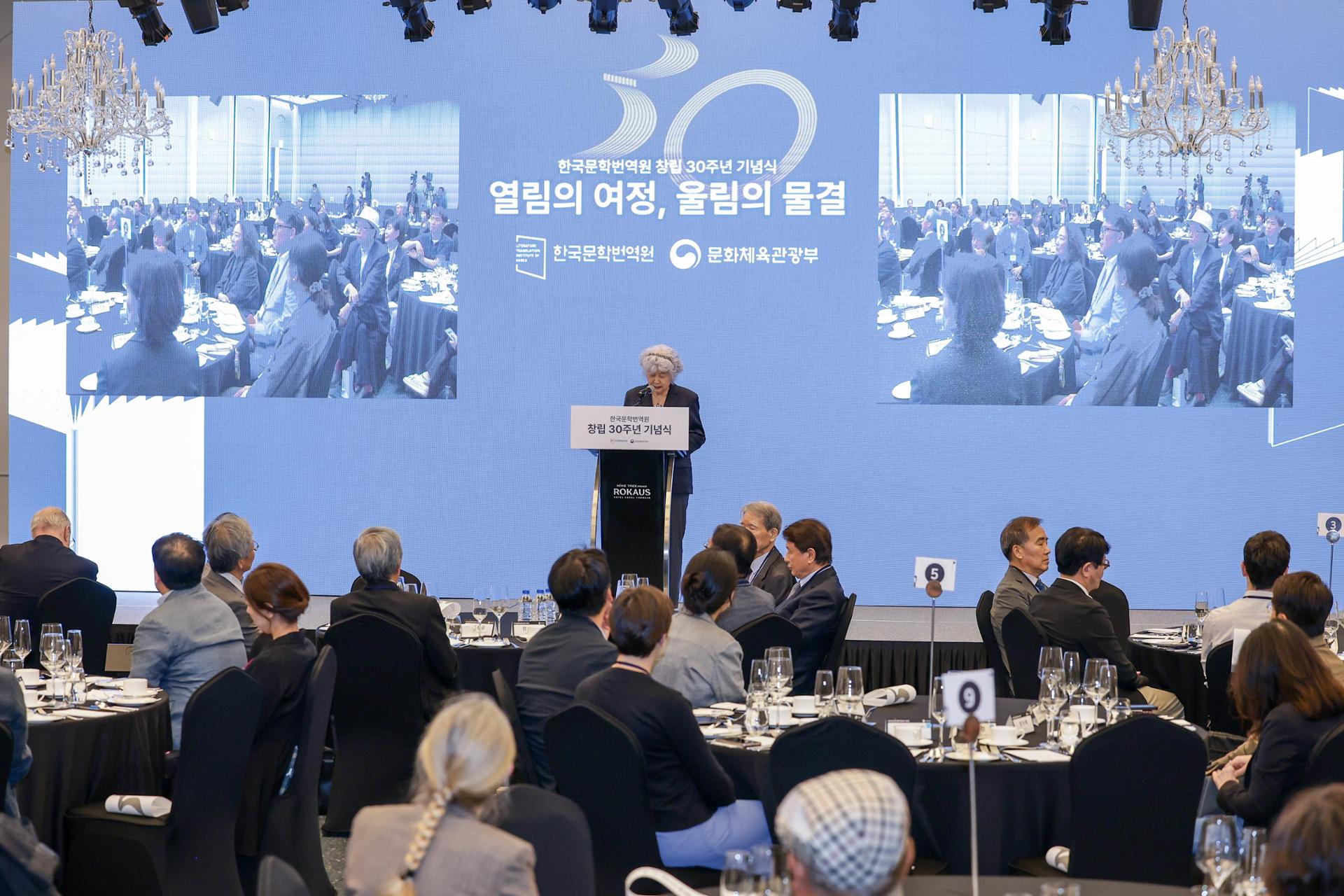
Chon Soo-young, president of the Literature Translation Institute of Korea (LTI Korea), speaks at the institute’s 30th anniversary event at a hotel in Seoul, May 21. Courtesy of LTI Korea
As generative artificial intelligence (AI) transforms the global translation landscape, the head of the Literature Translation Institute of Korea (LTI Korea) is making a counterintuitive bet: The future of literary translation will rely not less on humans, but more.
Chon Soo-young
“In literature, AI alone cannot meet the level expected by international publishers, without human intervention,” LTI Korea President Chon Soo-young said in a recent interview. “Even if more (advanced) AI models emerge, human post-editors would still be needed to review the work.”
Chon cited an anecdote shared by Kim Un-su, a novelist famous for “The Plotters (2010).” At LTI Korea’s 30th anniversary event on May 21, an editor at an English-language publishing house initially showed little interest after reading a translation of his work, but later decided to publish it after reviewing a version translated by Sora Kim, a prominent literary translator.