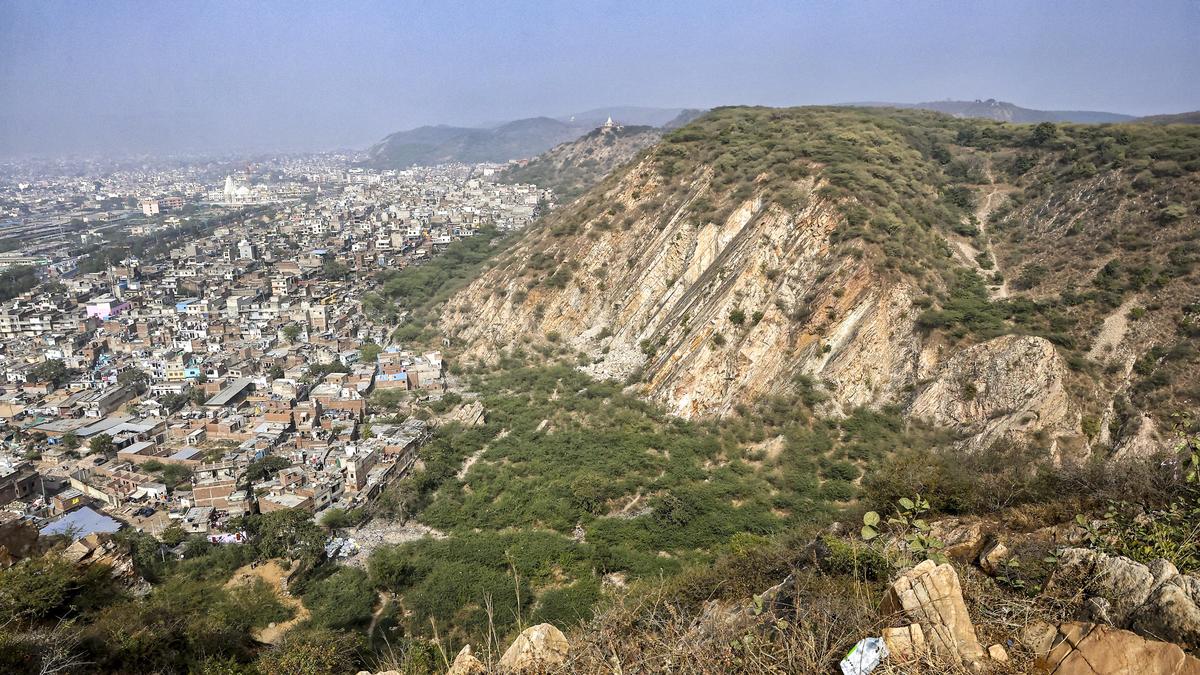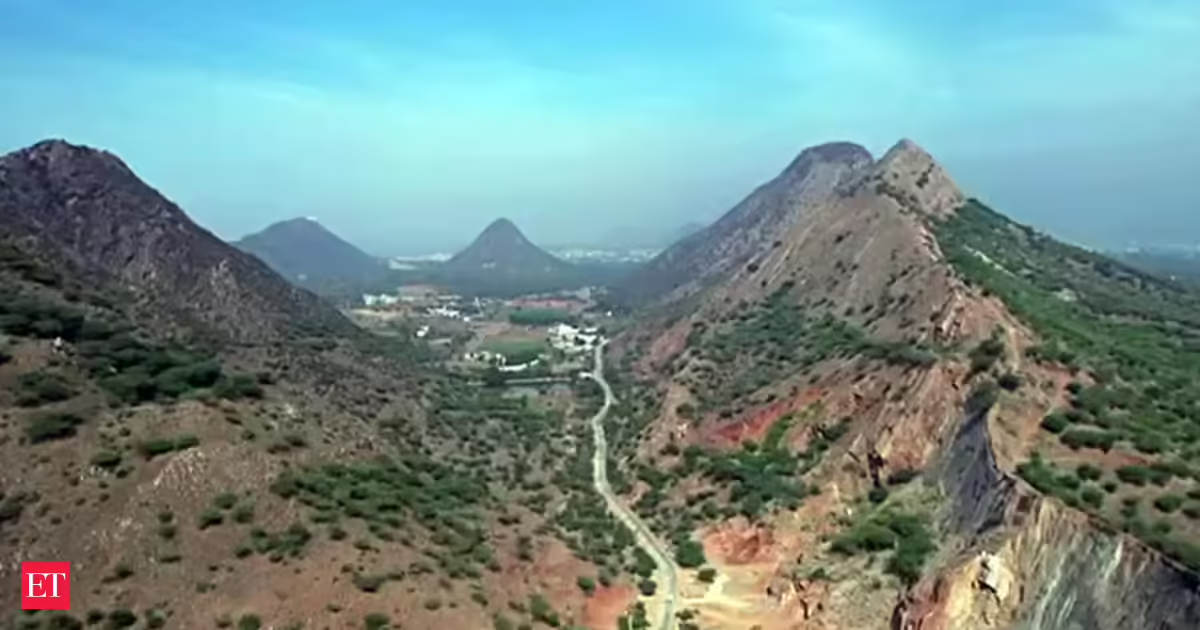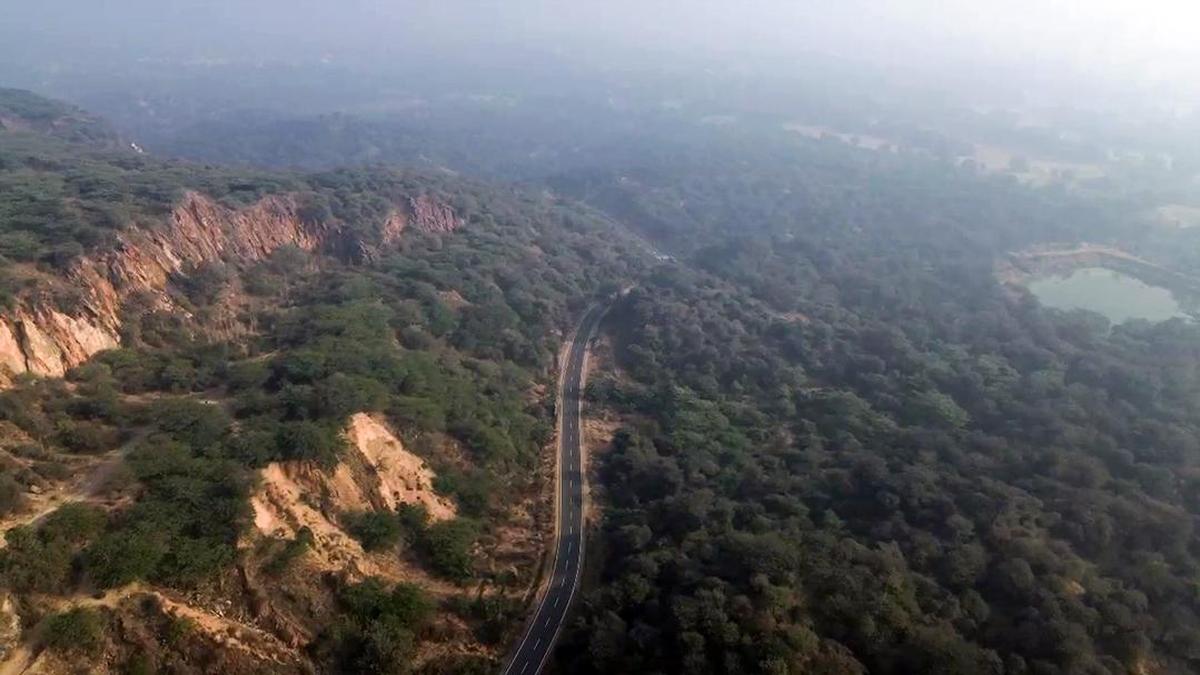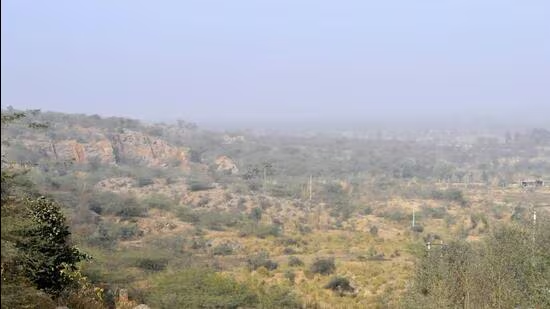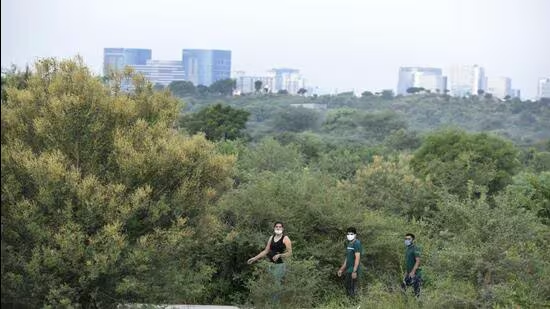
New DelhiThe Aravallis in Gurugram. (HT Archive)With the August 31 deadline for a Supreme Court-appointed high-powered committee to submit a report on the definition of the Aravalli hills looming large, environmentalists and activists have urged the Chief Justice of India (CJI) to constitute a fresh and independent new high-level committee to define the Aravalli hills. In a series of letters from June 16 to June 19, having at least 130 signatories from across the country, environmentalists have alleged that the latest committee constituted on May 25 was weaker than previous such panels and raised concerns of bias over multiple members directly or indirectly reporting to the Union environment ministry.HT has accessed a copy of the letters sent by the activists.Stalin Dayanand, director of Vanashakti, an NGO dedicated to environmental conservation, in a letter to CJI Surya Kant on June 18, said the new panel did not fulfil the criteria of being a high-powered expert committee nor did it appear to be impartial, a requirement specified by the Supreme Court in an order on December 29, 2025 in the same case. “It is a settled position of law that the entity reviewing any previous decision must be of higher rank and expertise than the earlier body,” Dayanand said in his letter.“Both the Chairperson (Director General, Indian Council of Forestry Research and Education) and the Member Secretary of the new committee are lower in rank, status and power compared to the earlier MoEF&CC committee and are under the control of the MoEF&CC. The Board of Governors of the Indian Council of Forestry Research and Education (ICFRE) is headed by the Secretary, MOEF&CC and the Union Minister for Environment, Forest and Climate Change is the President of ICFRE. How can such a committee do justice to the Aravallis?” he said.To be sure, the deadline for the committee to submit a report on the Aravallis, including how it is defined, is August 31, with the Supreme Court to hear the matter next on September 7.In November 2025, the Supreme Court adopted a uniform recommendation from MoEF&CC defining an Aravalli hill as any landform rising at least 100 metres above the surrounding local terrain, and grouping hills within 500 metres of each other as a “range”. However, experts said this would omit 90% of the Aravalli hills and leave it vulnerable to mining and construction.On December 29, 2025, the Supreme Court stayed its November 20, 2025, definition of the Aravalli hills and ranges, keeping the recommendations and directions in abeyance pending final resolution. The court also reinforced the ban on granting or renewing mining leases without its prior permission. On May 25, it appointed a new five-member committee, headed by Director General of Indian Council of Forestry Research and Education (ICFRE) Kanchan Devi and comprising Subhash Ashutosh, former director general of the Forest Survey of India (FSI); Rajendra Kumar Sharma, director (retd), Geological Survey of India; Brij Mohan Rathore, former joint secretary, MoEF&CC and Ashok K Bhatnagar, former professor at Delhi University.Joseph Hoover, managing trustee of United Conservation Movement, which is working to protect the Western Ghats, in a communique on June 18, said the new committee needed to be completely independent, with no direct or indirect link to the MoEF&CC.“The October 2025, Forest Survey of India (FSI) Report submitted to the Secretary, MoEF&CC had highlighted the importance of lower hills (under 100 metres) as a vital natural barrier against desertification... However, the MoEF&CC led Committee defined the ‘Aravalli hills’ solely on the basis of height, disregarding FSI’s opinion on the importance of lower lying hills...” Hoover’s letter read.He said that while FSI’s report mentioned 63 Aravalli districts, the MoEFCC-led committee’s report had mentioned only 37 districts.Ravi Chopra, an environmentalist and the founder-director of the People’s Science Institute in Dehradun, Uttarakhand, in a letter on June 19 to the CJI, said that he has served as the chairman of two committees formed on the orders of the Supreme Court. “In the present committee... almost all the members are serving or retired senior officials of the Government of India, or scientists in government-funded institutions. Therefore, I have grave doubts about their ability to express written unbiased opinions on the contested issues,” he said.CP Rajendran, geo-scientist and adjunct professor, National Institute of Advanced Studies, School of Natural Sciences and Engineering, Bengaluru, in a letter on June 18, said that the composition of such a critical committee should not be confined to serving or retired officials, but instead include specialists.Activists said there still remains time to revisit the committee and its composition.Prafulla Samantara, environmentalist and national convener of the Lok Shakti Abhiyan from Odisha, in his June 18 communique, said that in order to obtain a “fair, impartial, independent expert opinion” to protect the Aravalli range, “the chairperson and member secretary of the new committee should not be a serving officer of the MoEFCC, or any of its autonomous councils, bodies or authorities.”
Environmentalists urge SC to revisit panel to define Aravallis
Environmentalists urge India's Chief Justice to form a new independent committee for defining the Aravalli hills ahead of the August 31 deadline. | Latest News Delhi
815 words~4 min read