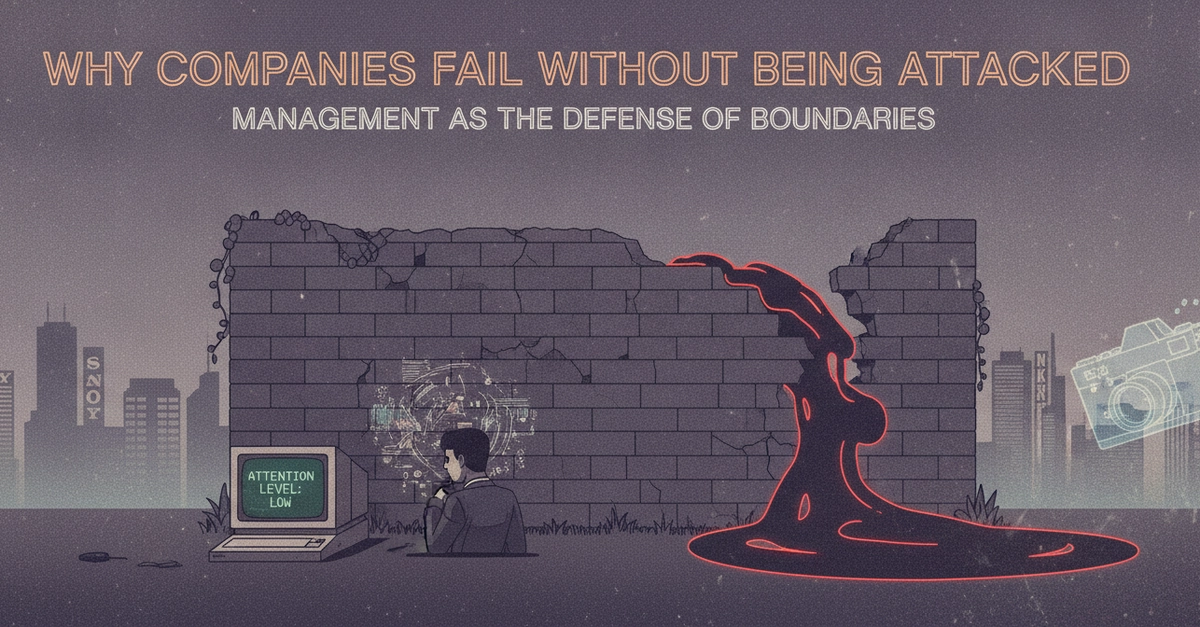
In short: companies usually do not lose a market by being outfought. They lose it by withdrawing attention from a boundary, which is then taken by whatever was already pressing on it. On the attention-based view of the firm (Ocasio, 1997), managerial attention is a scarce resource, and a boundary under external pressure decays at a rate set by that surrounding pressure, not by whether a direct attack ever arrives.
There is a pattern that recurs under all the frameworks of management, and it is worth taking seriously. Every boundary that has to hold must be actively held, or something on the other side takes it. A customer relationship, a product's quality, a position in a market: none of these stays yours because you once won it. It stays yours while you keep projecting force across its edge. The founder who steps back and watches the business drift does not usually lose to a clever rival with a better plan. He stops attending the boundary, and the boundary is taken.
That is the whole claim, stated flat. The rest of this piece is the evidence for it, and the honest limits of that evidence.
What actually happens when you stop paying attention?
The default story of business failure is a duel. A competitor builds something better, attacks head-on, and wins. That story is comforting because it makes failure feel like a fair fight you could have won with a sharper sword.