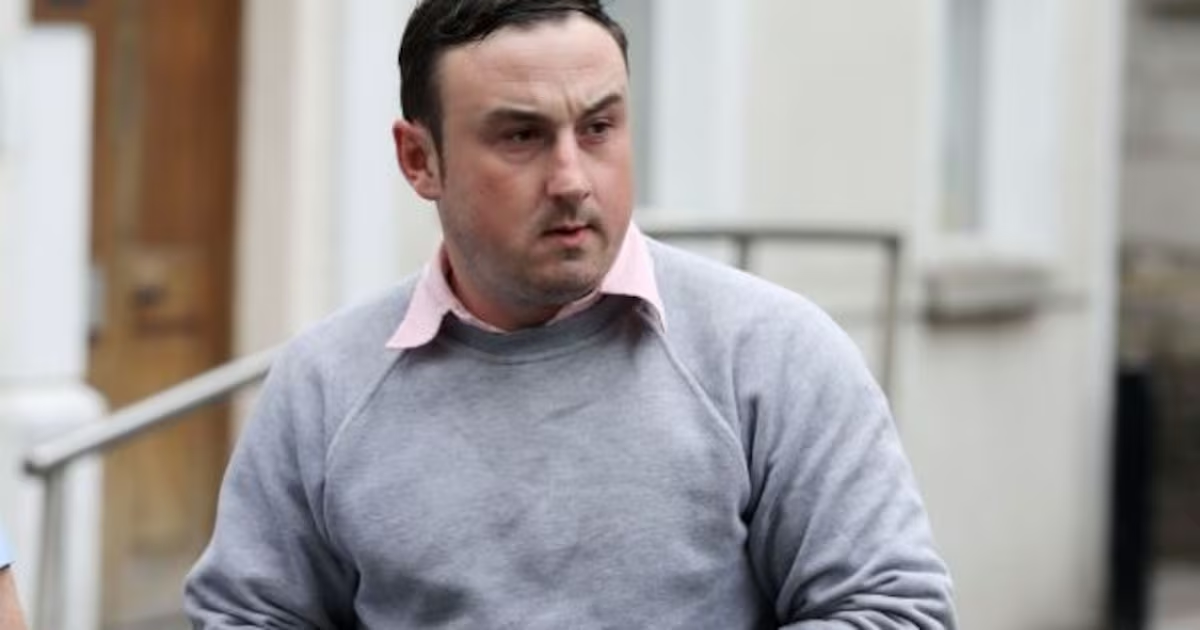
The Supreme Court will hear an appeal by a violent Dublin criminal over his conviction for conspiracy to pervert the course of justice during the trial of Aaron Brady for the 2013 murder of Det Garda Adrian Donohoe.In its determination this week, the Supreme Court said Dean Byrne (33), of Cabra Park, Phibsborough, seeks to challenge the Court of Appeal’s decision in December to reject his bid to overturn his conviction for trying to persuade a witness in Brady’s trial not to give evidence.The court will consider the question as to whether it can ever be lawful to seek to persuade a witness not to give evidence. Byrne, who has more than 120 convictions, was found guilty of the charge in 2024 at the Special Criminal Court. He was sentenced to two years for the offence. Brady, who is serving life for the detective’s murder, was sentenced to three years after he pleaded guilty to two offences related to efforts to pervert the course of justice during his trial.Last December, in dismissing Byrne’s appeal against the perversion of justice conviction, Judge Brian O’Moore said the defendant had tried to dissuade witness Daniel Cahill from giving evidence against Brady by contacting a member of Cahill’s family.Cahill’s evidence in the murder trial was that Brady confessed to him on three occasions that he had murdered a Garda.O’Moore noted that Byrne’s lawyers had argued that no offence is committed where a person uses lawful means to persuade a witness not to give false evidence.However, O’Moore noted the “lack of analysis” by Byrne as to whether Cahill’s statement was incorrect.The judge found that the Special Criminal Court was correct in finding that Byrne had used unlawful means in attempting to dissuade Cahill by sending the witness’s Garda statement to a third party.This week’s determination notes that the particulars of the offence were that Byrne “conspired with Aaron Brady to persuade Daniel Cahill, a prosecution witness, not to give evidence, a course of conduct which had a tendency to, and which was intended to, pervert the course of public justice, contrary to common law”.The determination reads that Byrne argued the evidence in the case was “consistent with a belief on his [Byrne’s] part that Mr Cahill’s evidence would be untrue”.It was further argued that persuasion not to give false evidence, or even truthful evidence, would not be a perversion of the course of justice and could not be an offence unless unlawful means – such as bribery or threats – were used.Byrne claims the persuasion was not “in itself” unlawful while the prosecution maintained that all attempts to persuade a witness not to give evidence amounted to attempts to pervert the course of justice.The prosecution had argued at the Special Criminal Court that Byrne showed his “true attitude” when he was recorded calling Cahill a “f***ing rat c***, filthbag rat bastard of a thing”.The question before the Supreme Court is considered one of “public importance”, regarding whether “it can ever be lawful to seek to persuade a witness not to give evidence”.Among his many convictions, Byrne was jailed for 18 years with four suspended for an aggravated burglary in 2013 in Tipperary in which he and six others broke into a family home and terrorised a couple and their three daughters, then aged eight, six and two.In August 2020, Brady (35), formerly of New Road, Crossmaglen, Co Armagh, was convicted by a jury of the murder of Donohoe during a credit union robbery at Lordship, Bellurgan, Co Louth, on January 25th, 2013. He is serving a life sentence with a minimum tariff of 40 years.
Supreme Court to hear appeal by Dublin criminal who tried to dissuade witness in garda murder trial
Lawyers for Dean Byrne argue that no offence is committed where a person uses lawful means to persuade a witness not to give false evidence
600 words~3 min read