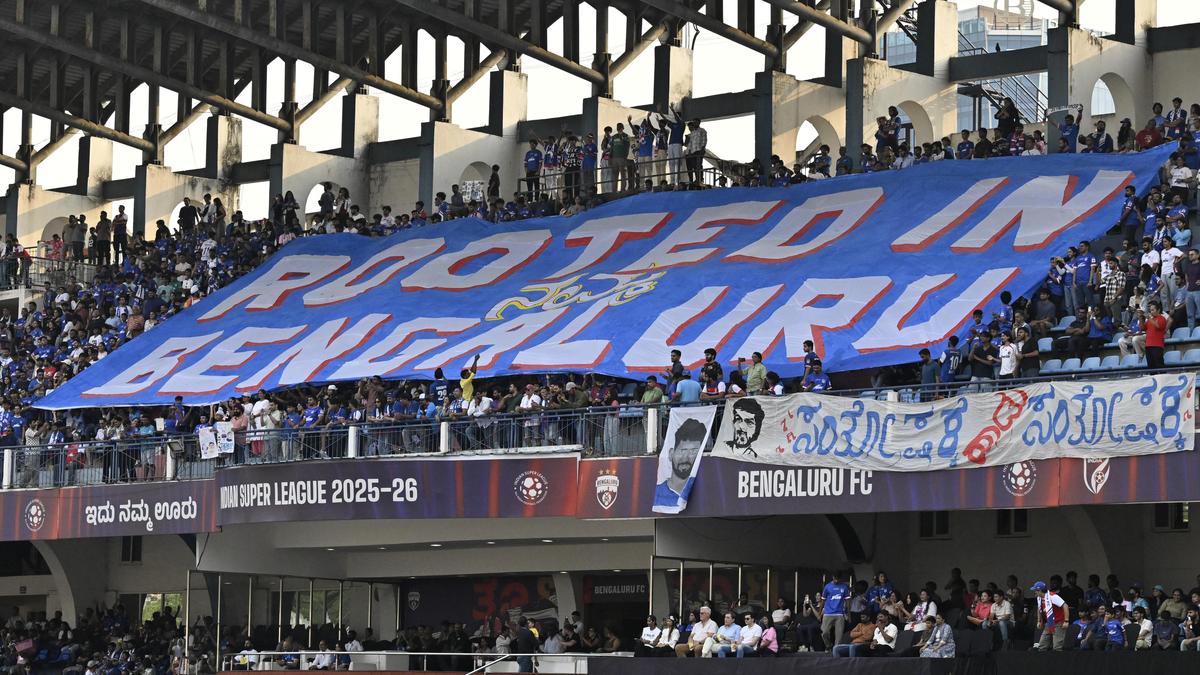
“In the 1980s, as children , we watched intense football practice sessions at Nandan Ground in Austin Town, which were followed by endless discussions about football, planting a strong passion for the game. All those who watched those matches dreamt of playing the game and emerging as heroes,” said R.C. Prakash, a former India player from Bengaluru.Like Mr. Prakash, hundreds of children growing up in the 1970s and thereafter developed the same passion, eventually taking up football seriously. This helped sustain Bengaluru’s strong football culture, which was originally introduced by the British.Mr. Prakash said that apart from the game itself, players who had featured in the Olympics used to practice at several grounds, including Nandan Ground and Bangalore Football Stadium, attracting more youngsters.“There was already substantial admiration for Olympic players, and they went on to start something called the Veterans Coaching Camp, which gave another push,” explained Mr. Prakash.Chikka Chennaiah of the Bangalore District Football Association said that football practice had meanwhile started in many parts of Bengaluru, including Vyalikaval and Malleswaram.While places like Gowthampura , Cox Town, and Austin Town produced many star players, such as Ulaganathan, Bengaluru also produced quality players from different parts of the city. Stalwarts emerged from Basavanagudi, Jeevanahalli, Periyar Nagar, Malleswaram, and many other areas, Mr. Chennaiah said.V. Ramkumar, who played in the 1980s for Public Sector Undertakings (PSUs), explained that football was not seen merely as a passion but also as a gateway to employment, as PSUs actively recruited local talent.“Teenagers started honing their football skills so that they could get opportunities to represent the State at an early stage. Once selected, they could land jobs in PSUs, as these organisations had started recruiting young players and building teams that could remain competitive for 10 to 15 years,” Mr. Ramkumar said.Mr. Chennaiah reiterated that the PSU dominance began in the 1970s, and the organisations quickly developed strong scouting systems, helping sustain the city’s football culture through the years until the early 2000s.The rivalryA. Saravanan, a former India player, explained that a mix of teams such as HAL, ITI, BEML, the Police Department, and MEG fueled Bengaluru’s football culture, while rivalries among these institutions further strengthened it.Among them, the most famous rivalry was between the HAL and ITI, which still gives goosebumps to football enthusiasts, said Mr. Chennaiah. “Their matches used to be intense, and fans would be on the edge of their seats,” he said.Mr. Prakash, who captained the HAL for three years in the late 1990s, said, “There was never a year when either of the teams was weak because the rivalry kept their training standards high and forced the PSUs to constantly search for quality players.” Former players from both organisations said that footballers often went the extra mile, dedicating additional hours to individual training just to perform well in the high-voltage clashes between the HAL and ITI. Players who failed to perform or made mistakes would return to training and spend extra time improving their game, he added.Mr. Chennaiah described it this way: “Throughout the year, players from the opposing teams would be friends. But when there was a match, they wouldn’t even look at each other, even if they crossed paths.” He also recalled how Mr. Saravanan emerged as a major crowd-puller during clashes between the two teams.Mr. Saravanan, who played for the ITI, fondly remembers a match against the HAL in which three ITI players were injured.“So, this time we actually had a setback, and we planned strategically. We targeted one key player (Rozario) and attacked him in every possible way to demoralise the camp. During the match, we had a few exchanges of barbs,” he said.“We eventually won the match. Despite all the heated arguments on the ground, once we stepped off it, both teams sat together and had tea,” he added, underscoring the healthy rivalry that kept football thriving. Packed stadiumsR. Thyagaraj, 75, who played for the BEL, said stadiums used to be packed, as employees from the respective organisations would arrive in buses and throng the grounds. Teenagers and local football enthusiasts also never missed a game.By the early 2000s, many PSU teams were disbanded, and recruitment gradually stopped. As a result, enthusiasm declined, leading to a sudden drop in the flourishing local talent that had once defined Bengaluru football, said Mr. Thyagaraj.However, even today, the HAL versus ITI rivalry is remembered as the “Titans’ Clash,” said Mr. Chennaiah. In 2019, Bengaluru FC organised a veterans’ match between HAL and ITI, which drew hundreds of spectators, underscoring the history the two teams hold.
Before Bengaluru FC, PSU teams defined city’s football culture
Explore Bengaluru's rich football legacy, from PSU teams to passionate rivalries that shaped the city's vibrant sports culture.
758 words~3 min read