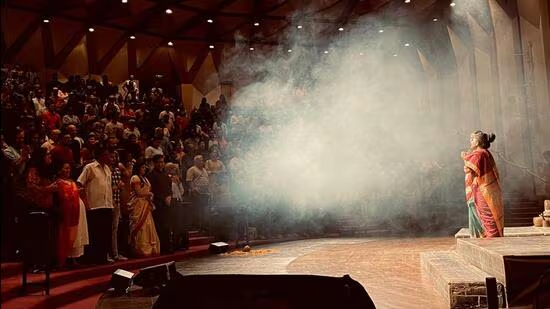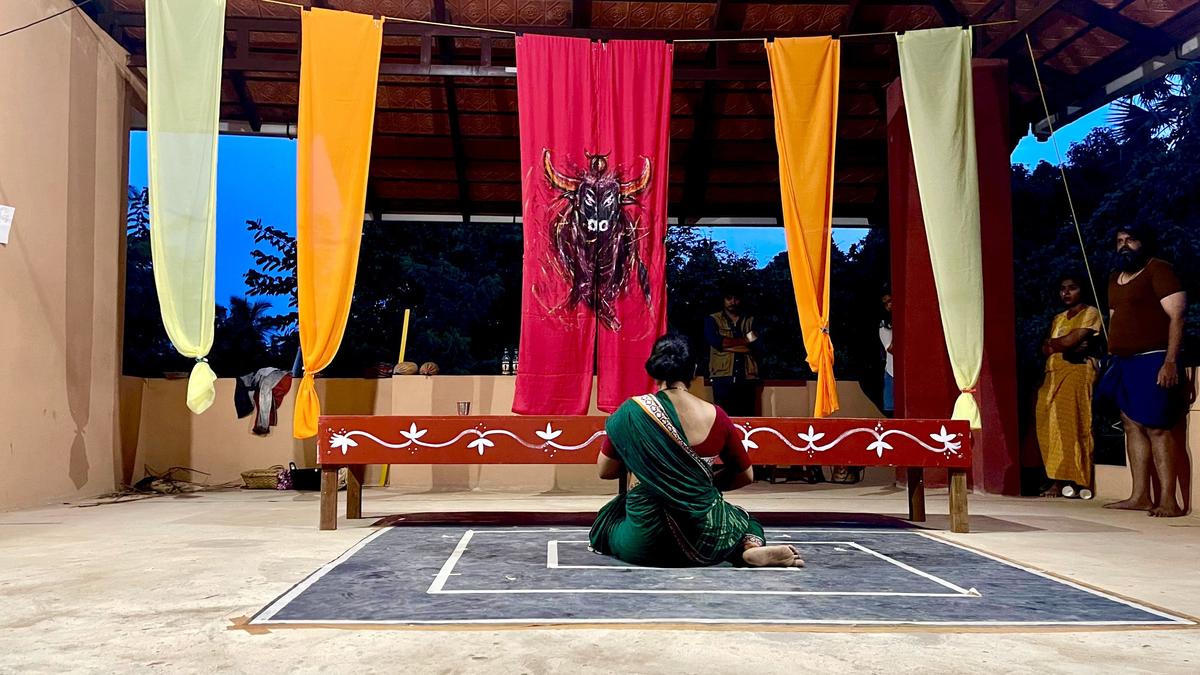
A scene from the play Angaara.
| Photo Credit: Special Arrangement
As part of the 2026 Girish Karnad Fellowship programme, playwright Usha Kattemane’s Angaara, directed by Abhinav Grover, was performed recently at the Prestige Centre for Performing Arts in Bengaluru as part of the Chiguru & Kusumale Theatre Festival organised by Samagata Foundation and Bhasha Centre. By combining local performance traditions, multilingual dramaturgical approaches and social-political criticism, Udupi’s Punaha Theater, examines the long-term consequences of the caste system in coastal Karnataka through Angaara.“Writing from a safe space is the easier path. But I like challenges. They keep a writer alive. That is why I tried to create a play that reflect the contemporary life of Tulunadu,” reads the Playwright’s note.Kattemane explores the religious and agrarian lives of the marginalised Koraga community of Tulunadu. The play uses Kambala, the buffalo ritualistic/race-sport of coastal Karnataka, as its dramatic background. The playwright skilfully creates a narrative that shows the contradictions of tradition and modernity, caste hegemonies, and social exclusions. It does not portray caste discrimination as being a relic of history; rather, it illustrates how it can live-on even beneath the rhetoric of cultural pride, progress and political ambitions.Director, Abhinav utilises the stage space effectively. Fabric partitions create separate areas on the stage representing different social worlds. The visual design evokes traditional theatrical methods and simultaneously operates as a metaphor for social division. The play uses languages such as Tulu, Kannada, Konkani, and English, spoken in multilingual and contemporary Tulunadu. Language serves as a dialogue between characters.