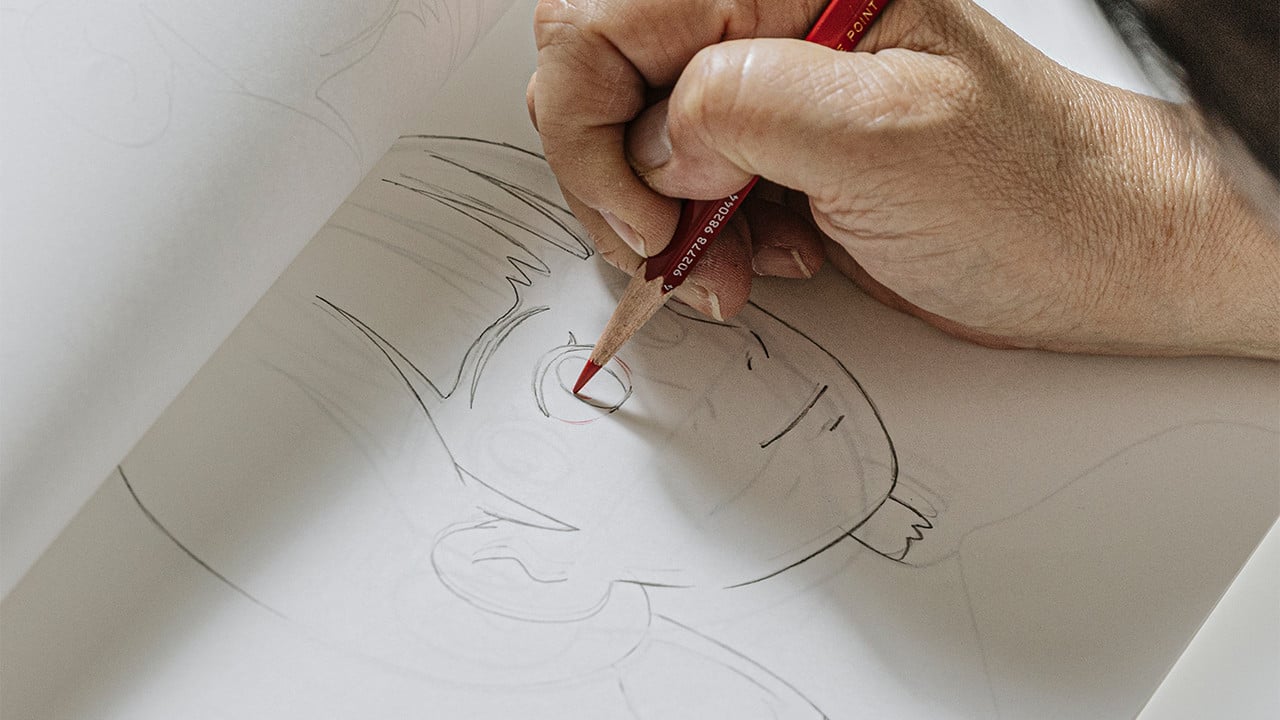
June 19th 2026 By Han Zhang Endo Mizuki always enjoyed seeing his drawings come to life. As a child growing up in a working-class family in suburban Kanagawa, a prefecture outside Tokyo, he made flip books for fun, drawing cartoon dinosaurs, “Toy Story” characters and stick figures chasing each other. By the time he reached secondary school, he dreamed of becoming an animator. But he knew that breaking into the industry was extremely difficult, and he needed a back-up plan. So when he was 16 years old, he enrolled in a vocational high school to study computer programming. There he largely kept his artistic aspirations to himself. “Even if I told my classmates about it, I didn’t think I could get them to understand it,” he recalled when we met in Tokyo in autumn 2024. Endo nevertheless continued honing his skills. After graduating in 2021 he picked up shifts as a cashier at a grocery store, which left him time to daydream and draw. At home he watched tutorials on YouTube and studied the styles of artists he admired, including Saito Atsushi, who designed characters for his favourite anime series, “Love Live! Superstar!!”, about a girlband. A cheerful young man with floppy bottle-blond hair, Endo showed me some of his work from those days. In one drawing a teenage girl in school uniform with green hair leans backwards to look at the sky; in another, a sweaty young woman with purple eyes opens a freezer door to cool herself down. “I drew as I liked and once I was satisfied with one picture, I moved on to the next,” he told me. The joy he felt made any doubts about his uncertain career prospects melt away. It would seem that there has never been a better moment for young artists like Endo to fulfil their dreams. Yet the industry is in crisis The industry Endo aspired to enter is in the middle of a boom. In the past decade the anime market has almost tripled in size to reach about $19bn, according to a report published in 2024 by the Association of Japanese Animations (AJA), an industry group. A Teikoku Databank survey, also released in 2024, found that the anime-production sector itself has been growing, too, seeing a 23% increase in sales from the previous year to hit more than $2bn. This bodes well for Japan, which is grappling with economic stagnation and population decline. As Weekly Toyo Keizai, an economics magazine, proclaimed in 2023, “A rare growth industry has burst onto the scene.” Anime’s success has been fuelled by interest from overseas. Between 2012 and 2022 the revenue from outside Japan grew sixfold; since 2020 the number of subscribers to Crunchyroll, a streaming service dedicated to anime programmes, has jumped from 3m to 21m. In the past few years, several anime films have topped the American box office. As a result of this popularity, anime-production studios are in high demand to work on titles for television networks and other companies. “The competition to reserve good studios is getting fierce right now,” an employee at a big distributor told me. The most reputable studios “are typically reserved for three to five years in the future. The industry has reached a bottleneck moment.” It would seem that there has never been a better moment for young artists like Endo to fulfil their dreams. Yet the industry is in crisis. Labour and creative predicaments have compounded, threatening the continued growth of the genre. The most immediate challenge is a shortage of animators. The talent pool has been hollowing out since the 1970s, when studios began to use contract workers to enhance efficiency and cut costs. Subsequent generations of anime artists have rarely received on-the-job training, and, feeling discouraged, many have left the industry altogether. The growing popularity of anime is making this trend more pronounced. At the beginning of the 21st century just over 100 anime series aired a year; in recent years the count is more than 300. “You’d think the number of animators would grow accordingly, but it didn’t increase that much,” said Fukumiya Ayano, of Nippon Anime and Film Culture Association (NAFCA), an advocacy group. In 2010 it was estimated that there were about 4,500 animators in Japan; today the number is between 5,000 and 6,000. Fan art Endo Mizuki sits at his desk in the offices of Bandai Namco Filmworks in Tokyo. His sketchbook is filled with observational sketches, which he will use to inform the frames he draws on his tablet. Merchandise from “Love Live! Superstar!!”, Endo’s favourite anime series, sits on his desk The animator shortage comes on the heels of shifts in the process of making anime. For instance, more artists now work on a single title than in the past, and each on a smaller number of tasks—contributing to a highly segmented workflow. Many animators and anime fans fear the art form will lose its distinct character as a result. People love anime for the world-building; the moments that viewers can fill in with their own imagination; the unpredictable human touch. “In Japan, there are so many unwritten rules. We can’t really say what we want to say. However, in entertainment, this kind of frustration bursts out in a very crazy way. It makes anime even more expressive,” the distributor employee said. I went to Tokyo to speak to artists, producers and teachers who are looking to seize this fraught moment to build more sustainable institutions and career paths. “I want to keep watching Japanese hand-drawn anime when I become an old lady,” Fukumiya said. “I’m in my 40s. If it goes on like this, Japanese anime will disappear.”For many anime devotees, one of the most treasured aspects of the art form is its devotion to tegaki—the craft of hand-drawing. In tegaki animation, the lines are not perfect; some may be feathery, even scratchy. As a result, scenes can feel more emotive than they do when made with CGI, the dominant method used by American animation studios. “CGI software is developed to present objects in their realness. It creates a texture very different from tegaki,” said Inoue Kiichiro, a general manager at Bandai Namco Filmworks, a video-production company. (Although CGI can be found in 80% of Japanese anime, according to Inoue, it’s often reserved for creating layouts before drawing begins, and for things that are difficult to animate by hand, such as fireworks and elaborate machinery.) “If it goes on like this, Japanese anime will disappear” The beginning of “The Boy and the Heron”, the latest film by Studio Ghibli, an acclaimed animation studio, exemplifies tegaki’s unique qualities. (The film is one of only two Oscar-winning animated features to have been hand-drawn; both were Ghibli productions directed by Miyazaki Hayao, who co-founded the studio.) The film’s protagonist, 12-year-old Mahito, races through a burning Tokyo neighbourhood during the second world war, trying to reach a hospital where his mother is a patient. Ghibli’s tegaki makes Mahito’s distress palpable. As he clamps his hat with his right hand, the outline of his fingers and upper arm become jagged and smeared. Parts of them then bleed into their surroundings; in flashes, his ears turn blurry, and his face becomes distorted. This intentional and sustained messiness conveys not only the intense heat and Mahito’s panic, but also the force of his lasting trauma. Anime as we know it took shape in the 1960s, alongside the rise of household television. Film studios looked to popular manga, or comic books, for inspiration. The first crossover hit was “Astro Boy”, about a robot child created by a scientist mourning the loss of his son. Its meditation on grief and techno-futurism resonated with Japanese audiences grappling with both the devastation of the second world war and the subsequent economic boom. Tateno Hitomi first saw “Future Boy Conan”, a post-apocalyptic series that was Miyazaki’s directorial debut, while she was a high-school student in the 1970s. “The way the future boy flies off, pyon,” she reminisced, deploying the Japanese onomatopoeia for bouncing. “It was filled with such unbelievable movements.” In 1979 she persuaded her parents to cover her tuition for a two-year programme at Tokyo Designer Academy, where she hoped to learn the basics of animation. She did, to a degree, but the courses were more theoretical than practical. Sometimes there were more than 100 students in a class, which meant that the teacher couldn’t correct her work. Going global (from top to bottom) One of the first anime success stories was “Astro Boy”, about a robot child created by a grieving scientist. Two decades later, Miyazaki Hayao co-founded Studio Ghibli, responsible for many worldwide, award-winning hits, including “Spirited Away”, “The Boy and the Heron” and “My Neighbour Totoro” After graduating Tateno began working for a small studio. It didn’t produce any of its own anime titles. Instead, it was contracted by bigger companies to complete “in-between” drawings—frames that capture the incremental movements between a scene’s essential moments, which are called “key frames”. When sequences of in-between drawings are connected, they create the impression of motion. (One second of anime often runs through 8 to 12 pictures, most of which are originally in-between drawings.) Traditionally, “in-betweening” has been considered an entry-level task, through which young animators can perfect their lines and learn to draw motion naturally. Mastering these foundations prepares some of them for more prestigious work, such as creating key frames, helping with the storyboard or even directing. Tateno found little fulfilment in her contracted assignments, which had her frequently flitting between different shows. She had no idea how to achieve the level of artistry that attracted her to the industry in the first place. “All I felt was anxiety, as if I was in a dark spot where I couldn’t see what was in front of me,” she recalled in her memoir, “The Pencil Warriors Saga”. Only two Oscar-winning animated features have been hand-drawn; both were Ghibli productions directed by Miyazaki Hayao, who co-founded the studio One day in the early 1980s Tateno was assigned a scene featuring Zorro, a masked vigilante. The sequence had already been partially completed by an unknown artist, who couldn’t finish it for some reason. In this person’s work, which depicted Zorro slashing his sabre in the air, Tateno spotted something unusual: the tip of the sabre didn’t form a perfect curve across the three in-between drawings. In fact, in the middle drawing, the sabre audaciously lurched off the invisible “track” that should have neatly linked the beginning and ending poses. Tateno realised that this counterintuitive treatment of the sabre’s movement gave Zorro a theatrical flair—what Japanese dramatists call kerenmi. She wanted to be taught this kind of artistic acumen. “How do you know when to stick to the conventional way, and when to break the rule?” she remembers wondering. After some pleading, she was put in touch with Otsuka Yasuo, the artist who oversaw the Zorro production. He invited her to apply for a job at Telecom, the studio that employed him as well as Miyazaki. After an interview that included both men, she landed a coveted spot at the company. At Telecom, Tateno finally received the hands-on guidance she craved. She showed her work to key-frame artists, and they gave feedback and corrected her lines. “I felt a little embarrassed to have taken up their time. But it helped me improve faster so I could work more independently sooner,” she told me. In 1985 Miyazaki co-founded Studio Ghibli. Over the next three decades, the studio developed a boutique operation, with an unusual emphasis on nurturing talent. When Tateno was 26, she was hired to inspect its in-between drawings. She worked on many popular Ghibli titles, such as “My Neighbour Totoro”, “Kiki’s Delivery Service” and “Spirited Away”. Looking back at her moment of career rupture, she told me, “It felt like fate.” As the young Tateno was striving to become a better animator, the industry was in the midst of a dramatic shift. In the 1960s and into the 1970s, production companies used an apprentice system, with experienced animators teaching the fundamentals to newly hired colleagues. According to a recent survey conducted by NAFCA, seven out of ten animators around Tateno’s age learned their craft from older mentors. This approach allowed studios not only to make fine anime, but also to incubate their future workforce. The artist’s way Tateno runs Sasayuri, her animation boot camp, in a former café space in Tokyo. Some students are sent by their employers—these are from Drive, an animation and music studio The demise of Mushi Production, an eminent studio, in the early 1970s changed everything. Mushi, the maker of the “Astro Boy” series, had been anime’s first big success story. After it went into the red, it became a cautionary tale: many people considered it proof that employing a large, full-time creative staff wasn’t financially viable. As Ueda Masuo, a former production executive who served as the director of NAFCA, put it, back then salaried animators weren’t your “9-to-5 worker types”: some slept during the day and worked at night; others suffered from creative block, drawing only when inspiration struck. “Even though there were hundreds of staffers, Mushi often ended up not being able to finish projects and having to contract with others for help. The cost really added up,” said Ueda. After Mushi declared bankruptcy in 1973, contract labour gradually became the industry norm. “It was easier for management to exercise control when they paid unit price as needed instead of monthly salaries,” Ueda explained. Tasks such as in-betweening were outsourced to small domestic operations, and to companies in East and later South-East Asia, where labour was cheaper. By engaging many contractors, with each of them responsible for a small portion of an episode, a production company could bring together new episodes quickly. Seven out of ten animators around Tateno’s age learned their craft from their older mentors. This approach allowed studios not only to make fine anime, but also to incubate their future workforce As anime’s first generation of fans grew up, the industry expanded. By the new millennium, it had evolved into a complex ecosystem. DVDs and merchandise brought in a lot of revenue, but overhead costs had increased as more companies became involved in a title’s production and distribution. A new funding structure had also emerged: instead of relying on television networks to take the lead, groups of investors began pooling funding and forming so-called production committees to commission new films or series. From the investors’ point of view, “a big budget and securing a production company with a talented staff does not guarantee a hit,” said Ishikawa Naoki, vice-secretary-general of AJA, the industry group. This means that they have to weigh up how many titles to invest in, and to what degree, in order to stay profitable. (This kind of risk evaluation has contributed to what’s known as tasan tashi—“many births and many deaths”—in the industry.) Despite the dramatic expansion of the anime market in recent years, production budgets remain tight, and only a fraction of overall sales trickle down to the production companies themselves; among those surveyed by Teikoku Databank, one in three was in deficit. In this environment many animators were stretched thin, and the industry became notorious for poor working conditions. As recently as 2020 social-media hashtags such as “the hell of being in-betweeners” brought attention to complaints of shifts that lasted more than 24 hours (one woman said she developed a hallucination after back-to-back all-nighters) and of being berated for taking a break to eat, or for asking for time off to attend a relative’s funeral. There have been improvements in the past few years—some companies try to curb overwork through policies such as turning off lights at the office around 9pm. But burnout-related problems persist. According to a 2023 report by the Japan Animation Creators Association (JAniCA), nearly a quarter of anime workers took four or fewer days off a month, and one in four reported depression or other mental-health struggles. Your browser does not support this video. Growing animated This clip, courtesy of Bandai Namco Filmworks, shows the basic stages of the animation process It’s not surprising that few veterans working today have the bandwidth to hover over a young animator’s desk: nowadays, only one in five animators are trained on the job, a sharp drop from Tateno’s day. Almost all the early-career animators I spoke to got started through dokugaku, or learning alone. Using textbooks or online tutorials can be helpful, but without hands-on training, it’s hard to become a professional, which requires artistic judgment as well as technical knowledge about the production process. One example of the latter is the timesheet, on which in-betweeners register the order of their frames to help their colleagues synchronise colour, background and other components. Some experienced animators I spoke to said that their junior colleagues’ lack of experience in these matters can even add to their workloads. The reality is that “young animators really want to improve their skills. When they become better, the money follows,” said Arimura Torahiko, an anime producer. According to the NAFCA survey, two-thirds of those under 30 earn less than $1,300 a month, which is below the average entry-level salary across Japan for new university graduates. The JAniCA report shows that the average salary then grows to $2,700 a month for those in the second half of their 30s, which is a little higher than the average income of Japanese workers in the same age group. Social-media hashtags such as “the hell of being in-betweeners” brought attention to complaints of shifts that lasted more than 24 hours and of being berated for taking a break to eat Lacking proper training and a viable salary, many young animators don’t feel they can keep going. The Japan Research Institute estimated that a quarter of them quit the industry within four years, and two-thirds in eight years. This retention problem has often been viewed as a form of natural selection. “I think this way of thinking is misguided,” said Sudo Tadashi, the author of two books about the anime industry. “Truly brilliant” animators are needed for roles like director and character designer, but without enough “adequately good” animators—particularly in-betweeners—the industry wouldn’t be able to function. “I don’t think a field where only top-level talent could stay on is a good place,” Sudo said. The question, then, is how to create an environment that helps more people become “adequately good”. Even veterans have become dissatisfied with the current state of affairs. “For long-term commercial operation, the existing production approach makes absolute sense, but it happens at the cost of personal creativity,” Oshiyama Kiyotaka, an esteemed director in his 40s, told me when we met in Tokyo. In 2017 he formed his own studio, Durian, which allows him to choose his own projects and work in a smaller operation. The core animation team of Durian’s first feature film, “Look Back”, which was released in 2024, had only eight members. Their responsibilities were unusually fluid: one colleague recalled that Oshiyama himself once drew 1,000 pictures in a week. This nimble approach enabled the team to make some unusual creative decisions, such as keeping imperfections in key frames that in-betweeners often smooth out. Even a casual viewer might snag on details in “Look Back”, like the disconnected outline of a collar. Given that the film is about two budding artists finding their way in manga publishing, this approach felt appropriate. “Before releasing the trailer, I wondered if some people might be offended by it,” Oshiyama told me. Yet viewers have been gratified by the way he rendered the artistic process more visible. The film, a commercial and critical success, has inspired an art book, an exhibition and a live-action adaptation. Back to the drawing board A single movement in a scene requires an artist to draw multiple frames. Here Tateno flips through a sequence that depicts a character turning her head, using a pencil and eraser to carefully refine the sketches Another institution reimagining how to make anime is Flat Studio, co-founded in 2019 by Ishii Ryu, a 30-something producer. When I visited its office, a minimalist duplex in Tokyo, Ishii told me the team was composed of 25 employees, with an average age of 26. Unlike the top-down structure of commercial anime studios, Flat Studio makes creative choices through collective deliberation. A star illustrator who goes by “loundraw” comes up with original stories and the team members together figure out concepts, from the storyboard to colours of a particular scene. Using this approach they have released a series of short films, as well as a 40-minute feature called “Summer Ghost”. At one point in our conversation, a staff animator pulled up some character sketches on the computer, including a drawing of a young woman with chin-length hair, wearing a sailor top and a pleated miniskirt. In small type beneath, there were detailed memos; one suggested highlighting the character’s youthful athleticism by flaring the edge of her top’s sleeves slightly upwards. “The memos are intended to encourage everyone to consider the best way to express the character traits as they draw,” said the employee. Any time an image or effect fell short of what the group envisioned, they would analyse and correct it as a team. “Each project is both work and an opportunity for everyone to learn together,” Ishii explained. “Truly brilliant” animators are needed for roles like director and character designer, but without enough “adequately good” animators the industry wouldn’t be able to function Some animators have decided that using cutting-edge technology will give them a different kind of control over their art. The producer Ito Hakubun, now in his 70s, was a pioneer in using CGI to make anime, back when it still required supercomputers. Last year he was once again at the vanguard, when he rolled out a mystery mini-series billed as the first AI anime on Japanese TV. Visually, Ito’s series bears the unmistakable imprint of AI. More conventional animators agree that the current technology is only capable of convincingly creating backgrounds, like landscapes or street scenes. Still, the idea of using AI to make any part of an anime production has stirred strong feelings. In 2023 Netflix Japan released a short film with an AI-generated background and received voluble public backlash. Two thousand people replied to Netflix’s Twitter announcement, many quoting Miyazaki, who once described a clip of an AI-made humanoid twitching on the ground as “an insult to life itself”. Anime fans tend to be protective of young animators, and their suspicion of AI is widely shared: after all, AI firms have made prodigious use of other people’s creativity without paying them (for example when models are trained on millions of copyrighted books). Yet the animators I spoke to are comparatively sanguine. The younger generation tends to find AI’s potential a remote concern compared with the day-to-day joys and challenges of navigating a tough industry. Mid-career producers, meanwhile, are interested not in whether, but how, the technology might be adopted. “I’m not opposed to AI when it’s used for conceptualisation. It’ll be useful to make demonstration clips for clients, for example,” Arthell Isom, an animator who owns a production studio in Tokyo, told me. “But I wouldn't use it for anything that would appear in the product.” Masterclass The Sasayuri students pay close attention as Tateno reviews their work and provides feedback Ito was unfazed when I mentioned the distrust of AI. He was more keen to show me the technology’s potential, using a scene from his series: a bright full moon above a sea of moving clouds. He logged into Gen 3 Alpha, an AI-powered video generation tool. “You put an image in this box,” he said, pointing to the left of the screen, “add some prompts and hit generate.” In one version the greyish-blue clouds had a high-contrast silver lining, making them look menacing; in another, they appeared muted and more gentle. “I tried maybe 10 or 20 times before getting it just right,” he said. (In the version that aired, the clouds were fluffy and half lit by the moon.) Just as various inventions—pens, typewriters, computers—have changed our approach to writing, Ito anticipates that AI will push humans to redefine art-making. As he sees it, the technology will enable people without drawing skills to create anime at home and make their own set of artistic choices: “It’s time that we ask ourselves: what is the creativity of a human being?” New approaches by boutique studios and individual creators promise to stimulate artistry on a small scale. But solving the talent shortage in commercial anime will require a different kind of commitment. One effort is led by Tateno Hitomi. In 2020, six years after she had retired from Ghibli, she and her partner Arimura, the anime producer, launched an academy named Sasayuri, after a lily native to Japan. They hope to prepare young people for animation careers with a boot camp featuring the kind of training Tateno had received at Telecom. “For long-term commercial operation, the existing production approach makes absolute sense, but it happens at the cost of personal creativity” Sasayuri offers a weekly course that runs for six months and admits up to 45 students per term. Each three-hour class session welcomes no more than six people, allowing Tateno to provide ample guidance. Some students are new hires sent by their employers; others are early-career animators looking for mentorship. “Each company has its own style, so it’s not about teaching students a fixed right answer. It’s about showing them how to enter the strike zone,” said Arimura, using a baseball analogy. More than 300 animators have graduated from Sasayuri; almost all have remained in the industry, crediting the academy for helping their careers advance. Among Sasayuri’s first students was Mukoyama Tsukasa. In her first job, the pay wasn't great, but she was mostly frustrated by the artistic compromises. Her breaking point came when she watched two episodes of the same anime programme on TV: one that she had worked on, the other made by a different production company. They didn’t seem to belong to the same show. “The movements were so different. The moment I saw that distinction, I strongly felt that I couldn’t go on like this,” she told me. She quit in 2020, and soon joined Sasayuri. After graduation she landed a role that paid enough for her to live without her parents’ assistance. But because she was the only new hire with experience, she ended up helping others on top of her own workload. The pressure became overwhelming, so she became a freelance in-betweener instead—a role she finds fulfilling. “I’d like to become staff at a company again if there are more veterans, but freelance allows me to meet more people,” Mukoyama said. “I really like drawing in-between frames. Being able to make money this way is the best!” On a bright Saturday afternoon, I joined Tateno and a few of her current students in a room that almost felt like a Victorian drawing room: glass vases were arranged on a windowsill, and lamps and chandeliers were decorated with designs of lilies and roses. The students sat at desks equipped with backlights and mechanical pencil sharpeners. Anime lover At Bandai Namco Filmworks, a model of a giant robot from the sci-fi series “Gundam” stands in the reception area. Endo was thrilled to become an apprentice, then an employee, at the company: “I had always wanted to be at Bandai” Tateno encourages her classes to use their powers of observation. “To create an evocative scene, making things up in your head is not enough. We must first imprint ourselves with memories of all kinds…when we draw, we add our personal touch,” she told me. The day I visited she invited the students to think about the way steam rises from a pot. “Yuratto,” she said, using onomatopoeia to describe a slow, swaying motion. “There is a blurring effect, almost smoke-like.” Standing in the middle of the room, she gently rotated her wrists to emulate the motion of ascending steam. “Without changing its form, let it rise like a mountain.” The students got to work on their steam drawings. Meanwhile, Tateno called them up one-by-one to discuss their homework from the previous week: sketches of long hair flowing in the wind. She flipped through the assignment—two in-between drawings made by each student, sandwiched between two printouts of key frames—whispering feedback as she corrected the lines. There was an authority in her gentle tone. “The middle of the hair shouldn’t move,” she said to a student in a denim shirt, who bent over to observe her corrections closely. After the class, I spoke to some of the students. Nishimura Go quit his graduate studies in machine learning to become an animator. He told me he had spent a couple of years doing dokugaku with online courses. “It’s really different when you can see the teacher at work,” he said. “It’s not just about seeing the end results.” About a year into his grocery store job, Endo Mizuki, the young animator from Kanagawa, came across an advertisement for Bandai Namco Filmworks’s paid apprenticeship. It is one of a few in-house training programmes that has been started by commercial anime firms in recent years. “About a decade ago we found it very difficult to secure animators for assignments. The number of titles produced in Japan was increasing and it was quite a scramble,” Okumura Kensuke, a company production assistant, told me. “We still assemble freelancers, but also want to develop creators within the company with the aim of bringing them on staff.” “To create an evocative scene, making things up in your head is not enough. We must first imprint ourselves with memories of all kinds” After a rigorous application and interview process, Endo began the programme in spring 2023. An acquaintance helped him find a cheap studio apartment in Tokyo, though the rent was still half of his monthly stipend of $600. (For the following class of apprentices, the stipend was raised to $1,100.) He lived on a diet of pasta with ready-made sauce. “Rice was more expensive,” Endo told me. “I was looking for the cheapest thing that filled the belly.” But he was exuberant. “I had always wanted to be at Bandai,” he said—the home of his favourite anime, “Love Live! Superstar!!” For a year Endo and seven other classmates gathered every morning for a themed lecture from a staff animator; after lunch the apprentices worked on assignments and received feedback. Initially they focused on creating in-between frames before moving on to key frames. “We used materials from real anime productions. I was able to learn the way of doing things that I couldn’t have prepared myself otherwise,” Endo said. After Endo finished the apprenticeship, he was hired full-time. (When the programme started in 2018, there were only seven animators on staff at the company; today, there are 41.) He was assigned in-between work across several titles; once he even got to draw a scene for “Love Live! Superstar!!” “Two characters were talking, and it turned into a bit of a fight,” he said, laughing. He was still working up the courage to ask for an autograph from Saito Atsushi, the “Love Live! Superstar!!” character designer. One day Endo hopes to develop his own anime—a career goal that no longer feels totally out of reach. He shared his business card with me. His name was printed above his title, “Animator, Department of Production”. In the top corner was a company slogan: “Fun for All, into the Future”. ■ Han Zhang is a writer in New York. She also edits fiction at Riverhead Books Photographs by Haruka Sakaguchi Additional images: Capital Pictures, Alamy, Toho / Supplied by LMK
The strange disappearance of Japan’s animators
Anime has never been more popular. So why does the industry have a labour crisis?
5,306 words~24 min read