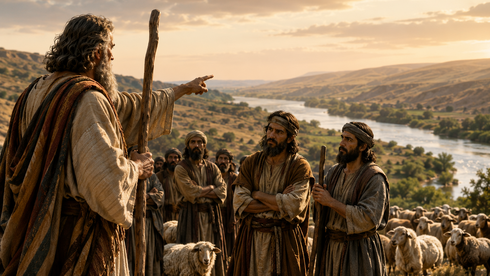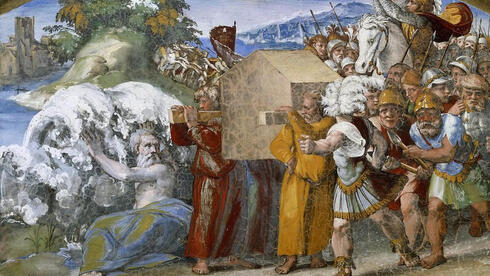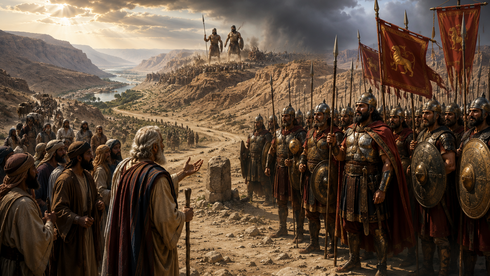
Parashat Chukat argues that Israel's detour around Edom reflected a long-term vision for regional alliances with neighboring descendants of Abraham, while the Amorite kings represented an irreconcilable threat that ultimately forced warMichael Eisenberg|In this week's Torah portion, the Nation of Israel arrives near the entrance to the Land of Israel, only to retreat. Moses sends messengers from Kadesh to the king of Edom, reminding him of their shared brotherhood. Moses politely requests passage through the King's Highway, promising not to consume their resources or stray into their fields. Edom adamantly refuses, threatening to engage marching Israel in a military battle. In response to Israel asking to pass via a side road through the hills, Edom refuses and marches out with a heavy military force, forcing Israel to turn away. To the outside observer, it appears Israel was afraid to fight Edom.Following the splitting of the Red Sea forty years prior, the surrounding nations, including Edom, Moab, and Canaan, were gripped with terror, as described in the Song of the Sea. Yet now, Edom seems less intimidated by a new generation that had wandered the desert and grown weary.Consequently, the Canaanite king of Arad attacks the Children of Israel and takes captives. However, Israel swiftly responds to this aggression, completely destroying them at Hormah. What, then, is the difference? Why did Israel yield to Edom and endure a lengthy detour around Edom, Moab, and Ammon, but later actively wage war against Sihon and Og, the mighty kings of the Amorites?Moses's retrospective account in the Book of Deuteronomy explains only half the picture, yet it holds the key to our portion's deeper insights. Moses explains that Israel avoided fighting Edom because they were the descendants of Esau (Jacob's brother) and spared Moab and Ammon because they descended from Abraham’s nephew, Lot. God had distinctly designated the lands surrounding Israel for them. Conversely, the Amorites, who shared no such familial ties, were conquered after refusing the Israelites' passage. Thus, the blocked path through Edom became a detour along the borders of Edom, Moab, and Ammon.Interestingly, Deuteronomy notes that Israel offered to pay Sihon for food and water "just as the children of Esau... and the Moabites did for me." This directly contradicts the narrative in Numbers, where Edom aggressively refused passage, provisions and payment for food and water, and it also seems to contradict Deuteronomy 23, where the Torah explicitly states that Ammon and Moab failed to greet Israel with bread and water on their journey.Furthermore, the conquest of the Amorites in Numbers evidently includes territories from the land of Moab, which Sihon had previously conquered from the first king of Moab up to the Arnon stream. This would appear to contradict the prohibition against taking Moabite land. Ralbag (Gersonides) explains that any one and any nation should pursue peace and avoid war even when military victory is assured. I would suggest that the deeper understanding is that conquering the Land requires preparing for "the day after." The initial appeal to Edom: "Thus says your brother Israel", and the subsequent avoidance of war, were not signs of weakness but a strategic vision. It was meant to establish an "Abrahamic Coalition," a regional alliance of nations tied to the biblical Patriarchs. Requesting to travel the "King's Highway" meant seeking an official, public alliance. When Edom refused, Israel tried to lower its profile by requesting to pass quietly on foot as mere travelers. Edom responded with overwhelming military threats, perhaps putting on a show of force for their future neighbors.Following Israel's decisive victory against the hostage-holding Canaanites at Hormah, Moab remained deeply afraid of Israel, as is suggested in next week’s portion: “and Moab was very afraid of the children of Israel”. Therefore, the Amorites could not count on them, and in order to physically block Israel's advance, the Amorites conquered parts of Moabite territory. If so, Edom may have also trembled at Israel's approach, yet ultimately mobilized against them due to the looming Amorite threat in the background.However, unlike Edom (who offered trade potential) and Moab and Ammon (who could serve as eastern buffer zones for the future Israeli state), there was no coalition potential with the Amorite kings. The Amorites and their proxies were settled on both sides of the Jordan River so they were determined to block Israel at all costs.When God told Moses to provoke Sihon, the Amorite king, Moses diplomatically claimed that Edom, Ammon, and Moab had cooperated with Israel, even if it was not true. This was intended to intimidate Sihon that his regional blockade was crumbling. This psychological and diplomatic tactic actually worked. Sihon abandoned his defensive home advantage, rushed into the desert to attack the Children of Israel, and suffered a massive defeat. Fighting in the desert favored the desert-born Israelites, turning the curse of their wandering into a tactical advantage. Sihon, having overextended his forces by conquering Moabite land, was left exposed, and this time Israel did not blink, and thoroughly defeated Sihon.Since the ban on fighting Moab stemmed from a desire for an alliance rather than a technical land restriction, taking Moabite lands previously conquered by Amorites was completely permissible. The Amorite proxy war backfired, directly expanding Israel's territory.The children of Israel, who immediately upon crossing the Red Sea had planned to cross to the Land - "Until Your people cross over, O Lord" - were forced to fight the Amorites for two main reasons. First, they needed to dispel the illusion of weakness projected by their detour, demonstrating they would fight ruthlessly when necessary. Second, the Amorites were actively imposing a new regional order, enslaving Moabites. They could have recruited more forces and insurgents, completely threatening Israel's vision for a prosperous region.Ultimately, the Amorite/Edomit attempt to close the Straits of Edom - the King’s Highway - failed miserably. As Edom decided to show force against us instead of engaging in prosperous collaboration, their military relevance faded from scripture for centuries. While Edom lived strictly by the sword, Israel eventually stabilized its dominion, turning the Land into the central, thriving commercial artery connecting the south and north, east and Egypt.
When restraint becomes a strategy for the future
Parashat Chukat argues that Israel's detour around Edom reflected a long-term vision for regional alliances with neighboring descendants of Abraham, while the Amorite kings represented an irreconcilable threat that ultimately forced war
1,015 words~5 min read