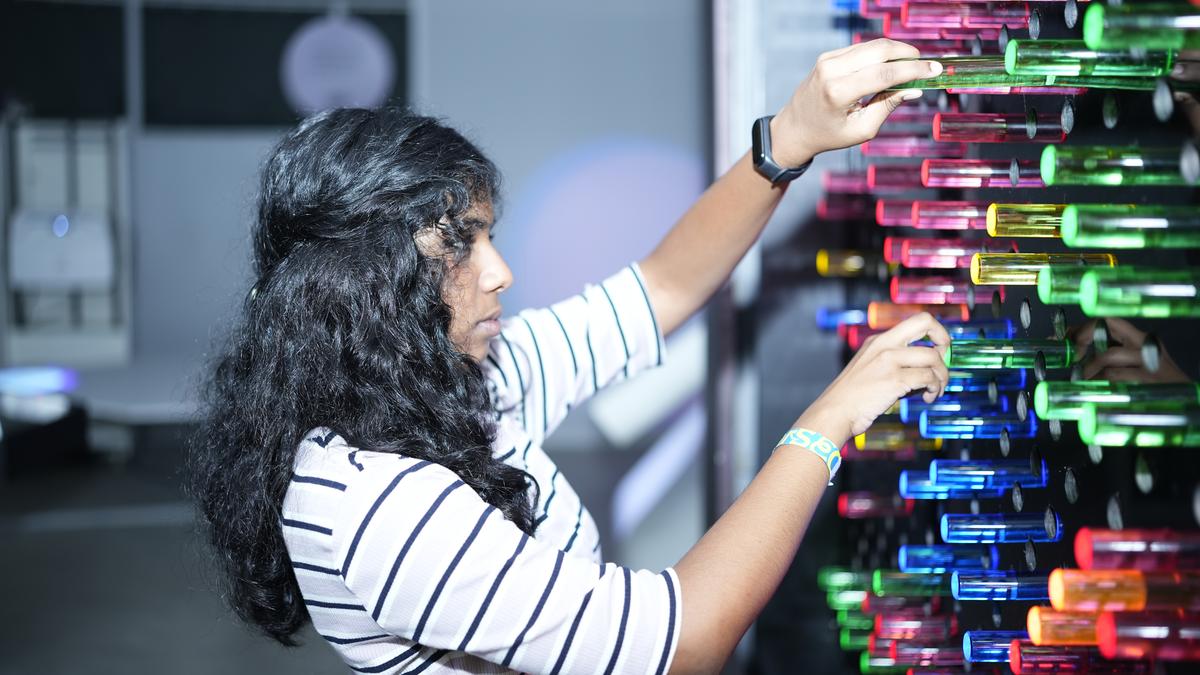
A visitor at PARSEC in Whitfield
A clock made entirely of mathematical equations, a robot dog named Muffin, and even an alien species attempting to understand humanity. These were some of the first things we encountered at ParSEC Whitefield, PARAM Foundation’s science experience centre in Bengaluru. Unlike most science museums, where exhibits are designed to be observed, nearly everything here asks to be touched, tested and interacted with. “The original vision was to make science a lifestyle,” says Inavamsi Enaganti, one of PARAM’s CEOs. The Bengaluru-based non-profit works to promote Indian history, science, innovation and culture, and ParSEC is one of its most ambitious public-facing projects.Rather than viewing science as a collection of facts, Enaganti hopes visitors learn to question, investigate and solve problems they encounter in everyday life. He describes ParSEC as a “living lab” where people can evolve from seekers to solvers and eventually, innovators. As we moved through the centre, we quickly realised there was something for everyone. One moment, we were making water droplets fall onto metallic plates to create different sounds. Next, we were peering through interactive telescope displays, exploring everything from Jupiter to distant galaxies with the turn of a dial.Throughout the experience, we were accompanied by the Zinions, a fictional alien species trying to understand human beings. Through questions, puzzles and interactive stations, we slowly became subjects of their investigation.Different galleries at the centreThe galleries themselves are organised around the Panchabhutas: Akasha (space), Jala (water), Prithvi (earth), Vayu (air) and Agni (fire). As we explored these spaces, we encountered exhibits that transformed abstract scientific concepts into something tangible. A motion-sensitive fire installation glowed brighter as we approached it. In another section, we experimented with light using prisms and lasers, observing how beams bent and changed shape.