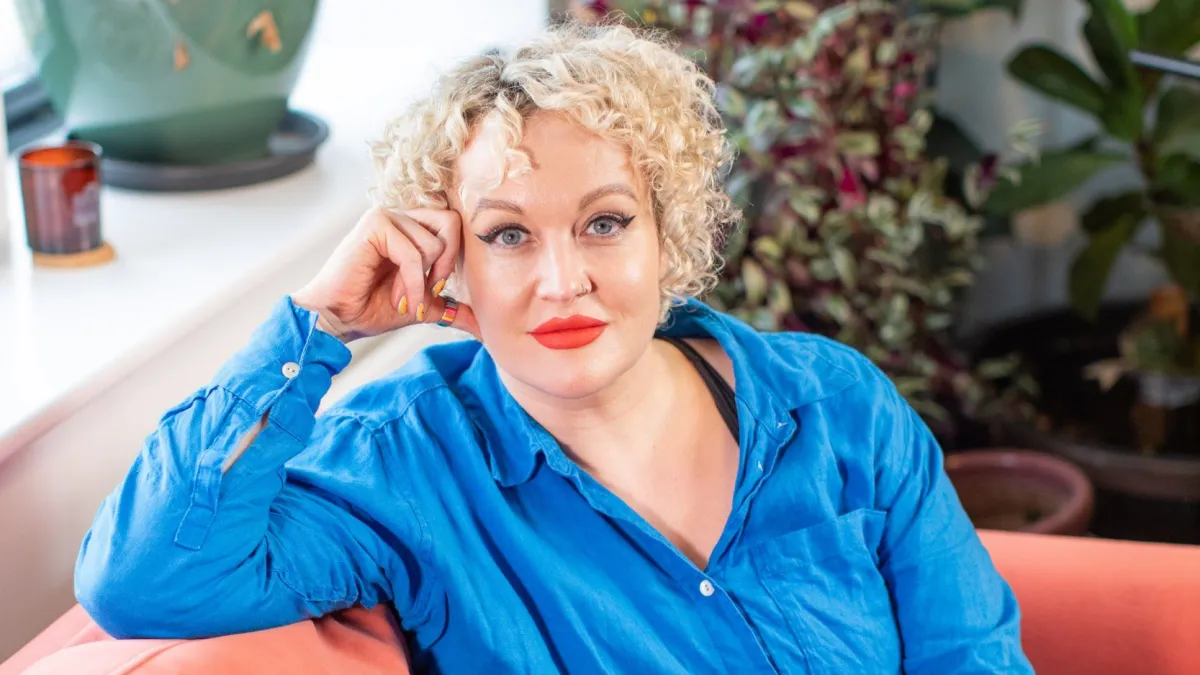
The last time I saw my mother, she weighed less than 5st. She was 64 years old but looked like a woman of 80 – tiny and hollowed out, her skin papery, the whites of her eyes yellowed. I barely recognised her. The stale, sweet smell of old alcohol clung to her. I had to breathe through the shock of it.I’d driven to the hospital in Great Yarmouth alone that July day in 2024. When I walked into her ward, she looked up, shocked and surprised.‘Have you come all this way to see me?’ she asked.‘Yes, Mum,’ I replied. ‘Just to make sure you’re staying out of trouble.’She smiled at that. I caught a glimmer of the vibrant young woman she must once have been – one I’d never known. I stayed for a couple of hours, digging for safe topics to chat about: my drive from Wiltshire, the weather, the food. Not the inevitable, which could only be days away.As I was leaving, she called after me. ‘I’m sorry, Louise,’ she said. ‘For everything.’I stood there, unable to take it in. All those years of silence, of absence, of wondering why she’d left – and it came down to this: a dying woman in a hospital nightgown, finally saying sorry.I took her tiny, cold hand in mine. ‘It’s OK Mum,’ I said. ‘I understand.’ Louise Muir-Sage says she was an alcoholic for 22 years before becoming sober Louise with her mother Mirian, who struggled with alcohol addiction, and half-brother DanielAnd I meant it. I understood what had made her abandon me when I was a baby. I knew what alcoholism does to a person, how it can strip even the strongest character of all reason, morality and self-preservation until drink is the only thing that matters.How did I know this? Because I was an alcoholic, too. For 22 years, drink had threaded its way through my life and slowly pulled me under, just as it had with Mum, robbing me of every lasting relationship – and even the confidence to ever become a mother myself.But there was one more thing I wanted to share with her that day, as we said our goodbyes. ‘I’ve given it up, Mum,’ I said. ‘I’ve been sober for more than two years.’She held my gaze for a beat longer and smiled her last smile. ‘I wish I had,’ she said. Four simple words that broke my heart.In the early hours of the following morning, I received a call from the hospital. I managed to arrive in time to hold her hand as she breathed her last breath. My mother, Mirian, was gone. She wasn’t the first victim of alcoholism in our family. It runs back through three generations – and who knows how many before that.Alcoholism was listed as cause of death on my grandmother’s death certificate. And now it was there on my mother’s, too.Not for the first time, I felt a huge surge of pain and gratitude that, somehow, I had managed to break the cycle.Although I wept the day she died, I’d never really known my mother. I was brought up by my father, John, after she walked out on us when I was 18 months old. By the time I was 18 I was going out four nights a week, drinking around 40 units a week, the equivalent of about four bottles of wine, writes Louise Louise was was brought up by her father, John, after her mother walked outI grew up not understanding why, sensing she was a subject too painful and too complicated to raise.Dad married again when I was four to a lovely woman called Anona, who has been my mother in every way that counts.But there were other things we didn’t talk about in our family, too – namely my paternal grandmother, Gina, who lived in Lowes- toft, 65 miles from our home in Weeting, Norfolk.As a child, I adored her. With my step-sister Sabrina, I spent school holidays there, and she was warm and fun and attentive.Drink was part of her character. She was always to be found with a glass of brandy or red wine in her hand, dancing around the kitchen to Radio 2.But it wasn’t until my mid-teens that I began to understand her behaviour was causing concern.My family explained it gently – she couldn’t always look after herself, they said. My grandfather Stuart, a former merchant navy captain, had spent long stretches away at sea, leaving her lonely and isolated, and drink had become her comfort.No one saw it as a problem in those days, and besides, her husband doted on her and would never hear a word against her. Gina’s drinking became a family secret, spoken around rather than about. At one point, Louise was drinking two bottles of gin a day and overall had spent £50,000 on drink over the course of my life In April 2022, Louise decided to quite alcohol after realising she had a drinking problemThe last time I saw her alive, I was about 25. She was at home in her nightgown, swigging brandy from a crystal decanter. She died aged 76 in hospital, with my grandfather at her side.My mother’s alcoholism was different – a stranger, lonelier story – yet with some painful crossovers.My father, John, worked as a marine engineer and, like his father, was away at sea at lot.They’d married in 1979 and had me in 1981, their only child. Mum was very pretty, fun and bursting with confidence, Dad told me.To start with, she wasn’t a big drinker, but she’d sought comfort from her husband’s frequent absences in other ways, by having several affairs.One day when I was a toddler, my father returned home to find me alone in the house and a note from my mother on the kitchen table, saying she was leaving.She’d taken all our family photos, along with every trace of her existence. When she later asked for a divorce, my father got sole custody.She married again and had my half-brother Daniel and half-sister Kimberley – before that marriage too hit the rocks.By that point, I believe, she’d started drinking heavily.I saw her every other weekend until I was six when the visits, inexplicably, stopped. Years later, she claimed this was to allow me to ‘get on with my new life’, though I was too angry to accept this explanation at the time.Dad – to his enormous credit – never once said a bad word about her. He felt it wasn’t his place. That it was down to me to form my own opinion, in my own time.I saw Mum only a handful of times over the following years. Once in my early 20s, at my maternal great-grandmother’s funeral, she came up to me and introduced herself, as if we were distant acquaintances. As if I was nothing to her. It hurt more than I ever admitted.The next time I saw her was at her own father’s funeral, several years later. She arrived late and drunk – shouting, slurring and stumbling. No words were exchanged. I stood and watched, ashamed.I next saw her at my half-brother Daniel’s wedding in 2012, when I was 31.She weaved her way up to me at the reception, obviously drunk, with a huge glass of wine in her hand.‘Ah, just like your Mum, eh?’ she grinned, clocking an identical glass of red in my hand.I felt a surge of something cold and frightening move through me. I thought: ‘I am nothing like you.’ But as I stood up unsteadily – that glass had not been my first or even my second – the thought struck me with horror: ‘What if she’s right?’Because the truth I could not yet admit was this: I was exactly like her. Through my genes, or that mother-shaped gap in my life that I’d tried to fill with drink, I was following her down an identical path.I’d had my first drink at 15 – cider at a house party, the Spice Girls on the stereo. I was quiet and studious and desperate to fit in. The moment the alcohol hit, I felt warmth, a looseness, a sudden freedom from myself. I spent the next 22 years chasing that feeling.By the time I was 18 I was going out four nights a week, drinking around 40 units a week, the equivalent of about four bottles of wine. I dropped out of college because the hangovers made it impossible to attend. I got a job as an accounts assistant and drank at least three large glasses of wine every lunchtime in the pub with colleagues. Nobody batted an eyelid. Neither did I.Looking back, the signs of my alcoholism were everywhere. I was always drunk before I went out, drinking in secret first so no one would see how much I really needed.When I woke up after a heavy night, I would frantically scroll through my phone, piecing together the evening, dreading what I might have done. I laughed off the stories people told me about my antics.My dad and step-mum knew nothing of this. I’d left home at 21 and was an expert at hiding my drinking – something I now know is very common with alcoholics.In my mid-20s, my drink was spiked on a night out. Two men walked me home and sexually assaulted me in an alleyway. I was too out of it to call for help. I reported the attack to the police; the men were arrested but not charged.I drank to forget what had happened. It was the only way I knew. In my late 20s I began a relationship with a kind man who barely drank, and we married in 2014 when I was 33. I hid the extent of my drinking from him throughout our 13 years together.I was on antidepressants. My skin was grey. I had no hobbies bar alcohol, no life outside of my new career in the motor trade. But I was still functioning, still turning up, still convincing myself and everyone around me that I was fine.Our marriage ended in 2021 and after that, the pretence collapsed. I started going to the local pub every single night, so I never had to be alone. At one point, I was getting through two bottles of gin a day.I took out payday loans and racked up £38,000 in debt. In the end, I calculated I had spent £50,000 on drink over the course of my life.Yet while I knew things weren’t right, I still didn’t think I was an alcoholic.I had a home, a job, I was always washed and well-dressed. I drank wine in the evening, not cheap cider in the morning.What changed everything was a stranger on Instagram. In April 2022, aged 41, I was scrolling through my phone and came across the account of a woman who had been sober for more than 200 days.Something made me message her. ‘How did you know alcohol had become a problem?’ I asked.She replied with three questions: ‘Does having one drink always lead to two? Can you not stop at two? Does your behaviour change when you drink?’I answered yes to all three. She suggested I get help. I worked out I’d drunk 170 units of alcohol in the previous three days. That’s the equivalent of 17 bottles of wine. The next day, I went to a support group. The room was full of normal-looking, well-presented people – people with jobs and families and mortgages.And every single one of them had lost control of their drinking. I sat there and felt, for the first time, the full weight of what I was. I broke down in tears.I was an alcoholic. I had always been an alcoholic. Just as my mother had been one, and my grandmother.Mum and Nan weren’t related, but I’d obviously picked up this trait from both sides of the family. Maybe the odds were always going to be stacked against me.I got sober that April. I haven’t had a drink since.When I told Dad and my step-mum, they were incredible. They confessed they’d suspected I had a problem, but didn’t want me to feel judged and waited for me to acknowledge it myself. They were so proud that I had.One of the hardest parts of recovery has been addressing the things I spent years drinking to avoid. The question of my mother. The question of why she left. Not just the marriage, not just my father – but me. Why she left me, her daughter? How could a mother do that?What I have come to understand, through the slow, painful work of recovery, is that alcoholism steals everything – your relationships, your choices, your capacity to be present for the people who need you.My mother didn’t choose to become an alcoholic, and I suspect the shame she felt was responsible for her breaking contact with me.One decision I made long before I got sober was that I would not have children. The fear had always been there that I might ruin everything, leave a child I loved or, even worse, pass on this baton of alcoholism to them.My husband had two children from previous relationships, so my fears didn’t cause an issue in our marriage.But before my alcoholism took hold I had longed to have children, so, while I don’t regret my choice, I am sad that I didn’t trust myself enough to become a mother.I am 45 now. I live in Royal Wootton Bassett with my two dogs. I am an aunt, which I love. I have started a business, called Something Kind of Woo, supporting people’s personal growth and well-being.I do not feel like I am missing something any more. The life I have built in sobriety is more real, more mine, than anything I had before.I don’t carry anger about any of it. Not towards my grandmother, not towards my mother, not even towards the years I wasted.Part of my recovery is letting that go. If I held on to the anger, I would relapse. I know that now.What I carry instead is a determination to be honest about what alcoholism looks like. About how it hides. About how it can thread through a family for generations, wearing different faces, making different excuses, taking different things from different people.My grandmother lost her clarity. My mother lost her family. I very nearly lost everything.But I am still here. And I intend for things to stay this way.Find information and support at alcoholics-anonymous.org.uk or drinkaware.co.ukAs told to Matthew Barbour
I gave up alcohol after asking myself three simple questions
The last time I saw my mother, she weighed less than 5st. She was 64 years old but looked like a woman of 80 - tiny and hollowed out, her skin papery, the whites of her eyes yellowed.
2,422 words~11 min read