For a century, physics has had the same embarrassing habit. We find the smallest thing. We call it the atom — Greek for indivisible. Then we split it. Inside is a nucleus; we split that into protons and neutrons; we split those into quarks. Each time we were sure we had reached the bottom, and each time the bottom had a basement.
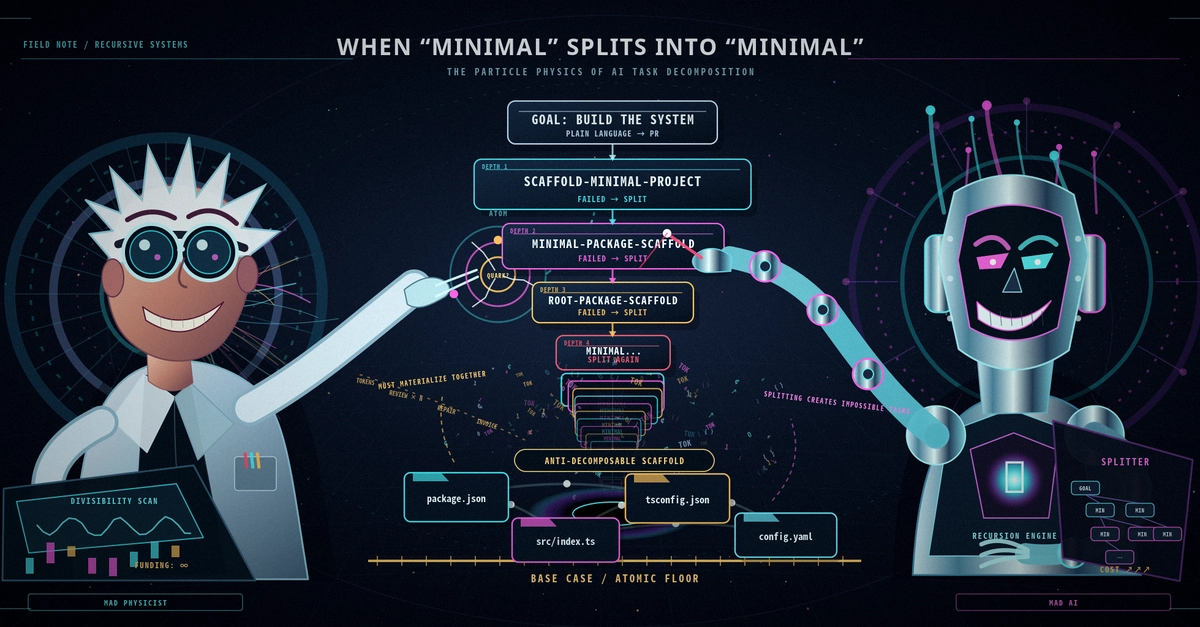
Last week I watched an AI rediscover this, by accident, in about forty minutes, while trying to create an empty software project.
The setup
I have been building an autonomous software org: you hand it a goal in plain language, and a controller decomposes the goal into a tree of tasks, builds each task with a small swarm of agents (designers, an implementer, an adversarial reviewer), and ships the result as a pull request. No human in the loop between "goal" and "PR".
The interesting part is the decomposer — the Splitter. A goal like "add a button that exports the table to CSV" is one small task. A goal like "build the whole billing system" is not; it has to be broken down. And the breakdown has to be good, because each task runs a full, expensive review pass. Split too coarse and the reviewer drowns in a change it can't verify in one sitting. Split too fine and you pay that expensive review N times for no benefit.