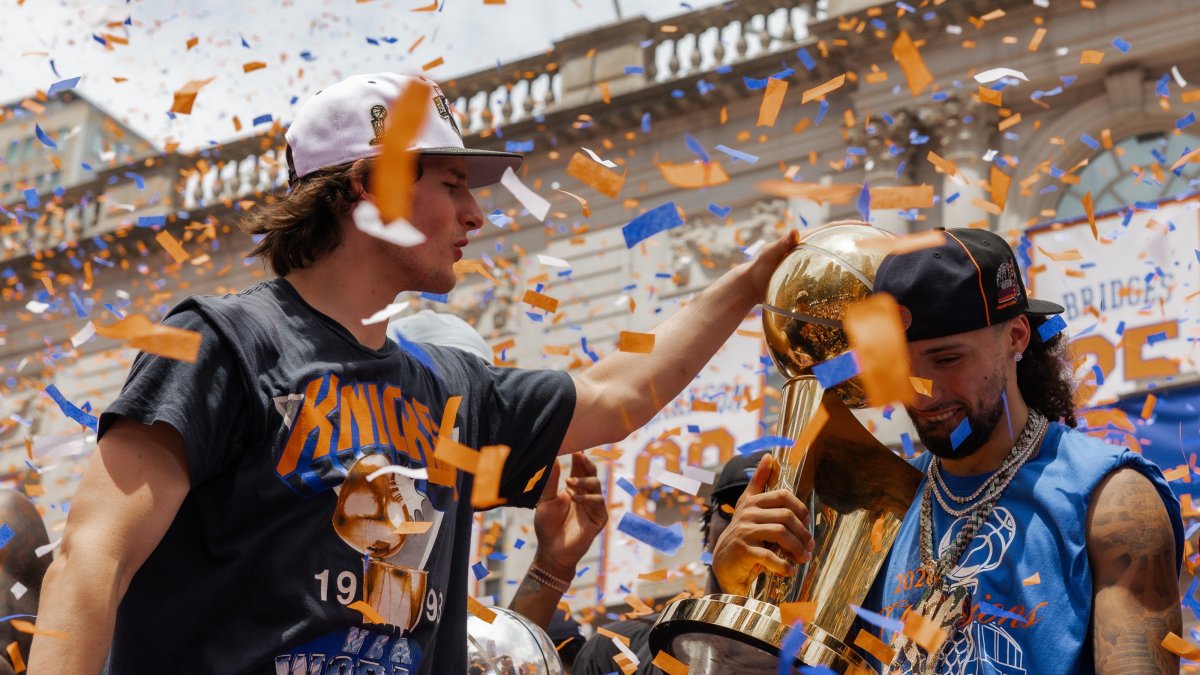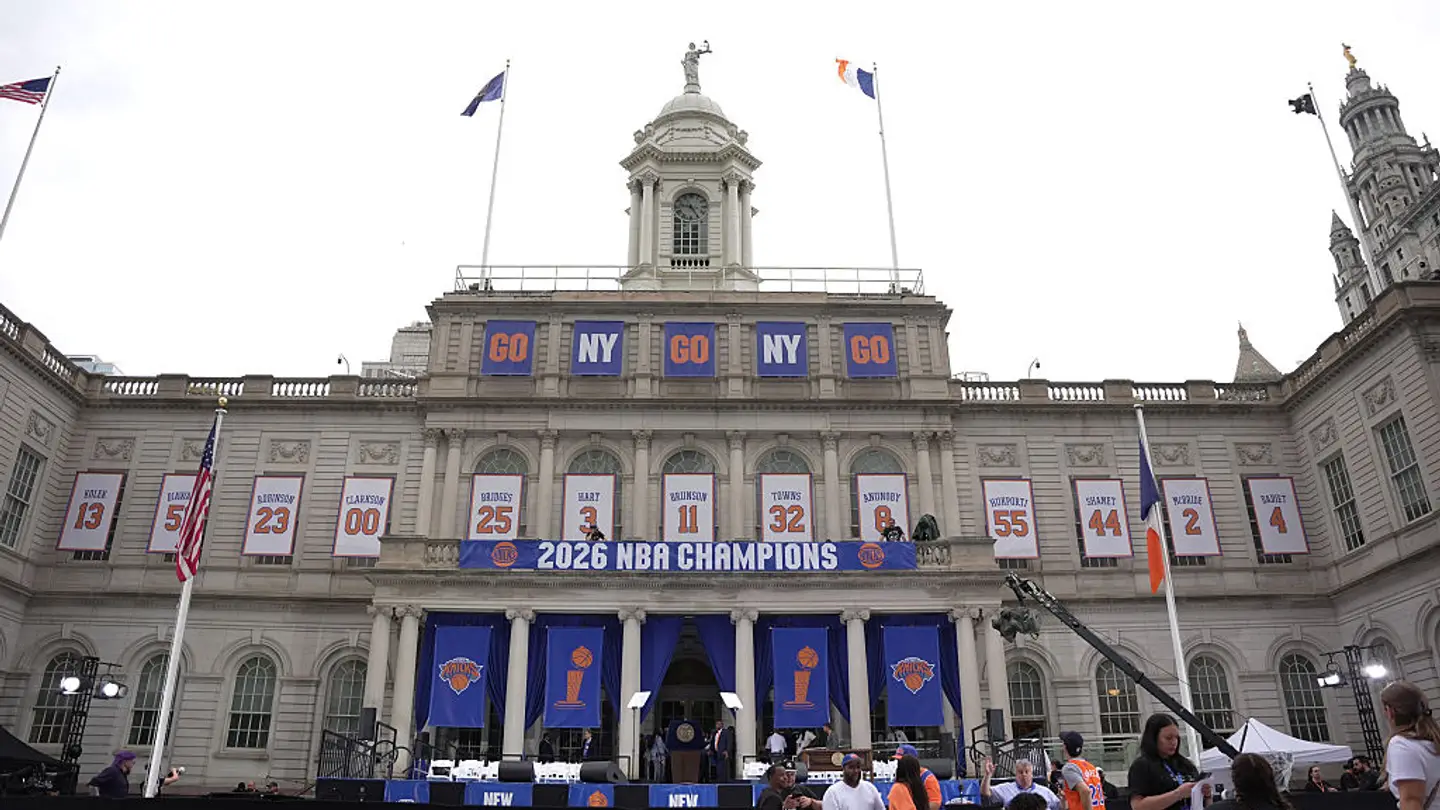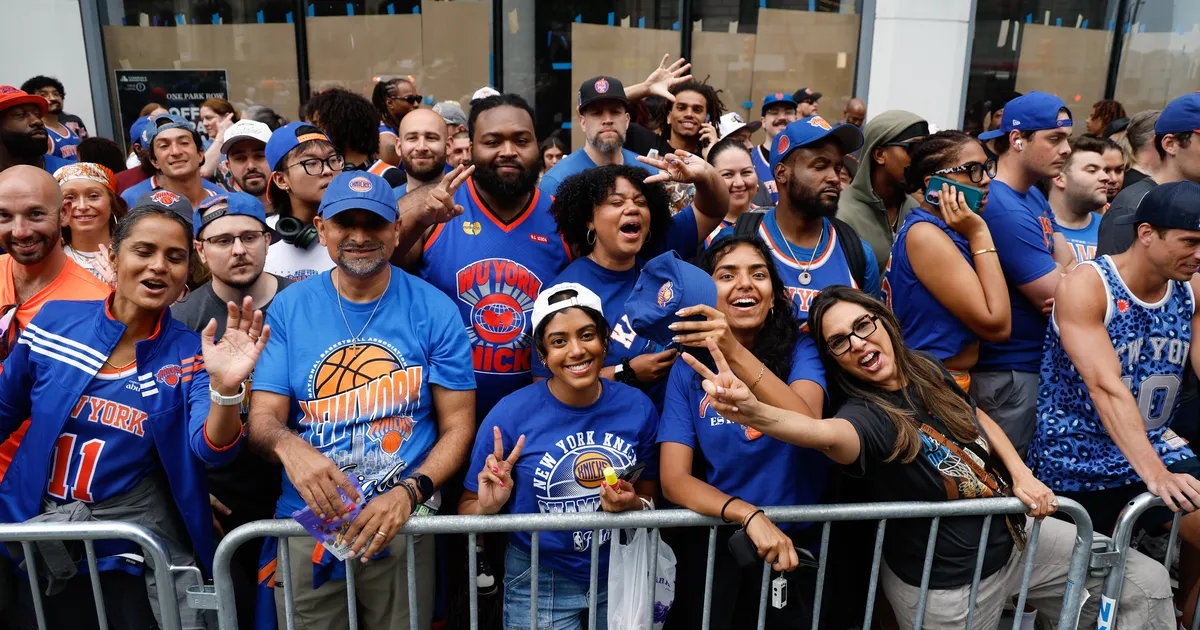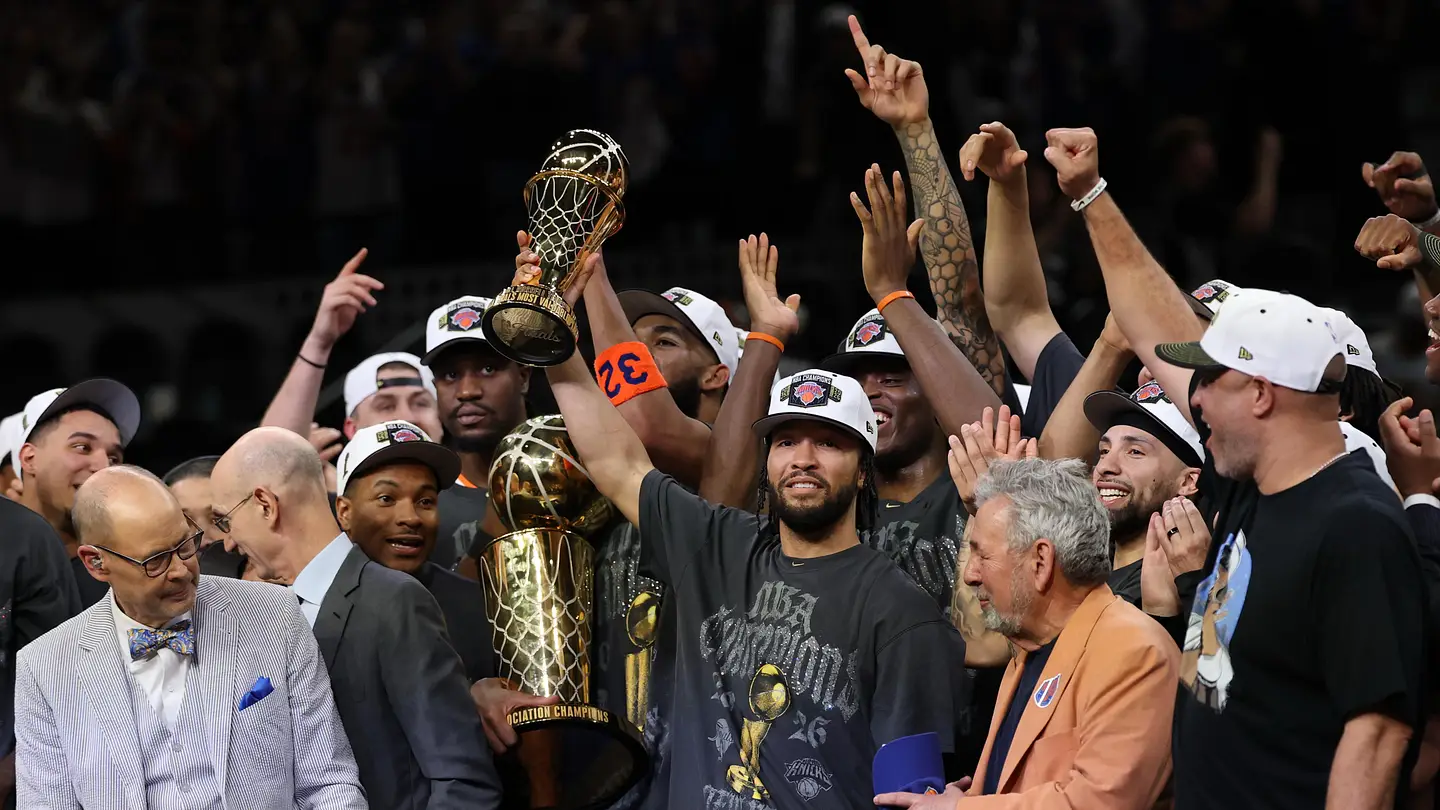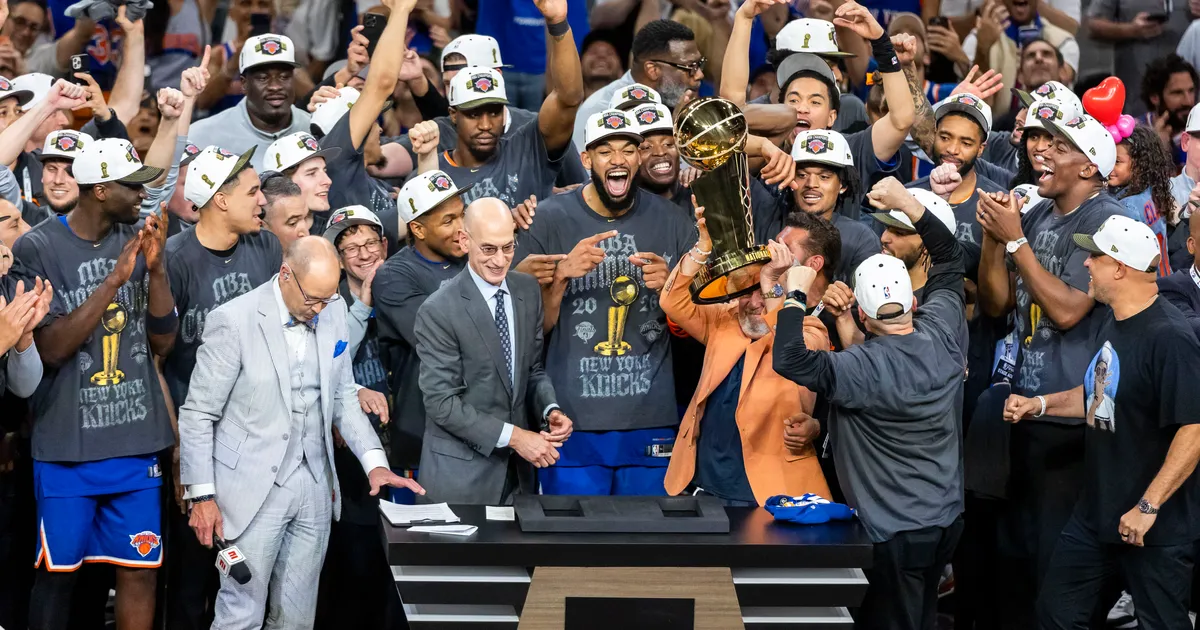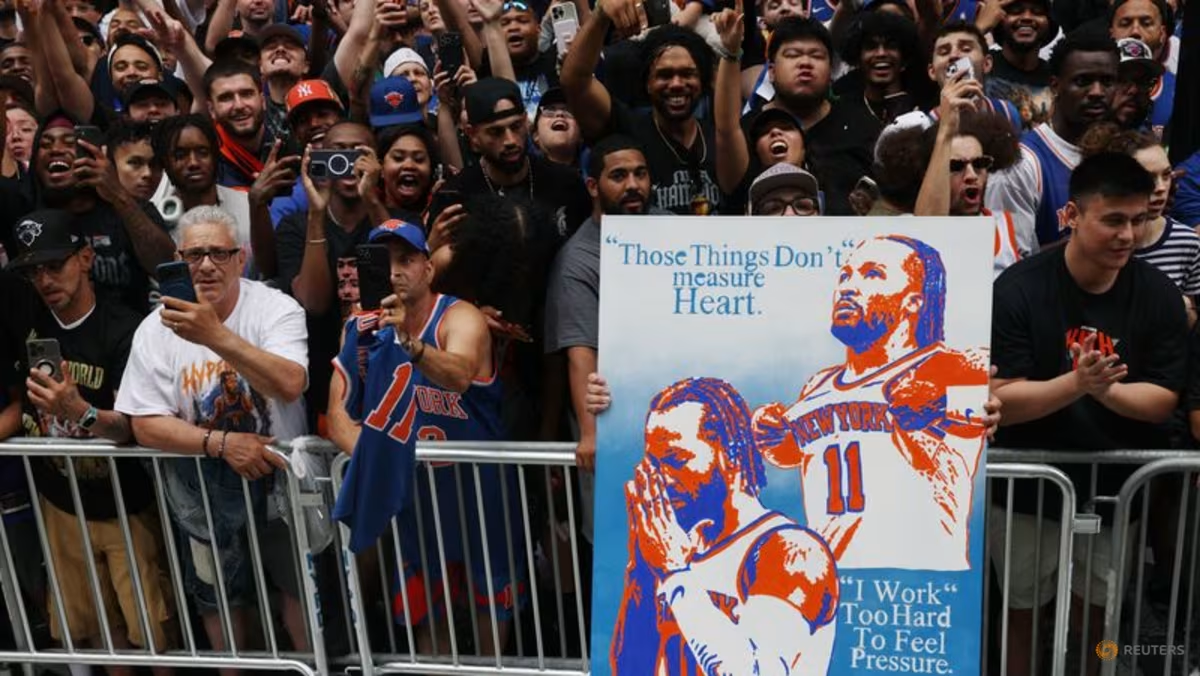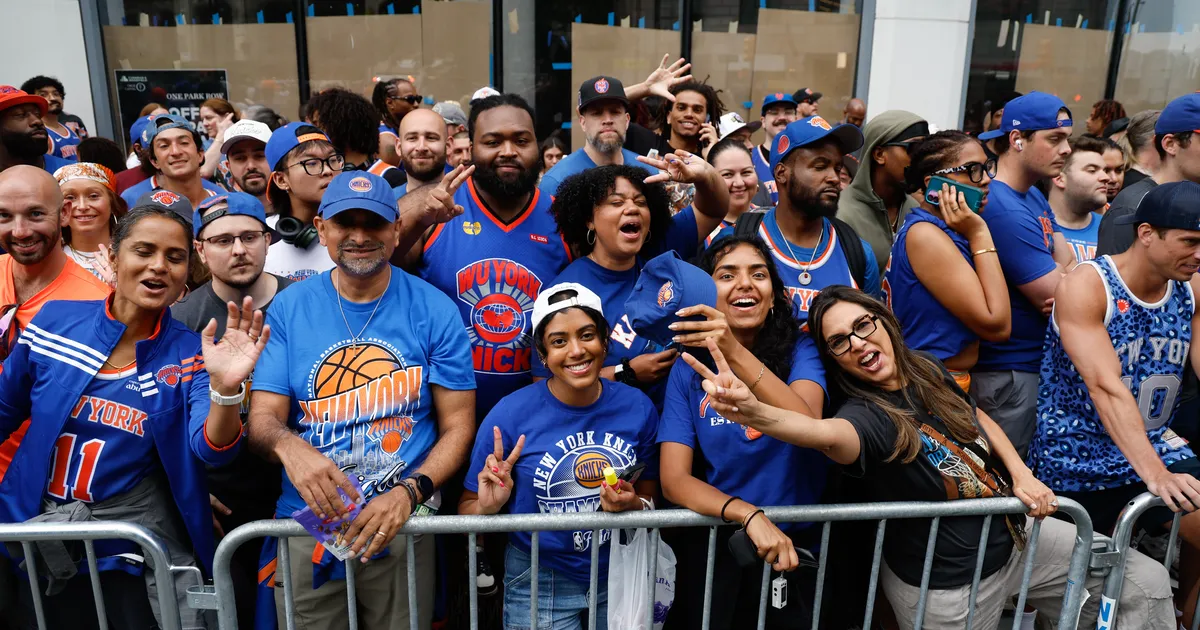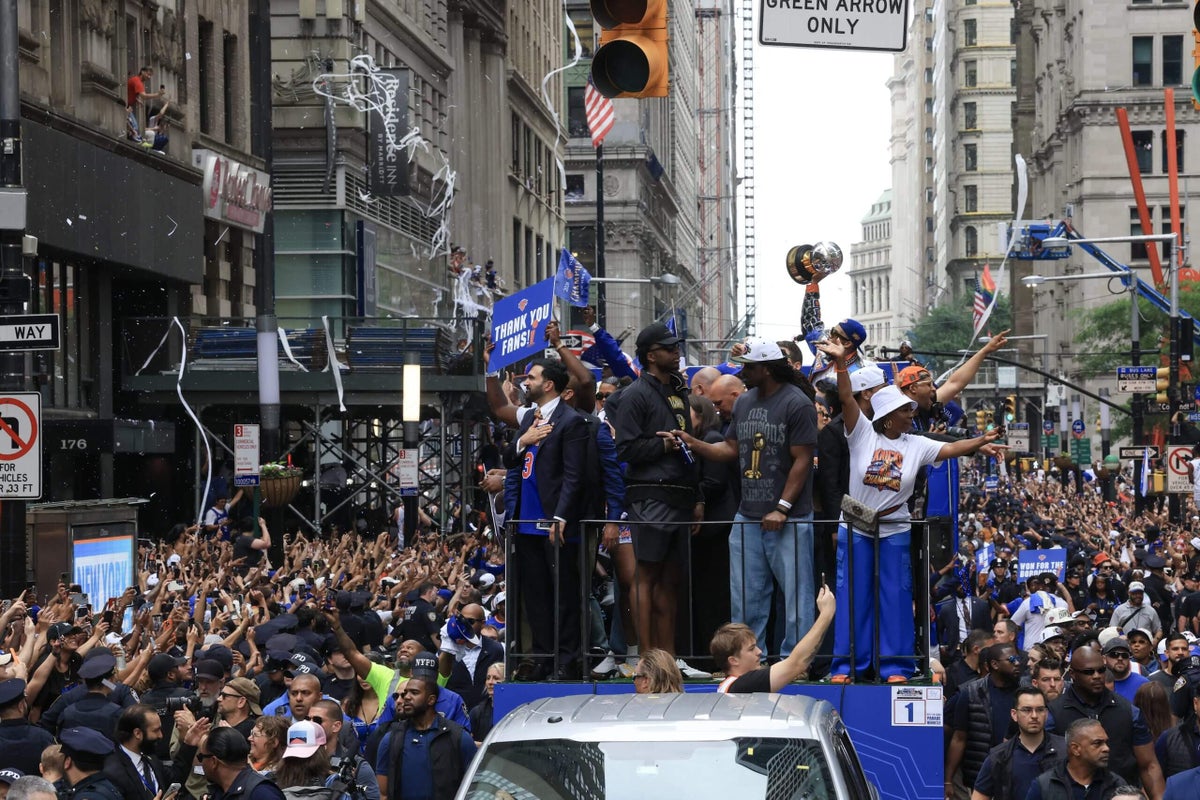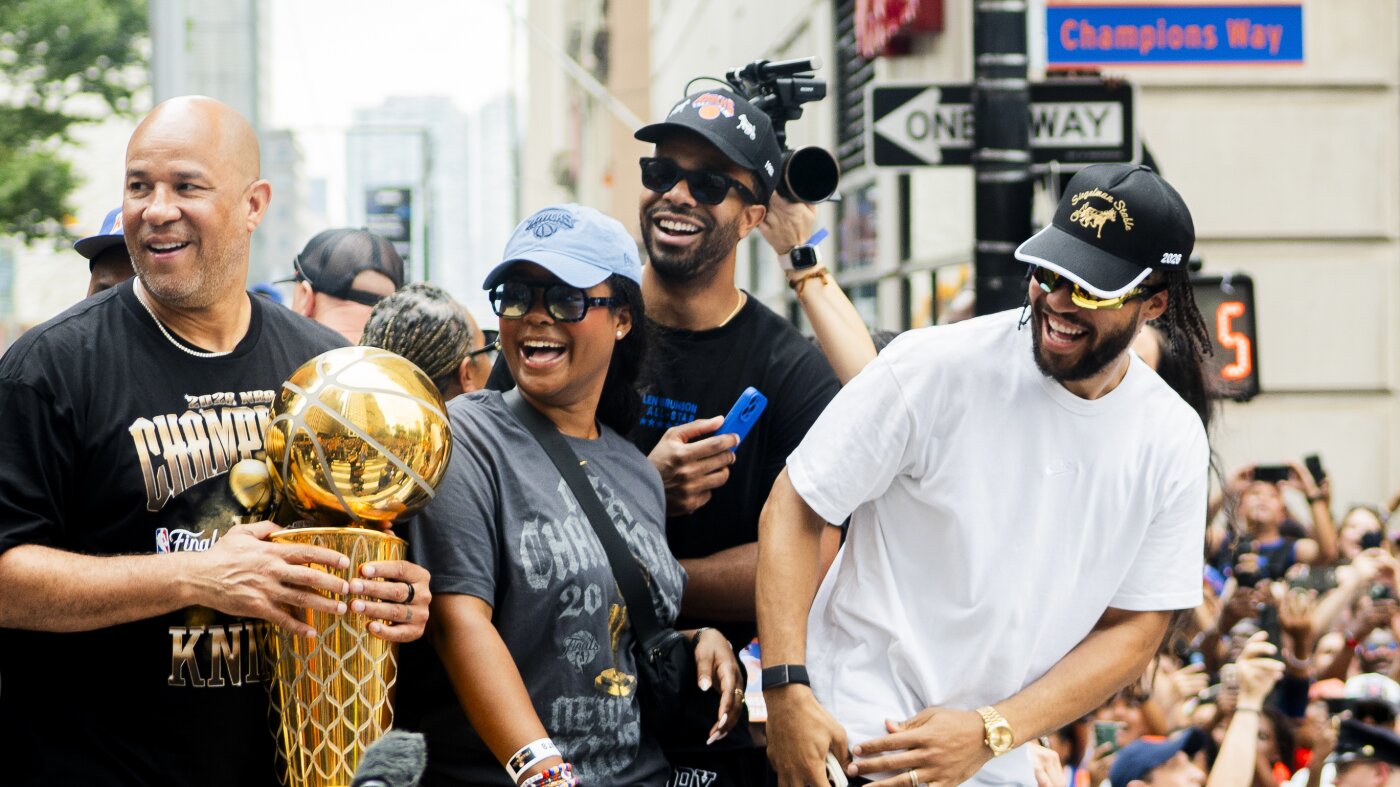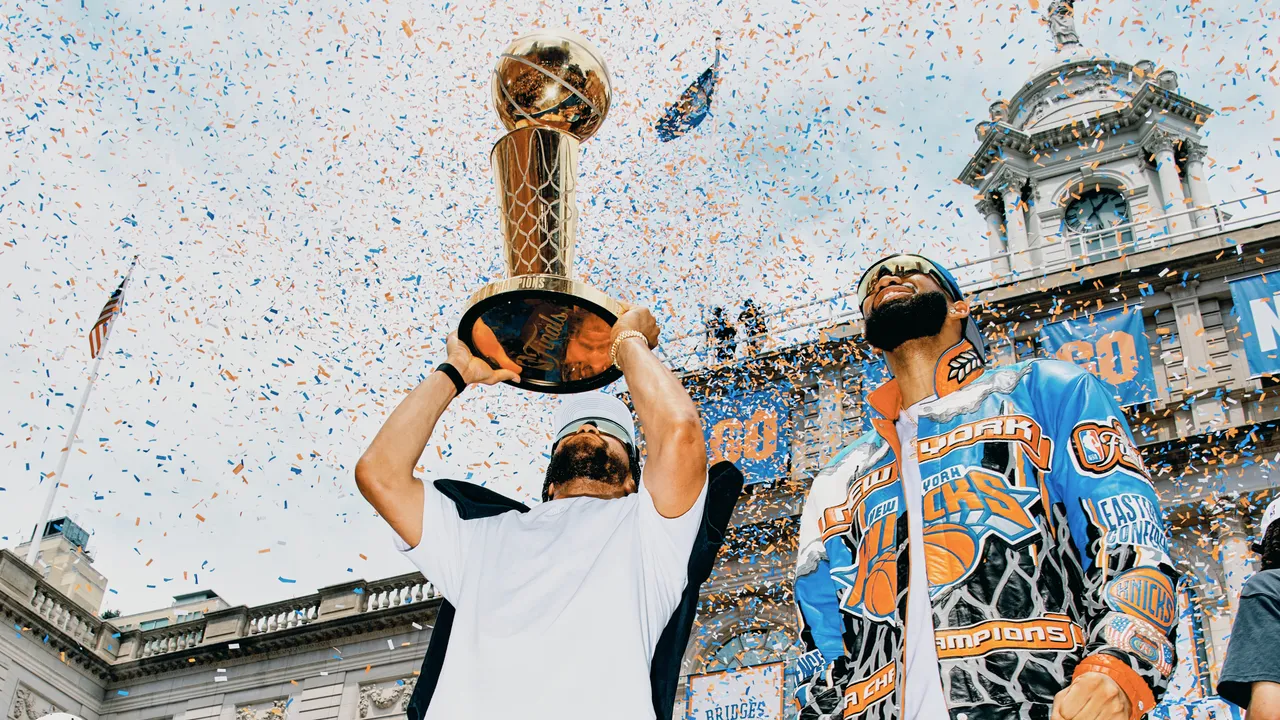
A joyous parade up the Canyon of Heroes proved a fitting celebration.June 18, 2026Photographs by Victor Llorente for The New YorkerBefore the sun had fully risen, the people were already coming. Around five-thirty in the morning, a man rode a commandeered CitiBike down a train platform in Bed-Stuy, Brooklyn, playing music from a speaker. Another guy was wearing a Knicks flag as a cape, two of its corners knotted at his throat. Everybody was waiting for the A—it was already full of bodies when it came. At almost all of the train’s stops, the doors would open and the new arrivals would start up a fresh cheer. The metal-and-white motif of the subway car was overtaken by blue and orange, and the conductor’s announcements were drowned out by chants.The Fulton Street station usually looks like the interior of a lightly used U.F.O.—sleek, cavernous, haunted by a mysterious connection between form and function. Now it was clogged with partiers. The ticker-tape parade through lower Manhattan, where Broadway takes on the misty nickname the Canyon of Heroes, wasn’t supposed to start until ten o’clock. But everybody knew that there’d be only so much space, and that others were coming, too. You had to find a spot and keep it.One of the many miracles of the New York Knicks’ championship run through the playoffs (a phrase whose novelty will never lose its sheen) was how it transformed space in the city. As the team entered the N.B.A. Finals on a hot streak for the ages—they’d swept two opponents in a row, and ended up winning the championship having lost only three games, by a total of six points—New York’s neighborhoods took on new guises, just by becoming so thrillingly full. In Fort Greene, for instance, a lively neighborhood nobody would think to call underpopulated, game days at the sports bar FancyFree, or the Mexican-Cuban restaurant Habana Outpost, made it so that you couldn’t see the white lines of the crosswalk in photographs or videos shared in Instagram. Friends of mine started showing up at sports bars just after noon to grab a spot at the bar for an eight-thirty tipoff. Intersections became improvised plazas, clotted with bodies. People, people, everywhere!A clichéd gripe about New York these days is that there are too many lines—for matcha, for pizza, for pastries, for tickets to sundry events. Tourists and transplants, influencers thirsting after “aura”: the blame for the obnoxiously crowded streetscape gets spread pretty thin. But this new fullness—a plenitude that’s spiritual as well as physical—didn’t feel like a reason to complain. It felt like an almost organic development in the life-narrative of the city, perhaps a contrapuntal response to the emptied-out streets New Yorkers still remember from the terrifying early days of the COVID-19 lockdowns. The city feels like it’s back in full swing, announcing its electricity by the simple act of showing up.So, yes, the streets near Fulton were dauntingly, densely packed. Cops stood near the hinges of endless yards of metal barricades, pushing the crowds through a maze of physical impediments. Mayor Zohran Mamdani had assigned more than ten thousand officers to the event, and all of them seemed busy keeping the masses at bay. The streets downtown are narrow, and many of the buildings very high, casting shadows as wide as avenues, making the sidewalks feel like dried-out waterways and the people walking them look small. Now it seemed as if the crowd, in all its collective strength, could have picked up one of those buildings and put it somewhere more convenient, the better to get a glimpse of the parade.At City Hall, where the parade would terminate, giving way to a celebratory ceremony, workers were busy putting finishing touches on the stage. Already there were banners hanging from the building, each designed to look like the back of a player’s jersey. Bridges, Hart, Brunson, Towns, Anunoby, on and on. These are names that will last forever in this town. The Canyon of Heroes thing is only corny if you think it isn’t true—but just watch. The mere mention of one of these players will keep calling up memories for people who have lived in this town over the crazed past two months of playoff magic.A piano tuner plunked at the instrument. (Alicia Keys was supposed to be playing “Empire State of Mind” at the ceremony.) The singer Avery Wilson did a test run of the national anthem—the guy always sounds good, and when he finished, a sweet ovation rang out. Corporations are in on the fun, too, these days, for good or ill. Across the street from the people’s house, a Citibank had placed signs in its windows. “GO NY GO,” they said, but NY didn’t need the spur. Office workers were planted at the windows of the Woolworth Building and of 250 Broadway, a dark structure that looks like a suit with subtle pinstripes, where several municipal agencies have their offices. I once worked there, for the New York City Housing Authority, which manages all of the city’s public housing.An unseen organ rambled through a rendition of Billy Joel’s “New York State of Mind.” A fleet of police on bikes, wearing reflective tape and bright-yellow jerseys, pedalled downtown, riding the parade path in reverse.Speaking of Billy Joel, there’s always a fun argument to be had about the best pop song about New York. “Empire State of Mind” has gathered a kind of hegemony that, I think, has more to do with its performers—Keys and Jay-Z—than with its quality. Most New Yorkers I know sort of sigh when it comes on. Milling about the plaza, I listened to one of my favorites, Don Henley’s “New York Minute.” It’s a melancholy song about how quickly fates can change:Harry got up dressed all in blackWent down to the station and he never came backThey found his clothing scattered somewhere down the trackAnd he won’t be down on Wall Street in the morningEverything in a life like this Harry’s, here in the “groaning city in the gathering dark,” can change, Henley croons, in a “New York minute.” That’s true on the nicer side of life, too. Suddenly the Knicks, who hadn’t won the big title in fifty-three years, can turn on some heretofore unseen mode of heroism, and—bang. A brand-new life for the game and for the city itself. Even as I thought this victorious thought, I could feel myself succumbing to Henley’s sadness. Every Knicks fan I know can name a handful of lost friends or family members or lovers whom they wish they could nudge away from the sleep of the grave for just a second, just to say, “They did it. It’s real!,” and say goodbye again.Once the floats started their passage from the southern tip of Manhattan up to City Hall, those lucky revellers who’d guaranteed themselves a spot put on their own show, one that rivalled the on-court exploits of the Knicks. People threw toilet-paper rolls and shredded office paper from windows. Kids climbed nimbly onto traffic signs. A group of friends watched from a fire escape. The great guard Walt Frazier, that god of style and symbol of bygone Knicks glory, rode past in a convertible waving gracefully, with a languid ease that made me think that he’d expected to live to see this day all along. Mamdani shared a float with Karl-Anthony Towns—the unlikely pair danced along to Fat Joe’s “Lean Back,” a song that is not about New York per se but manages by swagger and ubiquity to embody some of the city’s energy.Fat Joe himself was on another float, full of entertainers. So was Teyana Taylor, the singer and the deserving breakout star of Paul Thomas Anderson’s “One Battle After Another.” She swayed with the music in an almost calm way, absorbing the hectic rhythms of the crowd but not letting them speed her up. The point guard Jose Alvarado, shirtless and crazed by joy, zoomed by, passing 250 Broadway. Alvarado never fails to mention his roots in New York’s public housing, which NYCHA manages.Soon, the float carrying Jalen Brunson, the star guard whose stoicism and brilliance under pressure has made him a legend here, passed by. He was looking around in an almost impassive way, soaking up the scene, not lifting his hands or hogging attention. His dad, Rick Brunson, a former player who now works as a Knicks assistant coach, seemed markedly more excited, at least outwardly, to be there. Someone on the float was holding the Larry O’Brien trophy, that imagined possession of every basketball-obsessed boy. It belonged to us now, to the city. Everything can change in a New York minute!Soon the parading was done and the confetti was flattened to the ground, like a quickly made collage, or graffiti finely etched into the asphalt. Now the Knicks took the stage at City Hall. Each of them, along with their coaches, had earned a key to the city. Mamdani gave a florid speech, recalling great moments in the team’s history, plus past players who’d fallen short of the ultimate prize but had contributed to the momentum that had finally culminated in this great win. Carmelo Anthony was in the crowd, wearing a baseball cap whose logo split the difference between the Yankees and the Mets. Some of us are Pan-Africanists; Melo is a Pan-New Yorkist, a fitting identity for such a unifying time. Mamdani shouted Melo out, along with Jeremy Lin and Julius Randle and even, for the real diehards, the Puerto Rican forward Renaldo Balkman.Mamdani knows a ripe moment when one crosses his desk. This was probably the most visible of speeches since Election Day, and he acted like it. He recalled the glories of the Knicks like Pericles once praised Athens, or how Lincoln eulogized the dead at Gettysburg. It was a very dramatic speech for a very dramatic team. It was perfect for the occasion.The next speaker was James Dolan, the owner of the Knicks. You know, the guy who thought it’d be fun to have Donald Trump show up for Game Three, which turned out to be the Knicks’ only loss of the Finals. The billionaire made a little dig at democratic-socialist Mamdani, with whom he had exchanged snippy press releases about—what else—space for fans to congregate outside Madison Square Garden in the hours before Game Four. “I don’t need your vote,” he said outside City Hall. “I don’t need to quote to you, right, about what happened here, because if you’re real Knick fans you know it already.” It was a silly moment that didn’t change the mood in the seats at all. Most of the people at the ceremony had won a lottery to be there, and they also knew Dolan like the backs of their hands. When the owner—no one can own a phenomenon like these Knicks, everybody knows this—left the podium, everybody clapped politely but quietly, as one does at a golf tournament.A shining day in the city—an invincible mood! When Mamdani gave out the keys, you could barely hear the names of the players he was handing them to. The whole morning and afternoon had the sound of a shout. ♦A scientist with a Ph.D. from Harvard fatally shot three of her colleagues. Then revelations about her family history came to light.
The Knicks’ Championship Win Transforms the City
A joyous parade up the Canyon of Heroes proved a fitting celebration.
1,880 words~9 min read