Authors identify ways to improve innovation outcomes after interviews with AI Deciders
May 28, 2026
After analyzing interviews with AI Deciders at a variety of companies, CMU researchers are sharing ways to improve AI innovation outcomes.
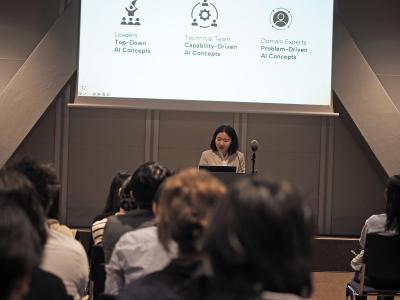
The Breakdown AI innovation projects are failing at an unsustainable rate of up to 95%.“AI deciders” often rush to choose a solution without exploring other concepts. Authors share 3 takeaways for innovators looking to maximize AI benefits and minimize AI harms for their organization.*** With everyone talking about artificial intelligence (AI) these days, companies are throwing AI at their innovation problems, hoping it will solve everything.Driven by the fear of falling behind their competitors, organizations are ignoring best practices for selecting new initiatives. A new mindset to hurry up and “AI this problem” has emerged, and it’s not going well.Research shows that throwing AI (and therefore money) at a business problem is not a panacea for most solutions. In fact, up to 95% of AI projects fail – a number that is neither cost-effective nor sustainable. At a downward trajectory like this, some fear the AI boom could become an AI bubble, bursting in the near future.So, in order to learn more about why so many AI projects are failing, Carnegie Mellon University (CMU) authors are taking a step back to explore the decision-making that takes place before the investment in AI.The majority of CEOs currently claim that AI innovation is a top priority, but less is known about the people who choose, approve, and guide companies’ AI initiatives. This empirical study with 25 interviews investigates how those people – called “AI Deciders” in the paper – reason about AI benefits and risks.The authors found similar, avoidable process gaps across a variety of organizations.“We found that organizations often commit to a single idea too early in the process,” said Shixian Xie, Ph.D. student at the CMU Human-Computer Interaction Institute and lead author on the paper. “When teams move too quickly into implementation, they may overlook other AI opportunities that could deliver stronger outcomes with fewer risks.”“We want to share these findings with people in industry who may be struggling to find value with AI. They may not realize that this is happening to everyone,” said John Zimmerman, co-author on the paper and Tang Family Professor of Artificial Intelligence and Human-Computer Interaction. “We want to help them understand that there are better ways to create value with AI.”