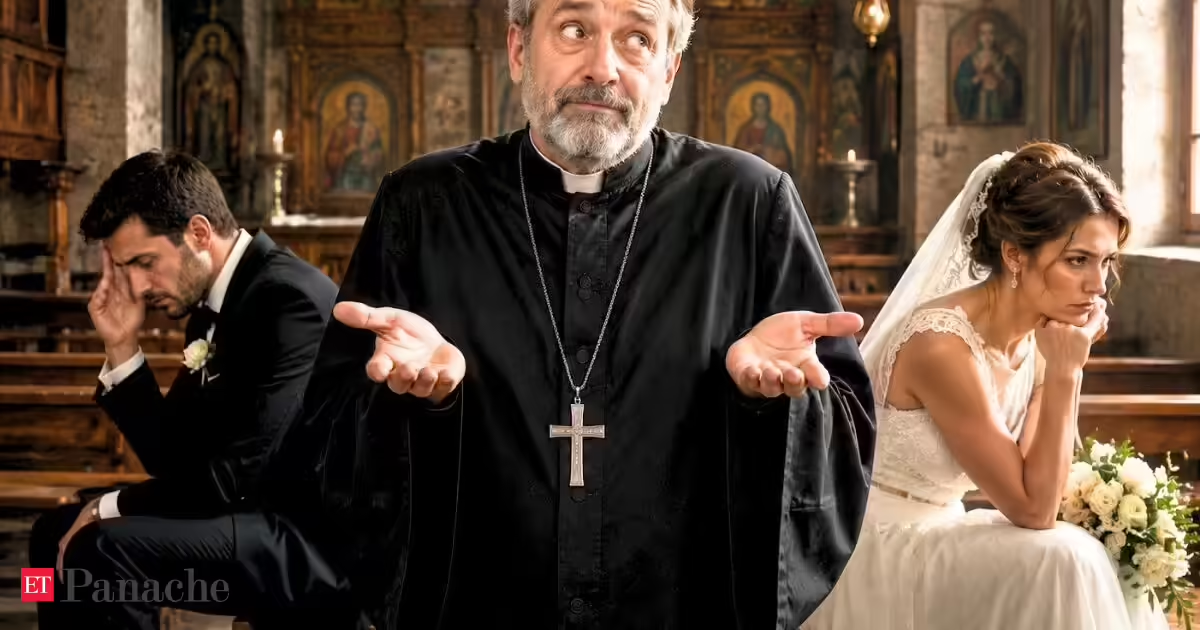
Proverbs often carry a mix of wisdom, humor, and social commentary. Some offer straightforward advice, while others use irony to make people think. One such saying from Bulgaria is: “If marriage were a good thing, the priests would have married long ago.” Though brief, the proverb has survived for generations because of the conversation it sparks about marriage, commitment, and human nature.Rather than praising marriage as an ideal institution, the saying approaches the subject with skepticism. It reflects a long tradition in folk culture where people used humor to discuss serious life decisions. Like many proverbs passed down through generations, it is less about giving a fixed answer and more about encouraging people to think carefully about the realities behind widely accepted beliefs.What does the proverb mean?At first glance, the proverb sounds like a criticism of marriage. The statement suggests that if marriage were truly perfect or entirely beneficial, religious leaders would have been among the first to embrace it. Since some members of the clergy traditionally remain unmarried, the saying jokingly hints that they may know something ordinary people do not.The proverb is not necessarily an attack on marriage itself. Instead, it highlights the challenges, responsibilities, and compromises that come with married life. It reminds people that marriage is not always the idealized version often presented in stories, celebrations, or social expectations. Behind every successful marriage lies effort, patience, and understanding, and the proverb uses humor to draw attention to that reality.A saying rooted in Bulgarian folkloreThe quote is widely recognized as a Bulgarian proverb. While it has sometimes been wrongly linked to other sources, including French playwrights or Roman Catholic traditions, its roots are generally associated with Bulgarian folk wisdom.In Bulgaria, the dominant religion has long been Eastern Orthodox Christianity. This background is important because the Orthodox Church follows different traditions from the Roman Catholic Church. Parish priests in the Orthodox Church are allowed to marry, provided they do so before ordination. However, bishops, monks, and other senior members of the church hierarchy are expected to remain celibate.Because the highest-ranking religious figures traditionally did not marry, ordinary people developed humorous observations around that fact. Over time, this proverb emerged as a witty comment on married life. The joke, in essence, was simple: if marriage were a flawless and entirely rewarding state, surely even those senior religious leaders would have chosen it.Why the proverb still feels relevantEven though the saying comes from a different era, it continues to resonate because discussions about marriage remain as common as ever. Around the world, people still debate whether marriage brings happiness, stability, responsibility, or sometimes stress. The proverb captures these debates in a single sentence.What makes the saying memorable is its use of humor. Instead of directly listing the difficulties of marriage, it uses a playful comparison. The result is a proverb that can make people laugh while also encouraging reflection. That combination is one reason many traditional sayings survive long after the societies that created them have changed.The proverb also reflects a broader pattern found in folklore across many cultures. Traditional communities often used jokes and clever observations to discuss subjects that affected everyone, including family life, relationships, work, and social expectations. Marriage, being one of the most significant life decisions, naturally became a frequent topic.Understanding BulgariaStudying proverbs often reveals much more than the literal meaning of the words. These sayings provide a glimpse into the experiences, values, and attitudes of the people who created them. Bulgarian proverbs, in particular, are known for combining practical wisdom with sharp humor.Bulgaria itself has a long and rich history. Located in southeastern Europe on the eastern part of the Balkan Peninsula, it is one of the oldest states on the continent. Founded in 681 AD, the country has maintained its identity through centuries of political and cultural change.The nation is known for its diverse landscape, which includes rugged mountain ranges, fertile plains, and a coastline along the Black Sea. Its capital city, Sofia, serves as the country's political and cultural center, while cities such as Plovdiv, Varna, and Burgas hold important historical and economic significance.Bulgaria also occupies a special place in European cultural history as the birthplace of the Cyrillic alphabet. Over the centuries, influences from Thracian, Roman, Byzantine, Ottoman, and Slavic traditions have shaped the country's culture. This blending of influences can be seen in its architecture, cuisine, religious traditions, and folklore.One reason proverbs continue to attract attention is their ability to express complex ideas in very few words. Whether people agree with them or not, they often reveal truths, fears, hopes, or experiences shared by generations.
Bulgarian proverb of the day: 'If marriage were a good thing, the priests would have married long ago...' A centuries old saying on why love alone is not enough to sustain a happy marriage
The Bulgarian proverb, “If marriage were a good thing, the priests would have married long ago,” uses humor and irony to comment on the realities of married life. Rooted in Bulgarian folklore, the saying reflects a skeptical yet light-hearted view of marriage, suggesting that every major life commitment comes with challenges. The proverb also offers insight into Bulgarias cultural traditions and the role of folk wisdom in shaping everyday perspectives.
764 words~3 min read