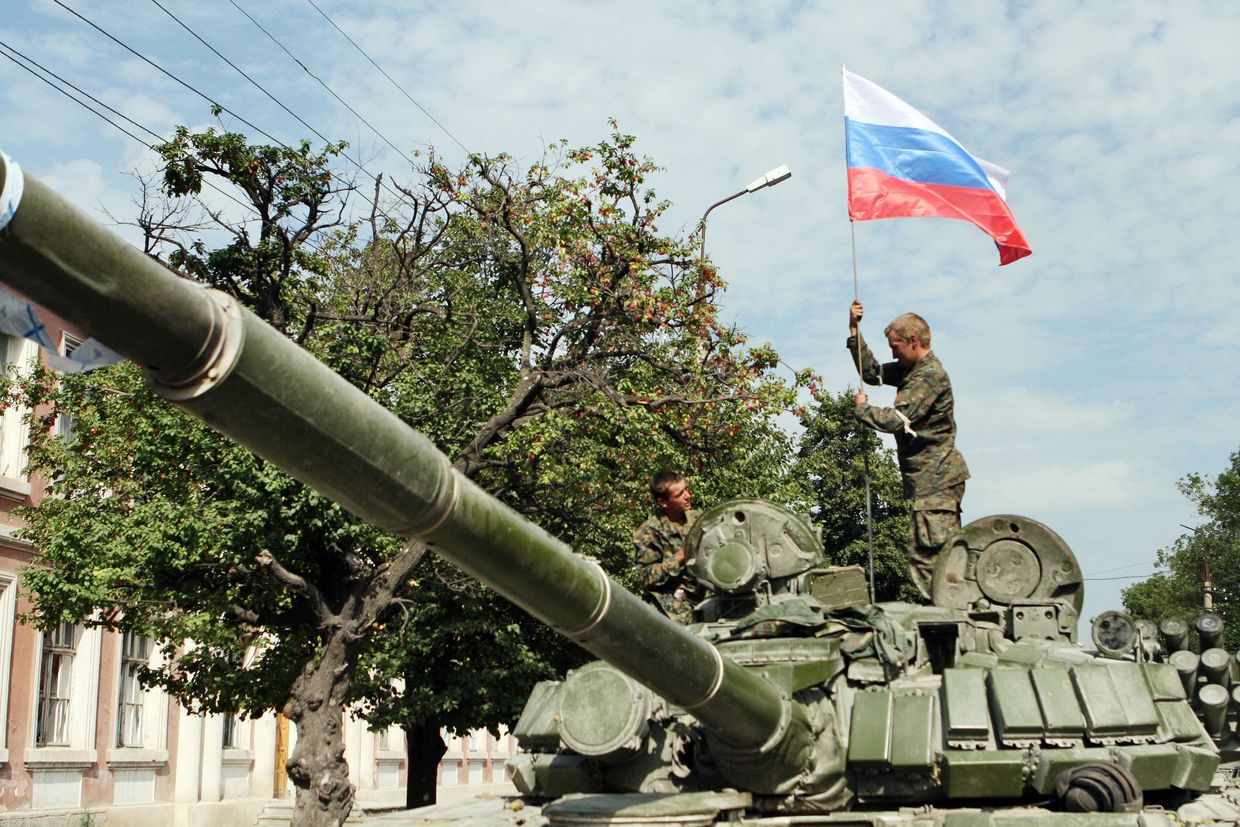
Russian soldiers place a Russian flag atop their tank in Tskhinvali, Georgia on Aug. 11, 2008. (Andrei Smirnov / AFP via Getty Images)Russia's new law authorizing the use of military force abroad to "protect Russian citizens" allows the Kremlin to deploy troops beyond Russia's borders if Russian citizens are deemed to face arrest, detention, trial, or other forms of perceived persecution by foreign states or international courts.Many will read this primarily as a possible legal basis for future intervention. Yet there's one more application we should all be aware of.Russia has previously justified military action beyond its borders through claims of protecting people in South Ossetia (Samachablo) and Abkhazia (Aphkhazeti), including holders of Russian passports, during the 2008 war in Georgia. Similar arguments concerning the protection of Russian citizens, passport holders, and Russian-speaking populations have also appeared in Russia's justification for actions in Ukraine.Yet Russian strategies are rarely one-dimensional. Their effects must be read across countries, narratives, security structures, and political developments that reinforce one another over time.This matters also because Western policy toward Russia has long rested on a difficult balance.NATO itself describes its approach as strengthening deterrence and defense while remaining open to dialogue, and former NATO Secretary General Jens Stoltenberg has called this "a dual-track approach — deterrence and defense, and dialogue."The new Russian legislation puts pressure on that balance.Its significance lies not only in what Russia may do militarily, but in how the language of protection can be used politically: by Russia, by governments operating under Russian influence, and by actors who want to portray criticism of Russian power as dangerous, destabilizing, or unnecessarily escalatory.Russian multiple rocket launchers "Uragan" pass a banner featuring a portrait of then-Russian Prime Minister Vladimir Putin in Tskhinvali, Russia-occupied South Ossetia, Georgia, on Aug. 25, 2008. (Dmitry Kostyukov / AFP via Getty Images)"Russophobia" becomes a security issueThe same week that Putin's new law was announced, Georgian authorities moved to create a new special division within the Interior Ministry to systematically monitor "hate speech, offensive campaigns, and aggressive communication in public spaces," including posts, photos, captions, and videos on social media.Officials also described the division as responsible for an "appropriate legal response."At the same time, pro-Russian NGOs in Georgia launched a "Council for Monitoring Russophobia," aimed at identifying and analyzing what they describe as anti-Russian rhetoric, discrimination, and hate speech in public space.According to OC Media, the council said it would pay particular attention to statements made after Russia's full-scale invasion of Ukraine in February 2022.The practical consequences remain unclear, but the direction is not difficult to read.
How 'Russophobia' becomes a tool against political resistance
Russia's new law authorizing the use of military force abroad to "protect Russian citizens" allows the Kremlin to deploy troops beyond Russia's borders if Russian citizens are deemed to face arrest, detention, trial, or other forms of perceived persecution by foreign states or international courts. Many will read this primarily as a possible legal basis for future intervention. Yet there's one more application we should all be aware of. Russia has previously justified military action beyond it
1,161 words~5 min read