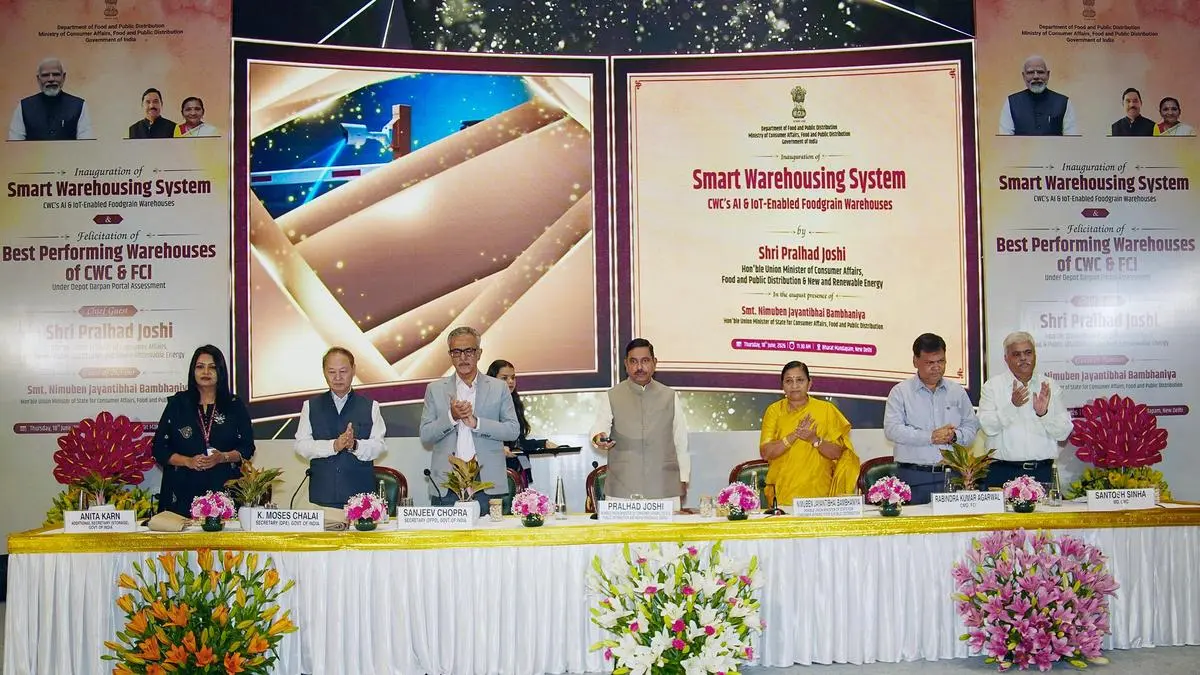
Union Minister for Consumer Affairs, Food & Public Distribution and New & Renewable Energy, Pralhad Joshi, inaugurated the Smart Warehousing System at Bharat Mandapam in New Delhi on Thursday. Minister of State for Consumer Affairs, Food and Public Distribution, Nimuben Jayantibhai Bambhaniya, is also seen
| Photo Credit:
Union Food Minister Pralhad Joshi on Thursday launched a smart warehousing system to monitor inventory and operations on a real-time basis in 216 grain storage warehouses of the public sector Central Warehousing Corporation (CWC) by using modern technologies, including Artificial Intelligence (AI).Launching the completion of the drive in all 216 warehouses, Joshi said: “It is our responsibility to keep the foodgrains safe and secure.” He hoped that the use of modern technologies would help strengthen the Public Distribution System (PDS). He termed smart warehousing as a food security initiative apart from a technology infusion.Food grains meant for distribution through the Public Distribution System (PDS) are stored in warehouses owned/hired by CWC and the Food Corporation of India (FCI). The smart warehousing system is being introduced to ensure transparency and check any foodgrains diversion for other than PDS, officials said.“Under a smart warehousing system, 216 CWC warehouses are equipped with a surveillance system to ensure foodgrains are stored in a scientific manner, not susceptible to proliferation,” said Sanjeev Chopra, Union Food Secretary. He also said that FCI would implement it in 150 of its warehouses by October.Under the smart warehousing system, CWC is deploying advanced AI and IoT-driven technologies in foodgrain and general warehouses, the food ministry said in a statement. It is also using FASTag and ANPR-based gate automation integration with VAHAN-SARATHI databases, a smart locking system for controlled godown access, AI-based bag counting, face recognition-enabled authorised quality inspections, IoT gas sensors for carbon dioxide and Phosphine monitoring, and AI surveillance for fire, smoke and rodent detection.These are integrated with the Enterprise Resource Planning (ERP) system, generating automated records, real-time alerts and multi-level operational dashboards.These interventions reduce manual dependence at critical points, such as gates, weighbridges and godowns, while creating cleaner records, faster movement, stronger controls and better monitoring from the warehouse level to the ministry.Later, speaking to the media on the sidelines, Joshi indicated that since there is a scope for issuing nearly 3 crore fresh ration cards to eligible beneficiaries after 2.21 crore ineligible holders were delisted from PDS, the Centre could consider adding more. He also clarified that the deletions were carried out by State governments following their own criteria. The Centre is providing, free of cost, 5 kg of rice/wheat per month to each of the 79 crore beneficiaries under the National Food Security Act.Published on June 18, 2026