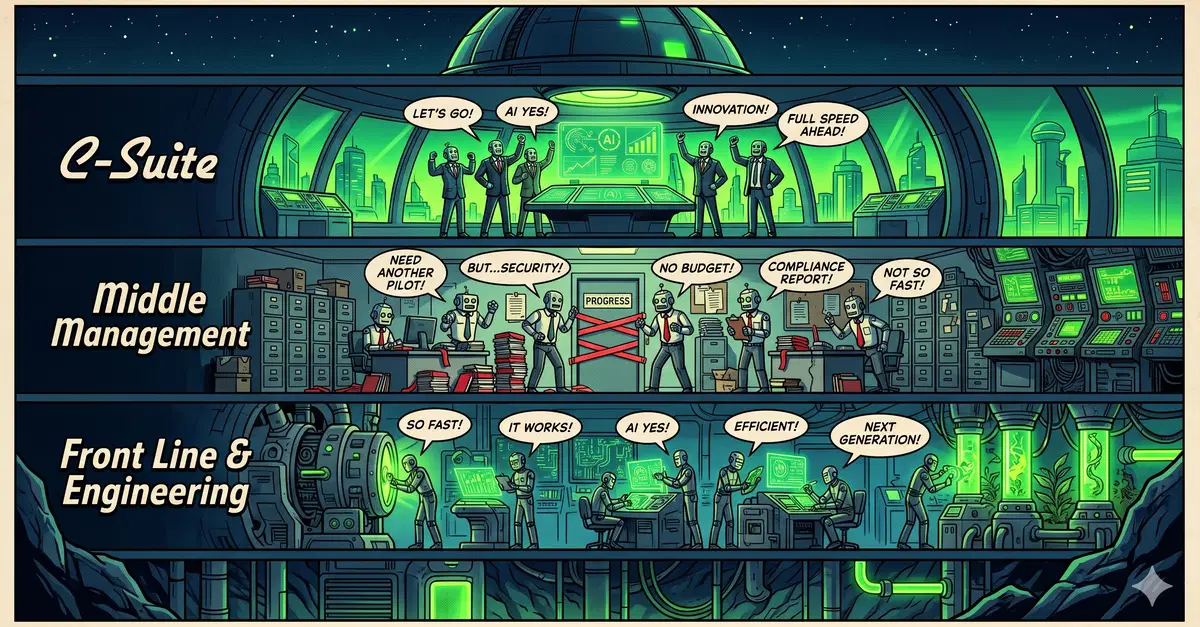
Andrew Antos is CEO & co-founder of Klarity, an AI startup that’s transforming organizations’ operations systems at scale.gettyThe best software teams realize 182 times more deployments per year and have eight times fewer failures. That finding from DORA research, across 39,000 engineers, came down to one thing: using a different operating model. With continuous integration and continuous deployment (CI/CD) streamlining the software development cycle, teams stopped shipping on fixed cycles and started shipping continuously. Tighter feedback loops surfaced problems before they compounded. Speed and quality moved together.AI is doing a similar thing for every function that CI/CD did for software. The teams pulling ahead have restructured how they operate around what AI has made possible. Andy Grove, former CEO of Intel, notably referred to this kind of thinking as "high output management." The version built for the age of AI is what I call high-frequency management, and the biggest gap most organizations have right now is in their management cadence.AI has commoditized execution. Research that took two weeks may now take two hours. Modeling that required a specialist working for a month can now take an afternoon. First drafts, audits, competitive scans—the work that filled most of the calendar is now table stakes for any team with access to the right tools. The constraint on organizational progress has shifted from how fast your team can produce analytical work to how fast you can review it, redirect and make decisions.Most organizations haven’t caught up to that reality. Their teams are producing in hours and waiting days for a review that was scheduled two weeks ago. That’s the gap, and closing it requires a fundamentally different operating model where no decision waits more than 24 hours.Three Principles For Running At AI SpeedThe bottleneck has shifted from how fast work gets done to how fast leaders can review it, make decisions and set the next direction. High frequency management is built around that reality, and I've found that three principles drive it:1. No cycle is longer than 24 hours. Meet daily, not just for status updates, but for direction. Every question gets an answer by tomorrow. Every analysis gets reviewed and redirected within a day. Alan Mulally ran Ford through its near-collapse with a version of this principle: senior leaders have exactly two jobs: execute the plan of record and make that plan better every day. If your team is producing work in minutes and hours, your review cycle needs to match it.2. Check in at 20% and 80%. This is the first and last mile of enterprise AI. At 20% completion, review direction. Is the framing right? Are we solving the actual problem? This is where course corrections cost almost nothing. From there, AI handles the analytical middle: the research, modeling and synthesis. At 80%, leaders are back in the loop to apply the judgment and institutional context that no model has—the read on how something will land, and the experience that separates a technically correct answer from the right one. Build these two checkpoints into every work cycle, and you'll catch nearly every misalignment before it becomes expensive.3. Give feedback in public. Run your daily reviews in front of the team. When everyone hears the same direction and absorbs the same reasoning, you eliminate the telephone game that quietly kills organizational alignment. Judgment is hard to document and even harder to train, but when leaders make their decisions visible, teams develop the same instincts over time. Every correction becomes a teaching moment. This is how judgment scales across an organization instead of staying locked in one person's head.The Gap Most Leaders MissMost organizations think they're further along than they are. AI-fluent teams use AI as a productivity layer. Work moves faster, but the operating model is unchanged: weekly syncs, monthly reviews and the same approval chains. These teams get more done, but they're running the same race at a higher speed.AI-native teams have restructured around AI’s possibilities. Cycle times collapse to 24 hours. Human judgment concentrates at the edges: direction-setting at the start and finishing touches at the end. Feedback happens live. The quality gate shifts from "Did the manager review the deliverable?" to "Did the team align on the decision and why?" Every function (finance, sales, operations, product, etc.) starts running the way software engineering's best teams run today.In a world where execution has become fast and cheap, the bottleneck is decision quality and decision speed. A manager’s output becomes the speed and quality of their decisions, multiplied by their team's ability to wield AI.Start with cadence. Run the 20/80 checkpoints. Give feedback where everyone can learn from it. In this way, you can build the conditions that let AI compound across your organization. I've seen teams make more progress in three days than in the previous three months by following this approach. That's what happens when your management cadence finally matches your execution speed.Strategy is the sum of decisions you make and execute over time. With AI making your organization faster at the execution part, you need to match the cadence and raise the frequency.Forbes Technology Council is an invitation-only community for world-class CIOs, CTOs and technology executives. Do I qualify?
Your Management Cadence Didn't Get The AI Memo
In a world where execution has become fast and cheap, the bottleneck is decision quality and decision speed.
862 words~4 min read