For more than a century, physics has been built on two great theories. Einstein’s general relativity explains gravity as the bending of space and time.
Quantum mechanics governs the world of particles and fields. Both work brilliantly in their own domains. But put them together and contradictions appear – especially when it comes to black holes, dark matter, dark energy and the origins of the cosmos.
My colleagues and I have been exploring a new way to bridge that divide. The idea is to treat information – not matter, not energy, not even spacetime itself – as the most fundamental ingredient of reality. We call this framework the quantum memory matrix (QMM).
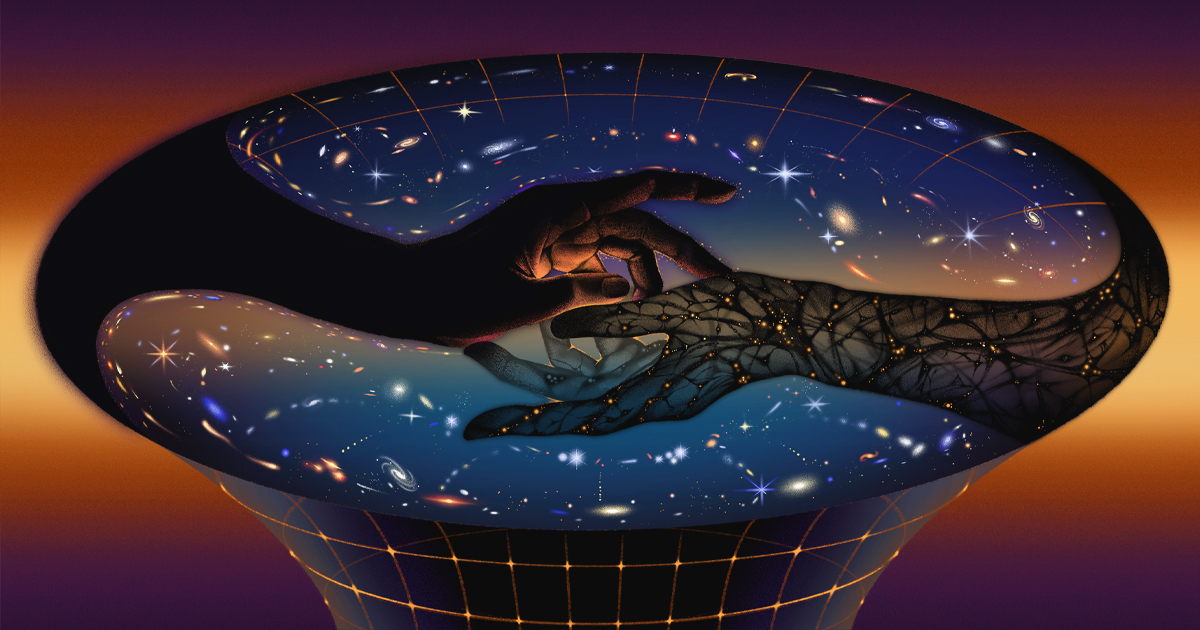
At its core is a simple but powerful claim: spacetime is not smooth, but discrete – made of tiny “cells”, which is what quantum mechanics suggests. Each cell can store a quantum imprint of every interaction, like the passage of a particle or even the influence of a force such as electromagnetism or nuclear interactions, that passes through. Each event leaves behind a tiny change in the local quantum state of the spacetime cell.
In other words, the universe does not just evolve. It remembers.