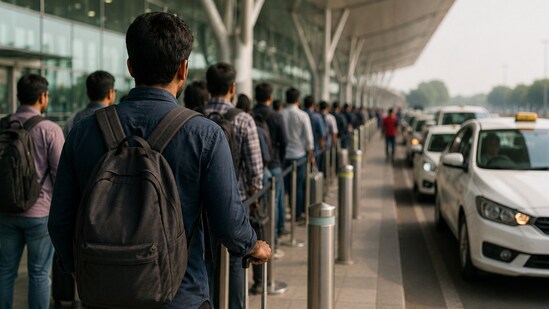
A LinkedIn post comparing Uber and Ola at Bengaluru airport has sparked a wider conversation online about why people often choose familiarity over cheaper alternatives. The post argues that the real cost for users is not just money, but the discomfort of uncertainty.The post led to a mix of agreement and disagreement. (Representational Image)Shared by Akash Kotalwar, the post describes a recent experience at Terminal 2, where Uber had long queues while Ola cabs were readily available nearby. Yet, many passengers still chose to wait for Uber or switched to a higher-priced option instead of moving to Ola.Why people choose certainty over cheaper optionsIn the caption, Kotalwar wrote, “I landed at Bangalore Terminal 2 last week. Uber Go had a 30 minute wait. There were 30 to 40 people in line. Right next to it, the Ola counter had cabs ready and rides available. I cancelled Uber Go and booked Uber Comfort. I paid more, but still chose Uber. Nobody from the Uber line moved to Ola, not even one person.”He added that this pattern repeats across services and platforms. “People choose Blinkit over Zepto even when Zepto is cheaper. People order Zomato over Swiggy even when Swiggy has a better offer running. People wait for Uber even when Ola is standing right there.”(Also Read: Tech founder hated working 8 hours in office: ‘I’m happy sitting in my village’)According to him, this is not about loyalty but about avoiding uncertainty after a tiring journey. He explained, “At an airport after a long journey, switching apps feels like a gamble. You know exactly what Uber gives you. Driver tracking, upfront fare, consistent experience. Ola might be the same, but might is doing a lot of work when you're tired and just want to get home.”He concluded that customers often pay more for predictability rather than the product itself. “The premium is not for the product. It is for the feeling of knowing what happens next.”Take a look:How the internet reactedThe post led to a mix of agreement and disagreement in the comments section. One user wrote, “It should be your personal experience. You cannot generalise it for everyone.”Another questioned the assumption behind the argument, asking, “Does the Indian customer really think about the cost of switching when they are just waiting to leave the airport?”Some users disagreed with the conclusion entirely, saying price remains the biggest deciding factor for most people. “For them, the brand that offers the cheapest option is the choice. They do not care what brand it is,” one comment read.(Also Read: ' ₹5,000 rent, ₹300 electricity bill': Couple shares cost of working remotely from Manali)Others pointed out that experience plays a bigger role than assumed. One user said, “It is not just the cost of switching. It is also the experience the brand has given over the years. Uber has had more customer centric systems, while Ola did not in its early days.”
‘People pay more to avoid uncertainty’: LinkedIn post on Uber vs Ola sparks debate online
A LinkedIn post comparing Uber and Ola claims users choose certainty over savings in stressful travel moments. | Trending
486 words~2 min read