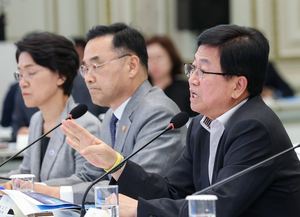
Education Minister Choi Kyo-jin speaks during a meeting on fostering regional universities in partnership with local industries at the Government Complex Sejong on Wednesday. (Yonhap) An old joke in Korea says colleges will close in the order the cherry blossoms bloom, starting with those farthest from Seoul.For more than a decade, the saying has illustrated the growing anxiety over South Korea’s shrinking college-age population and the widening gap between universities in the capital region and those elsewhere. Many regional universities face mounting financial pressure and the risk of closure as student numbers continue to decline.The concern is not only that some schools may disappear. Without a managed restructuring, entire regions could lose institutions that have long served as anchors for education, research, talent development and local industry.The government is now trying to put money and policy structure behind a long-discussed idea: strengthening regional flagship universities so they can serve as alternatives to Seoul National University and as hubs for local growth.The plan centers on fostering nine regional flagship national universities under the so-called “10 Seoul National Universities” initiative, while also supporting selected private universities that build closer links with local industriesDemographic pressure buildsAccording to the Ministry of Education on Thursday, the country’s population aged 6 to 21 is expected to fall from 7.5 million in 2022 to 4.24 million by 2052, a decline of more than 40 percent.A National Assembly estimate found that if universities maintain their current enrollment quotas, college-entry-age students would fill only 53.8 percent of available freshman seats.Despite the demographic shift, the number of universities has changed little. According to the university information disclosure system, the country currently has 403 higher education institutions, down by just 10 from 413 in 2022.Regional universities are expected to bear the brunt of the decline, as a shrinking college-age population coincides with students’ strong preference for universities in Seoul, Incheon and Gyeonggi Province.Analysts warn that if struggling universities are left to close one by one, the damage could extend beyond campuses, weakening local research capacity, innovation and economic vitality.“When universities disappear from a region, industries weaken and jobs disappear in a vicious cycle,” Rep. Kim Young-ho of the ruling Democratic Party of Korea said at a forum on regional universities late last year.“Universities are the backbone of regional talent development, job creation and industrial growth.”Old idea enters funding stageOn Wednesday, the Ministry of Education announced that it will select three regional flagship national universities in the third quarter to receive around 100 billion won ($66 million) each in additional funding.The selection marks an early step in the “10 Seoul National Universities” initiative, under which nine regional flagship national universities will be fostered as hubs for regional development, talent cultivation and cooperation with nearby institutions.Applicants will be evaluated based on their potential to contribute to regional strategic industries and develop specialized strengths in fields such as artificial intelligence.Alongside the national university initiative, the government has also launched a program to strengthen regional private universities. About 15 institutions will be selected this year to receive roughly 5 billion won annually for five years, together with regulatory exemptions to support specialized development and closer collaboration with local industries.“By coordinating with other ministries from the university selection stage, we aim to create successful regional growth models and ensure that people can experience the benefits of balanced development driven by university innovation,” Education Ministry official Choi Kyu-jin said.On the private university initiative, Choi said it would help regional private universities adapt to the shrinking college-age population while supporting regional growth.Concerns lingerThe strategy, however, has drawn criticism from universities that fear the policy could widen disparities within regional higher education by concentrating resources on a limited number of institutions.The concerns are particularly strong among universities in regions with relatively weak industrial bases, as collaboration with local industries is a key criterion for receiving government support.“Compared with universities in other regions where major companies are more concentrated, Gangwon’s industrial base could be undervalued,” Kangwon National University said. “The requirement to attract industry-led participation and investment represents the biggest barrier for us.”Chonnam National University also warned that using the presence of global companies in a region as a selection criterion could create unequal treatment among regions.
Korea bets on regional universities as student pool shrinks 40%
An old joke in Korea says colleges will close in the order the cherry blossoms bloom, starting with those farthest from Seoul. For more than a decade, the sayin
698 words~3 min read