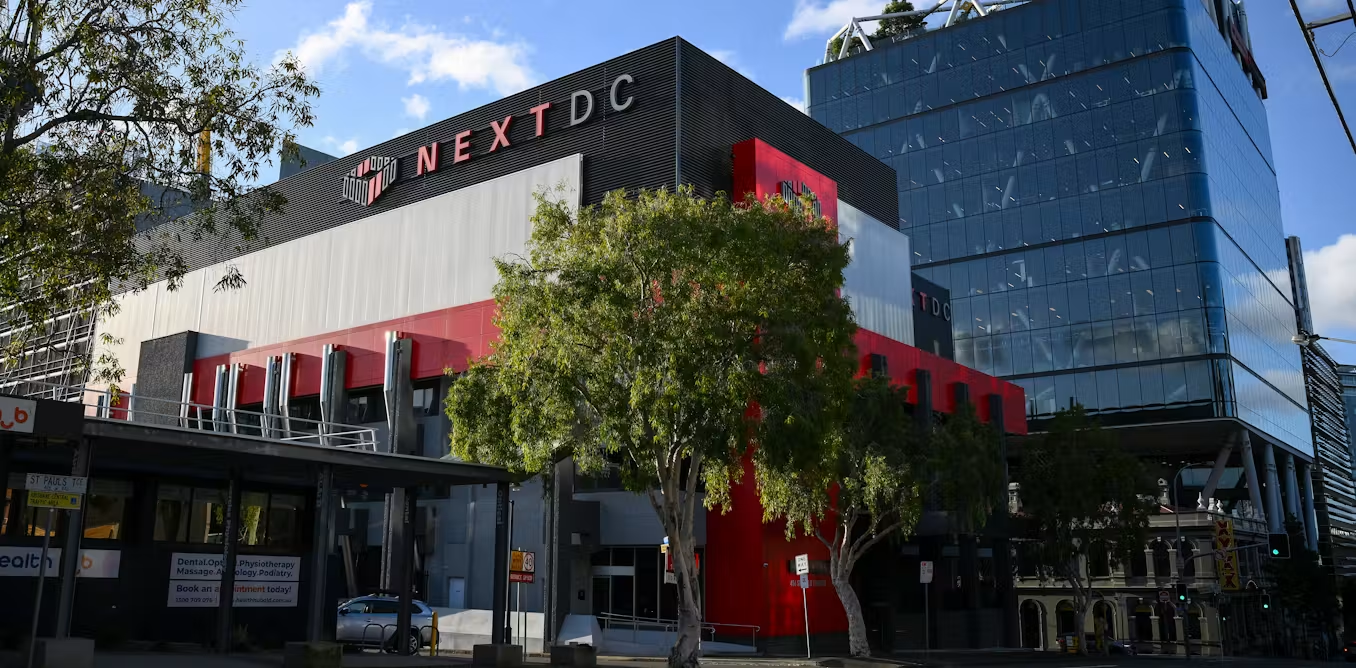
Australia has emerged as a global hotspot for data centre growth, driven by the surge in dependence on artificial intelligence.The country's strong appetite for AI, geographical position within the Asia-Pacific region, stable regulatory environment, ample land and renewable energy potential are among the reasons investors are homing in.Data centres are not only crucial for AI, they also help power modern life such as streaming services and cloud storage. But there are concerns that finding locations for this energy- and water-intensive infrastructure, which operates 24 hours a day, will become increasingly challenging in a world affected by climate change.As data centres rapidly come online to meet demand, governments are being urged to ensure that development does not outpace adequate planning.Data centres are coming online at a rapid place in Australia. (Supplied: Cloud Carrier)Data centres in high-risk areasXDI, a company that analyses the physical risk of climate change, examined almost 2,600 planned data centres around the world, revealing that some of the fastest-growing digital infrastructure hubs had emerged as climate-risk hotspots.The analysis found 154, or 6 per cent, of the data centres examined were vulnerable to physical damage or operational disruption due to climate change.South-East Asia was the most vulnerable, with 20 per cent of data centres already deemed high risk, a number expected to a least triple by the end of the century.XDI director of science and technology Karl Mallon said much of the debate around data centre development had focused on energy demand and water consumption."But physical climate risk is becoming an increasingly important consideration in its own right," he said."The question is no longer simply where the next generation of digital infrastructure gets built, but whether those assets can remain operational, insurable and economically resilient over their intended life."Mr Mallon said states and countries deemed to be high risk typically experienced a high number of natural hazards, but could also have poor planning laws. "Places like Texas or Florida, you're seeing a lot of data centres going to places where that's not necessarily a sensible place to put a data centre," he said. "It may be that there's weak planning laws in some places that are allowing data centres to go in."While Australia ranked 22nd for risk of physical damage to planned data centres, the report found the country was facing one of the steepest increases in risk over time.New research has found extreme heat poses an operational challenge for digital infrastructure. (ABC News: Gian De Poloni)The analysis examined the risk of damage and disruption from 11 hazards including flooding, coastal inundation, bushfire and tropical cyclones, with extreme heat emerging as a key challenge for digital infrastructure in Australia."We can design cooling systems but we design them on what our normal temperature range is," Mr Mallon said."Our temperatures are going to go up quite a lot and therefore we need to be thinking about extreme heat and extremely hot days as being something that we need to plan for."Mr Mallon said New South Wales and Queensland were both found to have a planned data centre that would be exposed to flooding if built, and one in Western Australia was at high risk from bushfires. "A lot of the infrastructure around data centres is potentially more at risk, so electricity supply, telecommunication connections, water for cooling," he said. "Is the infrastructure that supports these data centres as resilient as the data centres themselves?"Belinda Dennett says Australia should make the most of its data centre potential. (ABC News: Jack Ailwood)Australia's data centre appealThe United States is the AI infrastructure capital of the world, home to more than 5,000 data centres, but the country is facing capacity constraints around energy availability and locations.With global demand for data centres still high, investors are looking for opportunities elsewhere. "Australia has a lot of the attributes that investors, that data centre operators look for," Data Centres Australia chief executive Belinda Dennett said. "Availability of land, which is something many of our neighbouring countries in the Asia region don't have, the potential for the abundance of renewable energy, which certainly the global tech customers are looking for."Ms Dennett said the transition from fossil fuels to renewable energy was also influencing where digital infrastructure was being built. "Markets that solve this challenge are the ones that are going to benefit from this data centre boom opportunity," she said. Australia is now home to 162 operational data centres, with 90 more in the pipeline.Investment in data centres has soared in recent years, from more than $460 million in 2023 to $6.8 billion so far in 2026.Ms Dennett said operators looked for power availability, fibre cable and water connectivity, as well as proximity to a skilled workforce and tech support when selecting a site to build, which made the urban fringe a popular area. Melbourne and Sydney have become Australia's digital infrastructure hubs, with many data centres being developed in industrial areas. Ms Dennett said some companies were using AI models to help inform investors and operators around site selection, including climate change and community concern data. "AI, the thing that we're building a lot of data centres for, is being used in how we make decisions about where to locate new builds," she said. "There are a whole bunch of steps that an operator has to go through to get planning approval. They are extremely robust."That process needs to be faster, not less rigorous, but faster because countries are competing. Speed to market is the most critical thing."Government guidelinesEarlier this year, the federal government laid out its expectations for people seeking to build data centres in Australia.Data centre operators were encouraged to co-locate renewable energy projects and battery storage to offset their supply and cover transmission infrastructure costs.Within the expectations, operators were also instructed to use "innovative, efficient and sustainable solutions to minimise water use" and build a "social licence" within communities.During a meeting of energy and climate ministers last month, all states except Queensland agreed that data centres should have to fully offset energy with additional renewable energy generation. Ministers requested advice from the Australian Energy Market Commission, which will examine whether laws can be changed to ensure data centres help with the transition and do not put upward pressure on energy prices. Energy Minister Chris Bowen said the federal government wanted digital infrastructure to be an "asset to the energy grid, not a strain". "If data centres want to benefit from Australia's energy grid, we think they should do their bit to strengthen it," he said."It's clear that the overwhelming majority of states agree."Queensland Energy Minister David Janetzki said the state was committed to affordable and reliable energy. "We expect to see details on costs, benefits and risks before agreeing to any national proposal that impacts Queensland's energy system and Queenslanders' electricity bills," he said. "Further work is needed before imposing under-developed national proposals to advance other policy objectives."Planners issue warningPlanning Institute of Australia head of policy and advocacy Nicole Bennetts said data centres were critical infrastructure that would be key to reshaping the economy.But she said greater scrutiny of where they would be built was needed before reaching the approvals phase."It's about doing the strategic planning at the front end so that we can say these are the best locations for data centres," Ms Bennetts said."Renewable energy zones came out of an up-front strategic planning process where they said these are the best locations for wind generation, solar generation and so forth."Whether or not it's about identifying wholesale areas for data centres or is it more about identifying those areas where there's the grid connectivity, there's not going to be climate risk, they're not too close to residential areas."Nicole Bennetts says more strategic front-end planning is needed for data centres. (ABC News: Glenn Mullane)In 2019, Singapore introduced a moratorium to moderate the growth of data centres, which was then lifted in 2022.While the country's market has remained subdued due to ongoing regulatory controls, it remains one of the world's top investment locations.Ms Bennetts said while Australia did not need to replicate the moratorium, it could map out ideal locations for different scales of data centres while simultaneously assessing proposals.She argued this approach could speed up the assessment process."If we can get that up-front strategic planning work done, it gives far more certainty to the infrastructure investors or data centre investors," she said.Capacity forecast less certain beyond 2030Data centre capacity in Australia was 1.4 gigawatts in 2025, which is forecast to exceed 3 GW by 2030.But the capacity forecast beyond the end of the decade is less certain and dependent on large projects progressing through the planning stage.Mr Mallon said unlike existing infrastructure, planned data centres created a window of opportunity."Decisions make today about site selection, engineering standards and resilience investment may materially influence future performance, insurability and operational continuity," he said.Ms Dennett said digital infrastructure provided a "once in a generational opportunity for Australia to transform its economy". "For so long we've been dependent on resources and mining exports and this really is the new economy, exporting intelligence to the region, building the infrastructure here so we have a say in how AI is created, how it's produced," she said. "Making sure we own more of the value chain and the jobs that come from that, that's the opportunity here for Australia and we think we should seize it."
Is Australia prepared for the data centre boom?
As data centres rapidly come online to meet demand, governments are being urged to ensure that development does not outpace adequate planning.
1,554 words~7 min read