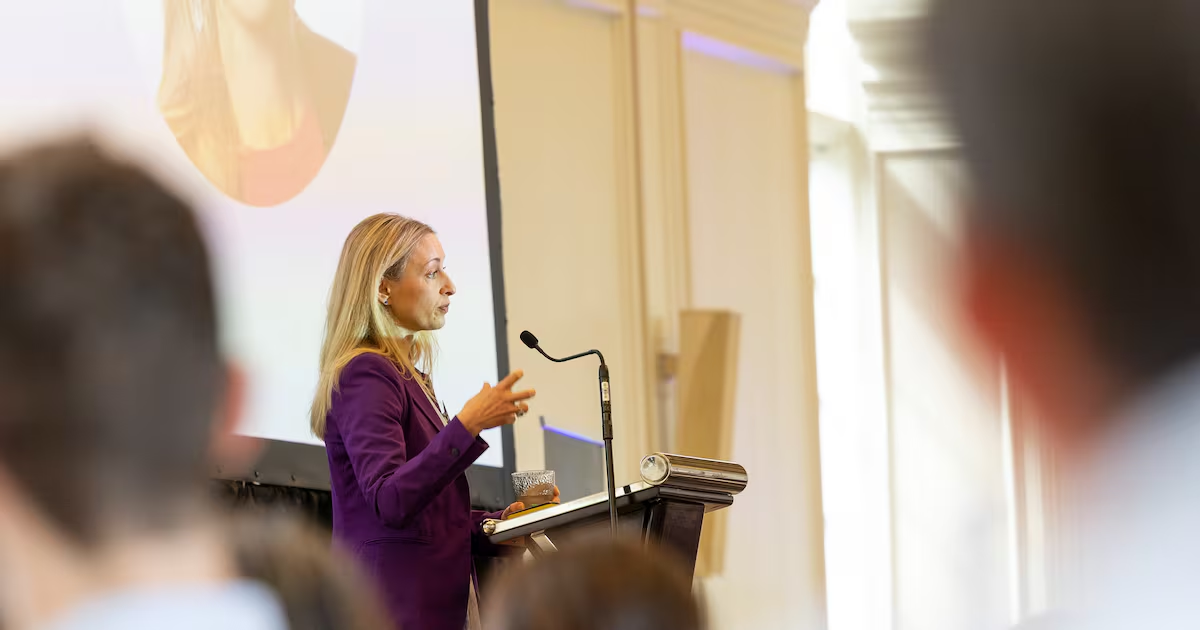
Research Ireland has embarked on a nationwide project designed to gain an understanding of how people across Ireland experience and engage with research in their everyday lives. Rather than focusing only on what people think about research, the Research in Ireland Barometer 2026 focuses on lived experiences, perspectives and priorities. There are no right or wrong answers, the emphasis is on people’s own perspectives.According to Research Ireland director of research for society Ruth Freeman, the barometer is not a traditional survey of public opinion and moves away from tick-box exercises. “It is designed to build a more grounded understanding of how research connects to everyday life,” she says. “We want to hear from as many different voices as possible, especially people whose perspectives aren’t always heard in these kinds of conversations.”Key to building that broader understanding is the qualitative approach taken. Rather than relying only on fixed-choice questions, the survey includes open story-based questions to invite people to reflect on their own experiences of research and make sense of them in context. It also uses interactive elements such as sliders and triads, allowing participants to express nuance, balance and strength of feeling rather than selecting a single answer.The open questions asked in the online survey include: “In a few sentences, tell us about a time when research came up in your life, or when it affected something you care about”; “In the experience you describe, how did it shape the way you think about research?”; and “In the experience you described, how did the research affect you?”These questions are designed to capture real-life moments, reflection, and personal impact, rather than abstract opinion.“We are inviting people to share their personal experiences and to tell us about the impact of research on their life or something they care about,” says Freeman. “We want to get under the numbers and get people’s own perspectives. Research by definition is all about new knowledge and new ways of thinking. Society has a role in shaping questions for research, and this survey will help us to develop evidence informed policies.”Freeman notes that this is not the first survey of its kind with the first iteration carried out in 2015. “We wanted to do longitudinal research on the impact of research on people’s lives and planned to do it every five years. When it came to the second time, it was during Covid and the results were influenced by the particular circumstances of the time.”The current survey asks many of the questions asked before as well as some new questions. By repeating previous questions, the longitudinal aspect of the series is preserved and it will be possible to track changes and spot trends in attitudes to research.“We also want to find out if there are parts of society feeling excluded and left out of conversations on research,” says Freeman. “That will help us find ways to bring them in. For example, when we ran the first survey, one of the things we found was that the group that felt most disconnected from science was women and girls from less privileged backgrounds. That enabled us to ensure that programmes we funded had specific categories to enable us to reach out into that community. That research also helped to identify geographic regions where more support was needed.”She is keen to emphasise that the survey is not confined to scientific research. “It can be any kind of research that impacts on people’s lives,” she says. “It could be a local folklore project, for example.”The barometer involves a combination of an online nationwide survey and community-engaged focus groups. “We have placed an emphasis on mobile-friendly and accessible formatting for the online survey and on providing opportunities to take part in focus groups. We have a great network of partners across the country who are helping to set up the focus groups. These are small group conversations where people can talk in more detail about their experiences.”The findings will bring together survey responses, personal stories and focus group discussions to identify patterns in how research is experienced across society. “We will publish the findings and seek feedback from the public on them to keep the conversation going.”The survey is open to anyone aged 16 and over and resident in the Republic of Ireland. “We want to hear from as many people as possible,” says Freeman. “It takes less than 15 minutes to complete the survey. We hope that people share the link with others once they have completed the survey. Everyone’s experience matters, and this is an opportunity for people to make sure their voice is heard.”Click here to complete the Research in Ireland Barometer survey
Do you feel connected to science? Research Ireland wants your story
The Research in Ireland Barometer 2026 focuses on lived experiences, perspectives and priorities. There are no right or wrong answers
774 words~4 min read