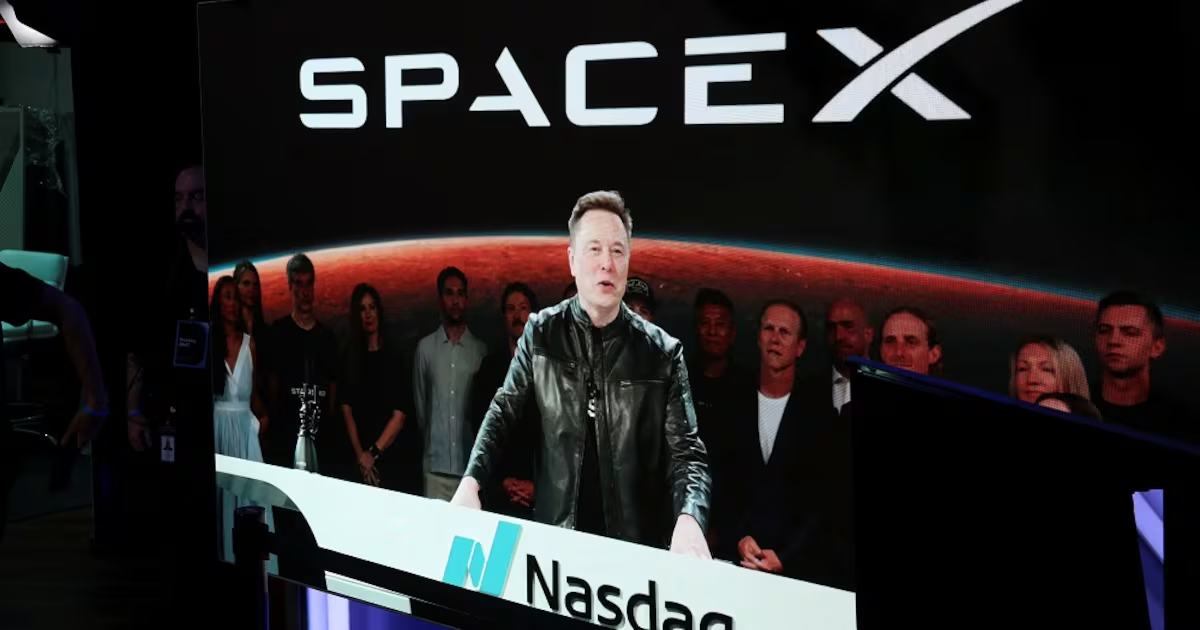
The listing of SpaceX and prospective listings of OpenAI and Anthropic have become one of the dominant conversations in markets. If they proceed at anything close to the valuations being discussed, they will ask investors to absorb an exceptional amount of new equity at a time when enthusiasm for AI is already high and US market valuations are demanding. That does not make the initial public offerings (IPOs) a warning sign in themselves. Strong companies should come to market. But their scale makes this a useful moment to revisit some of the assumptions underpinning portfolios.I previously argued that the call to “Sell America” was misplaced. I still believe that. The US remains the centre of global capital markets and home to many of the world’s strongest companies. There is no obvious alternative with the same combination of liquidity, profitability and technological leadership.However, a sound long-term observation can become dangerous when it hardens into a permanent conclusion. America may remain exceptional, while US equities become more vulnerable to disappointment.For years public markets have benefited from a relative shortage of shares. Companies have repurchased stock, private equity firms have taken businesses private, and successful technology companies have stayed private for longer. That scarcity has supported valuations.A wave of large IPOs may begin to alter that balance. Investors may need to decide whether to allocate fresh capital to the next generation of technology companies or sell existing holdings to fund those purchases. At the same time, the established technology leaders are committing vast sums to AI infrastructure, including data centres, semiconductors and energy capacity. The next phase of the AI cycle may therefore require markets to absorb more equity issuance and more debt issuance at the same time. This is not a forecast of an imminent correction. It is a test of investor discipline. For years public markets have benefited from a relative shortage of shares. Companies have repurchased stock, private equity firms have taken businesses private, and successful technology companies have stayed private for longer. That scarcity has supported valuations. A wave of large IPOs may begin to alter that balance. The real question is not whether AI is important. It clearly is. The harder question is whether the returns will justify the amount of capital being committed and the valuations investors are being asked to pay.That matters because the market is already pricing a demanding combination of outcomes: resilient earnings, attractive returns on AI investment, moderating inflation, manageable bond yields and no material deterioration in the cost of capital. Any one of these assumptions may be reasonable. The risk lies in expecting all of them to hold at once.This is why the bond market may matter more than the daily headlines. The US government continues to borrow heavily. AI infrastructure will require substantial funding. Inflation remains a constraint. If governments, technology companies and infrastructure developers are increasingly competing for capital, the cost of money may remain higher for longer than equity markets expect. That would matter most for long-duration growth assets, where much of today’s valuation depends on earnings expected well into the future.The same discipline should be applied to the political environment. Markets have repeatedly looked through tariffs, confrontations and policy reversals on the assumption that the most extreme outcomes will eventually be moderated. But the cumulative effects matter. Policy uncertainty becomes an investment issue when it affects inflation, borrowing costs, business confidence or trust in the institutions supporting US assets.None of this makes a bearish conclusion inevitable. America remains difficult to replace. Its strongest companies are highly profitable global businesses with formidable competitive positions.AI may prove to be one of the most important productivity-enhancing developments of our time. But a good company is not always a good investment at every price, and a strong market is not always a safe one when expectations are elevated.The practical implication is not to abandon America. It is to avoid allowing portfolios to become too dependent on a narrow set of assumptions. Investors should review how much US exposure they own, how concentrated that exposure has become and whether their portfolios would remain resilient if bond yields stay higher for longer, AI returns take more time to materialise or markets become less willing to pay a premium for distant earnings.The super-IPO moment does not tell us that markets are about to fall. It tells us that this is a good time to revisit our assumptions.• Dr Marais chairs Wealth Associates.
NICO MARAIS | The super-IPO moment is a reason to revisit our assumptions
Wave of mega listings challenges the scarcity premium in US equities
737 words~3 min read