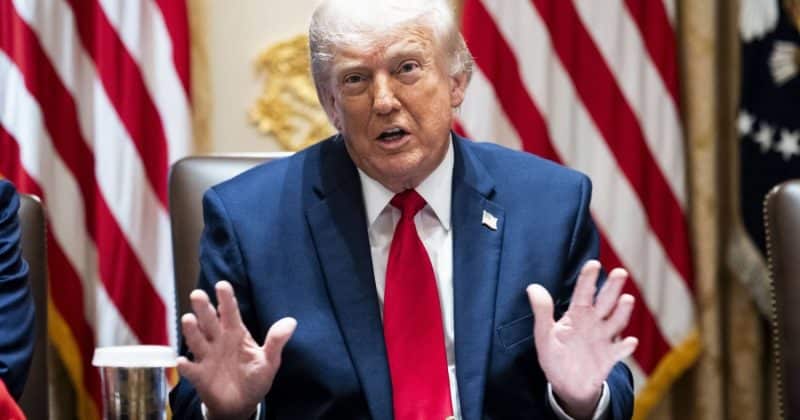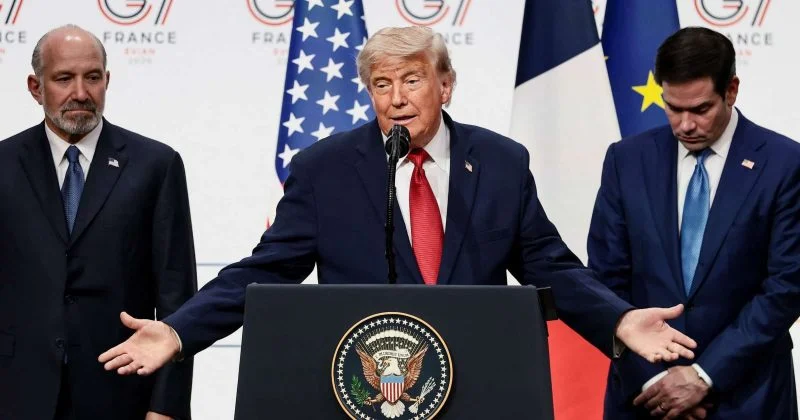
President Donald Trump and his team had several red lines that they used to justify the US war against Iran. At a press conference on Wednesday, Trump largely brushed them aside.Explaining his decision to agree to an interim peace deal, Trump repeated his insistence that the country would never get a nuclear weapon. Yet he went on to suggest that Iran should have the right to enrich uranium, be allowed to develop ballistic missiles and get access to billions of dollars in frozen funds.Also read: Inside the chaotic Iran talks that let Trump claim victory, but not yet peaceThose three things have been at the center of the debate around how to approach Iran for years, dating to the 2015 agreement that the US, under President Barack Obama, and other great powers signed with Iran to limit its nuclear program. Not only that: Trump had repeatedly cited those issues as reasons why Obama and past presidents had failed so badly in containing the threat posed by the regime in Tehran. In a head-spinning turn of events, Iran hawks including former Vice President Mike Pence and former US Ambassador to the United Nations Nikki Haley lamented Trump’s new vision, while some of the president’s most vehement critics cheered.“It’s doing a lot of the things that Trump criticized Obama for doing,” Christian Whiton, a State Department adviser in the George W. Bush and first Trump administrations, said of the president’s comments. “And whether or not he means it, he has expressed to them he will not resume military operations because doing so will cause the worst recession since the great depression.”The National Iranian American Council, meanwhile, cheered what it saw from Trump.“The measures in this agreement should not be read as concessions but rather corrections to a decades-old policy of coercion that was an abject failure and made war inevitable,” the group said in a statement.Hours later, at the palace of Versailles near Paris, the president signed the so-called memorandum of understanding to end the war and reopen the Strait of Hormuz.To be sure, he has a history of taking a hard stance only to reverse it days — sometimes even hours — later. And Iran hawks may not need to worry too much: The interim deal opens the door for 60 days of negotiations and Trump hasn’t given anything away yet.The Trump administration also has said Iran has been so weakened economically and militarily that the US has achieved its goal of threat reduction and even opened the door to the country rejoining the global economy, if its leaders choose that path.But there was plenty in the press conference that surprised even the president’s supporters.Take Iran’s ballistic missile program. Days after the US and Israel launched the war with Iran in late February, Defense Secretary Pete Hegseth said the US objective was to “destroy the missile threat” posed by Iran.Trump shrugged off that idea at the press conference marking the end of a Group of Seven summit in Evian, France. He even derided those offering him advice — he referred to them as “guys I like” — as focusing on the wrong thing with the fixation on ballistic missiles. “I mean, they have to have some because other people have some,” Trump said.“Missiles aren’t the problem,” Trump told reporters. “They hurt a little location but they don’t blow up the planet.”The president took the same approach with nuclear enrichment. For years, he and many Republican critics of Iran have questioned why it should be allowed to enrich uranium if, as it insists, it doesn’t want a nuclear weapon. Secretary of State Marco Rubio told Fox News in May that Iran needs to “walk away from enrichment.”With Rubio standing right behind him on Wednesday, Trump made clear he no longer agreed.Also read: Trump signs Iran ceasefire deal, warns of renewed bombing if Tehran violates pact“It’s a little hard when other people have it, other adjoining states have it, and you’re not letting them have it for purposes of electricity and things like that,” Trump said. “You have to use a little common sense.”The third red line Trump crossed centered on Iran’s frozen assets. The country has billions of dollars in overseas accounts that the US has blocked banks from releasing. Part of the justification for years has been that Iran is a leading state sponsor of terrorism, funding proxy groups such as Hezbollah in Lebanon and Hamas in Gaza, and can’t be trusted not to do so again.“It’s not our money, it’s their money — and we froze it at a certain point in time,” Trump said. “I guess we’re going to have to give it back, you know. If we didn’t give it back, nobody would ever invest in the dollar again.”That idea met with strong opposition from some of the president’s most ardent supporters including Senator Ted Cruz, a Texas Republican.“History teaches us giving billions of dollars to theocratic lunatics who want to murder us is not a good idea,” Cruz said in an interview.
Trump blows through his Iran red lines in justifying peace deal
President Trump signaled a significant shift in US policy towards Iran, seemingly abandoning key "red lines" previously used to justify military action. He suggested Iran could have the right to enrich uranium, develop ballistic missiles, and access frozen funds, surprising both critics and supporters.
835 words~4 min read