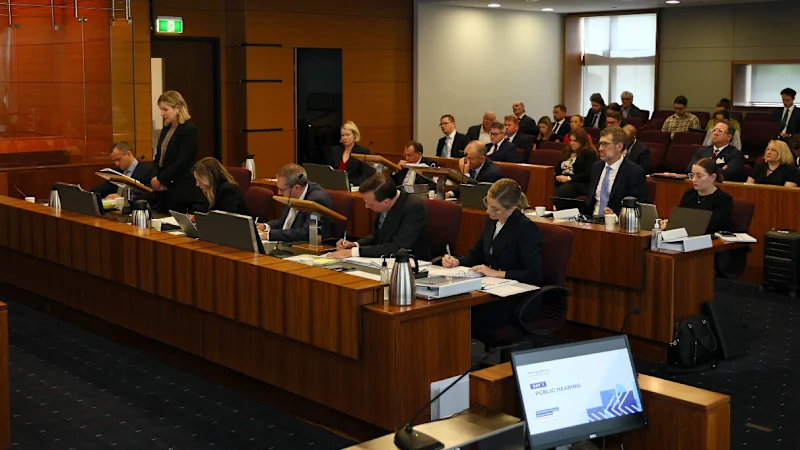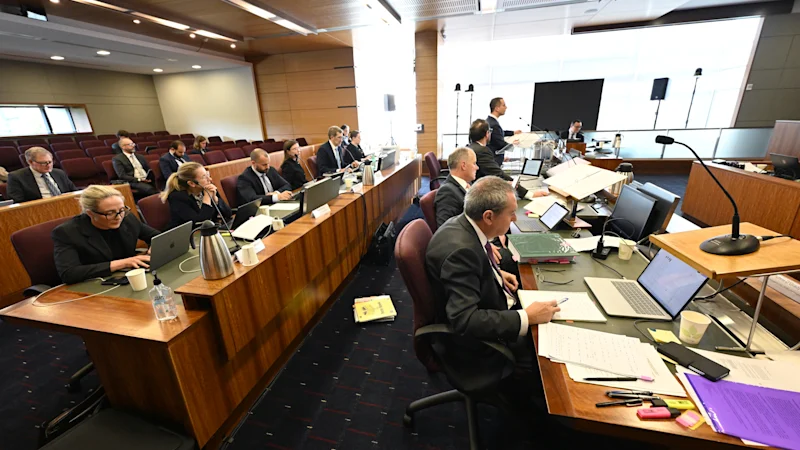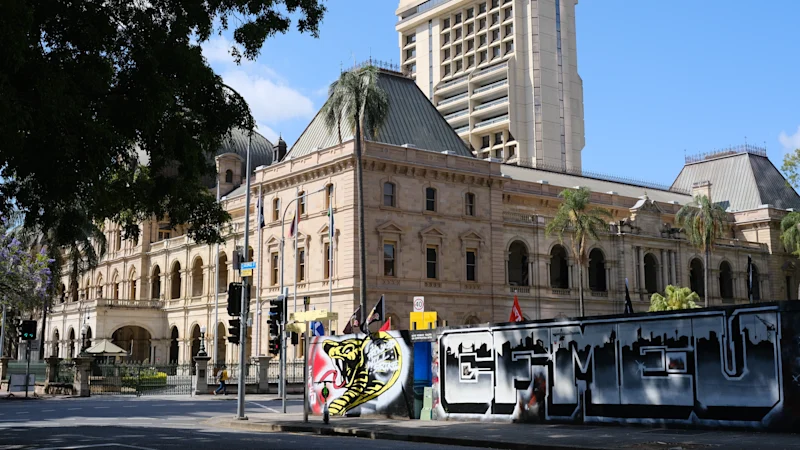
Updated June 18, 2026 — 4:01pm,first published 10:43amInternational experts have told Queensland’s CFMEU inquiry that evidence and allegations levelled against the union appear to show it acting as a Mafia-like organised crime outfit, recommending US-style racketeering laws as a solution.The powerful public probe is also pursuing a case that overlapping roles held by former Queensland union leaders on related bodies, and the money trail of these back to the union, could be unlawful and expose the organisation to tax liability.A CFMEU mural on the remaining part of the Queen’s Wharf construction site opposite Queensland Parliament, since removed at the request of Deputy Premier Jarrod Bleijie.Matt DennienCounsel assisting the inquiry Andrew Meagher KC, leading this week’s hearings probing alleged financial misconduct, said such evidence was relevant to the reason the CFMEU gathered its funds and “goes to the heart of whether or not the CFMEU properly paid tax”.The Crisafulli LNP government launched the $19.7 million commission of inquiry last year after reporting by this masthead and 60 Minutes into criminality, corruption and misconduct in the union and construction sector nationwide.This month, the probe was given a nearly 18-month extension to December 2027. This week’s hearing block – the 11th – is the first to dig into the union’s financial structures, activities and alleged wrongdoing, including the improper payment of personal fines.In evidence over video link and written statements provided to the inquiry after reviewing material it had provided, two expert witnesses in criminal governance and organised crime agreed the CFMEU appeared to have been acting in such a way.One of the criminal governance experts, criminology professor Federico Varese, giving evidence via video link on Thursday.Commission of Inquiry into the CFMEU and Misconduct in the Construction IndustryOne of the experts, former University of Oxford criminology professor Federico Varese, described governance organised crime as “the unlawful regulation and control of the production and trade of goods and services”.“On the basis of the material reviewed, it is likely that the union had the opportunity to establish and, in some respects, may have operated as a form of governance-oriented organised crime,” Varese wrote.“[It did this] by exercising or seeking to exercise control over access to labour and worksites, coercing businesses, influencing regulatory processes, and relying on credible coercion to regulate market participation outside lawful institutions.”Varese, along with University of Cambridge criminology professor Paolo Campana, agreed that – with modifications – a survey they developed to help police identify gang members in London could help map the union’s role across Queensland.They pointed to the United States’ Racketeer Influenced and Corrupt Organizations (RICO) Act, allowing figureheads of organised crime to be jailed even with distance from the group’s crimes, as an example of how to stamp out the activity.“We need a combination of criminal law, but also civil law and administrative measures,” Varese said, pointing to use of the laws against New York City labour racketeering involving Mafia families and unions.“That is the path forged by the United States … and I think the RICO measures, and in general, the measures to clean up the unions in the United States, has been very successful.”Campana added it was important to boost internal union democracy, as unions played an important democratic function, which could be undermined by those operating unlawfully.Wednesday’s evidence from forensic accountant Natalie Faulkner laid out a number of related entities, linked to the CFMEU through workplace agreements and shared officeholders, which delivered revenue to the union.On Thursday morning, Meagher said that where office holdings overlapped, the union figures’ knowledge became that of the other entities “as a matter of law”. Some entities, like charities, can only distribute money under their stated purposes.“But, if in truth, the charity knew the purpose was not charitable, it would become taxable. It might also be a breach of ... corporations law, competition law, and trust law,” Meagher said.Asked by Commissioner Stuart Wood AM KC what options the inquiry might have if it agreed with the expert assessment, Meagher noted that under tax law, unions are exempt only if their income and assets are used solely for their established purposes.Meagher said this meant that unions could be misused, but remain exempt if also fulfilling their purpose. “Those are the sorts of reforms that might entertain your mind,” Meagher explained.“I know this is a state-based commission, but you have it well within your powers to make recommendations about federal law reform as well – and they might not be accepted.”“If it is capable of being recognised as a particular form of an operation, it can be effectively destroyed financially. And if wrongdoers cannot make money out of it, they will not do it.”The federal Coalition under former leader Peter Dutton pledged last year to introduce RICO-style laws to target the CFMEU, something the Albanese government dismissed as unnecessary.The inquiry resumes its next public hearing block on July 14.Start the day with a summary of the day’s most important and interesting stories, analysis and insights. Sign up for our Morning Edition newsletter.From our partners
Australia urged to copy US laws to stamp out organised crime in union
Experts appearing at the Queensland inquiry recommended laws like those used in New York City to crack down on the Mafia’s labour racketeering.
831 words~4 min read