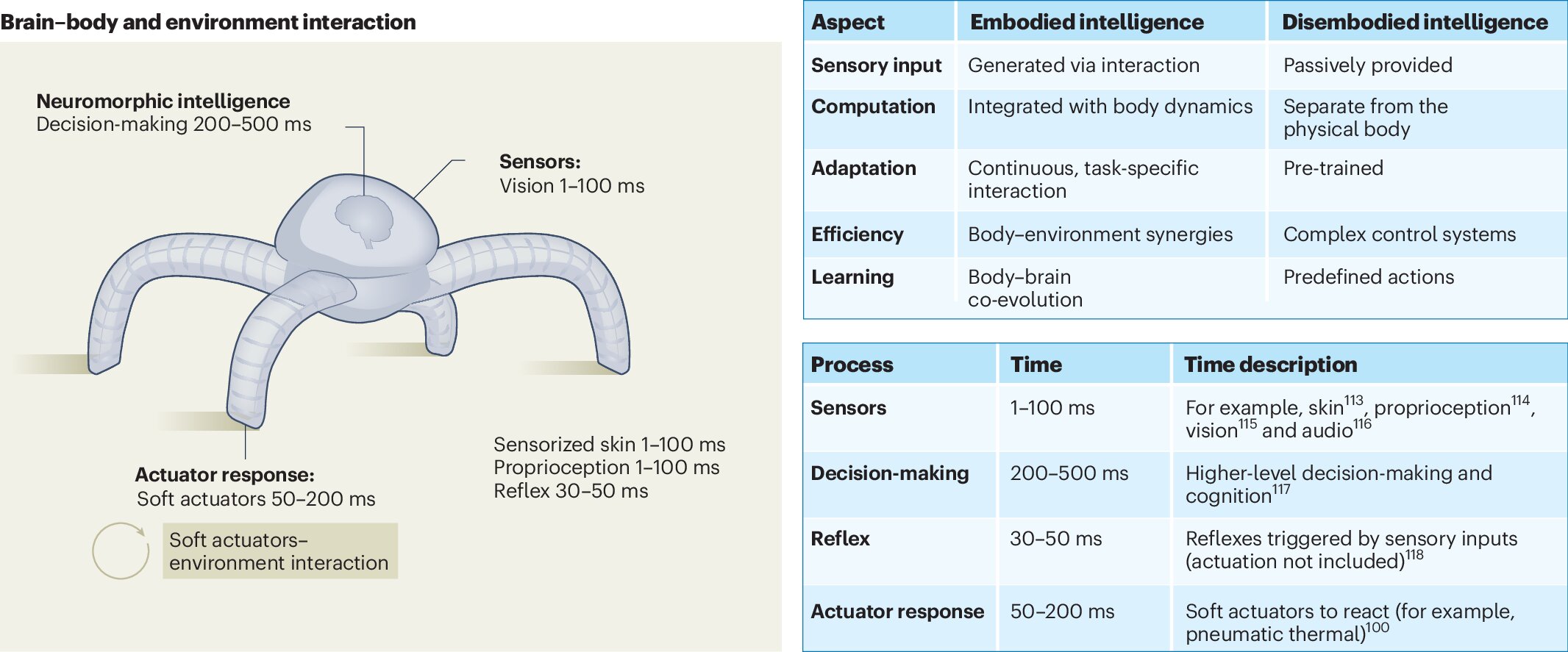
A system overview of embodied soft robotics. Credit: Nature Machine Intelligence (2026). DOI: 10.1038/s42256-026-01197-w
Many AI robots appear intelligent as long as they operate in controlled environments. Neuroscientist and robotics researcher Elisa Donati explains why robots with real-world readiness require more than just fast software.
Robots already perform a huge range of tasks: they work on factory floors, deliver parcels and clean our apartments. However, many systems become surprisingly clumsy once they are expected to navigate an unpredictable real-world environment. This is why developing AI robots requires more than a narrow focus on artificial intelligence—we also need to consider the interplay between brain, body and environment. Intelligence, it turns out, is not contained in software alone.
When a robot has an intelligent body, its "brain" can afford to relax a little. One good example can be found in the animal kingdom: Many animals are far less intelligent than humans and possess only a rudimentary nervous system, yet they are capable of orienting themselves, navigating around obstacles and interacting with their environment. Part of this behavior emerges directly from the interplay between body and environment.