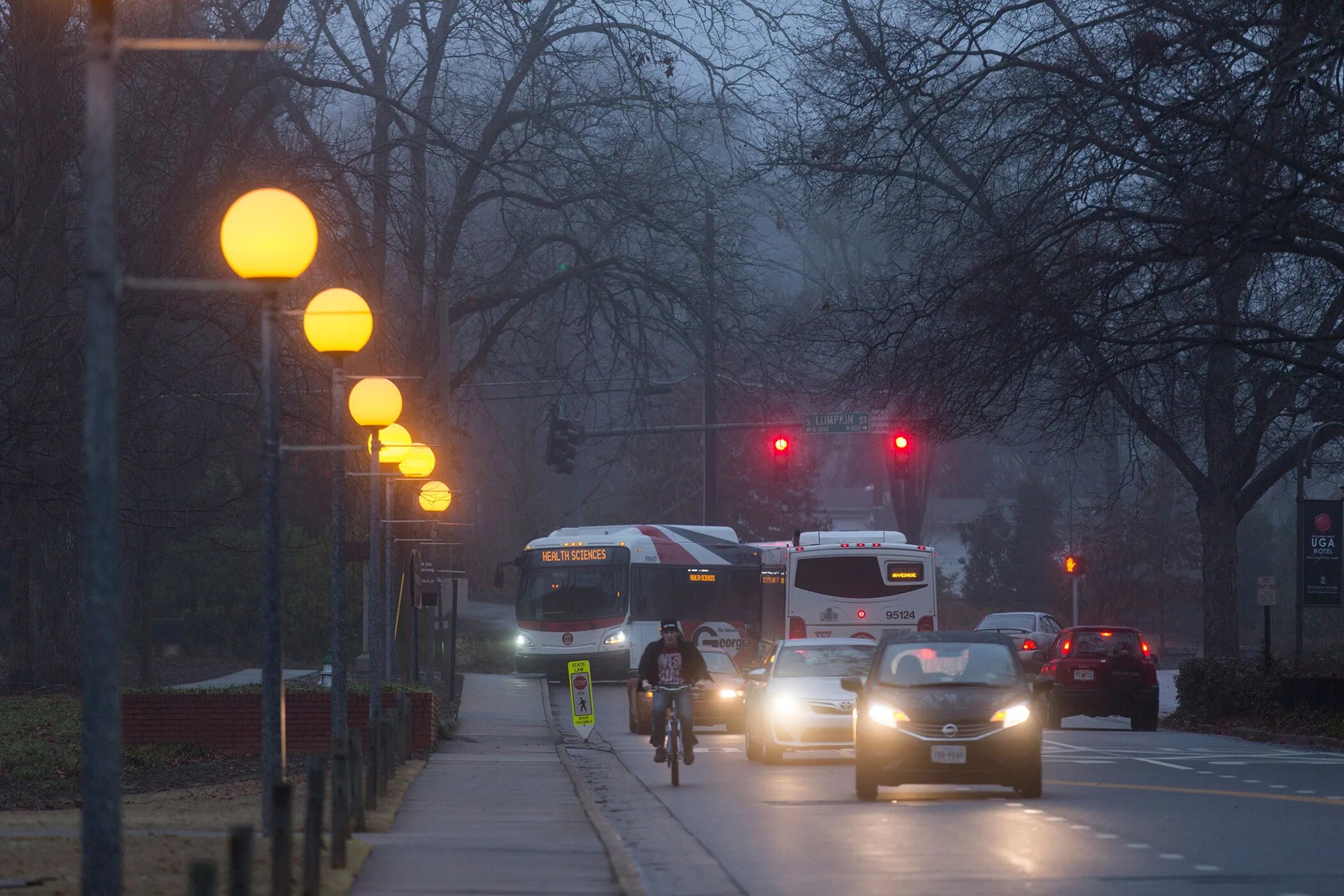
The Federal Highway Administration estimates that wet pavement and severe weather contribute to around 500,000 injuries and 6,000 deaths each year. Credit: Andrew Davis Tucker/UGA
As summer approaches, you might be planning a road trip. A recent study from the University of Georgia explores how you can stay safe while driving in the rain. Vehicles can hydroplane when water gathers on a road, causing tires to lose their grip.
UGA researchers used both a computer and a live simulation of tires on a wet road to explore the different factors that contribute to hydroplaning. Speed and water thickness both increased the chance of hydroplaning, but the risk fell once the water was about 10 millimeters (0.4 inch) deep. The paper is published in the journal Applied Sciences.
The Federal Highway Administration estimates that wet pavement and severe weather contribute to around 500,000 injuries and 6,000 deaths each year.
"This is a very important safety issue," said Linbing Wang, corresponding author of the study and a professor in the UGA College of Engineering. "If we have a good understanding of what the contributing factors are, then we can improve them, either through the design of pavements or the vehicle design, helping to save lives."