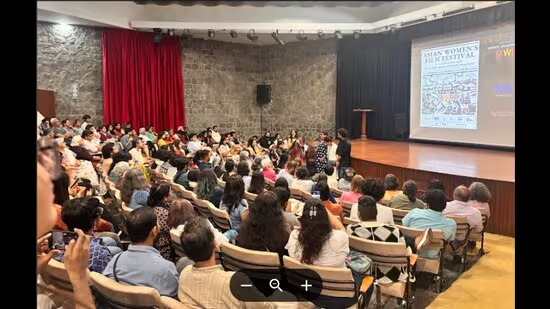
At the India International Centre, beside the Lodhi Gardens in full bloom, the scent of the Delhi spring still lingered fresh in the air. The flowers were ablaze with life, and so was the screen at the Asian Women’s Film Festival held from 13 to 15 March. Showcasing 75 films spanning documentary, fiction, animation, and experimental work, the 21st edition of AWFF had everything generally expected from a women’s film festival: masterclasses? check; panel discussions? check; a fierce urge to challenge patriarchal structures? double check.The Q&A session after the screening of Shadowbox at the Asian Women’s Film Festival 2026 (Courtesy AWFF)Women’s film festivals often are an act of resistance. Festival director Bina Paul believes that they are also a show of solidarity. “It is rare that women come and celebrate their work,” Paul says adding that such an even is actually “much more than an act of resistance”. This year’s programming reflected that vision. “When you curate a festival, it becomes a palette you paint on. I wanted to include films from Kazakhstan; Bhutan, too — a country we rarely hear from. We had 280 entries, and there was so much interesting work to choose from,” she said.Bhutanese feature I, The Song (2024) directed by Dechen Roder opened the festival. Also screened was the Tamil documentary, Auto Queens (2025, directed by Sraiyanti Haricharan), which follows women autorickshaw drivers in Chennai and shows them navigating a sexist system even as they lead a mobility revolution in the state.The second day began with the premiere of Keiko Okawa’s documentary, Oasis (2022), which focuses on the world of Mai and Rintaroa, a Japanese couple who weave through the city on bicycles. Later, at a masterclass with filmmaker Reena Mohan, Okawa gave attendees glimpses of her immersive, tender gaze and of her deeply observant approach to documentary filmmaking.The roundtable discussion on film pedagogy absolutely won over this film critic. 12 academics, each associated with film studies at eminent institutions like Film and Television Institute of India (FTII), Jamia Millia Islamia and Shiv Nadar University, among others, critically examined the evolving challenges and contradictions within film academia today.“Institutional histories aren’t monolithic histories,” said Shohini Ghosh, emphasizing that the challenges plaguing film academia also change with each decade and possibly, with the government at the centre. “Every teacher has a different way of experiencing an institutional history. These institutional histories also intersect with personal histories,” she added. Mausumi Bhattacharyya, Associate Professor at Visva-Bharati University delved deep into the impact of social media on filmmaking, how it is affecting attention spans of students and the kind of films they wish to make. “You are often trying to ground the students in theory but they want to immediately jump to practical,” she said.Bhattacharyya also lamented that most current students prefer fiction. As a result, she believes, few are inclined towards documentary filmmaking. Everyone seemed to agree that classroom engagement had declined. “Classrooms are dead now and are increasingly getting obsolete,” one academic said. The discussions around the decline of cerebral filmmaking, the rise of right-wing politics, and the growing anti-intellectualism in discourse around cinema were all lively.If the second day took attendees through the streets of Japan, the third turned the focus onto AWFF’s compelling guest programming. Its integration with niche film festivals like Mumbai’s AniMela Film Festival and Gujarat’s Asanjo Film Festival especially stood out. The programming from these two standalone festivals offered viewers an experience that extended beyond AWFF’s thematic focus and engaged with distinct curatorial voices — one being region-specific, the other form-driven.The festival closed with Shadowbox (2025; Bengali: Baksho Bondi) co-directed by Tanushree Das and Saumyananda Sahi. In attendance were director Das, actor Tillotama Shome and producer Shaunak Sen, whose documentary, All That Breathes (2022), was nominated for an Oscar in 2023. People queued for hours to watch the deeply moving Shadowbox, which was being screened nearly a year after its Berlinale premiere. The penultimate scene where Maya, the film’s protagonist, after having been through hell and beyond for her husband, accepts his fate and chooses to love him, even if the world around ostracises her for it, was especially moving.In the post-screening Q&A session Das and Shome reflected on the film’s central themes: PTSD, working-class struggles, and personal resilience. Das also shared a series of amusing behind-the-scenes anecdotes, recounting what it was like shooting during the pandemic and how the crew improvised their way through several key moments.It was late when the crowd streamed out. The night was bracing though there was a hint of the impending summer. It struck me then that AWFF felt like spring itself — brief, generous, and quietly transformative — arriving just in time to remind us that renewal is always possible.Deepansh Duggal writes on art and culture. He tweets at Deepansh75.
Report: Asian Women’s Film Festival (AWFF) 2026
The 21st edition of the event showcased 75 films spanning documentary, fiction, animation, and experimental work
794 words~4 min read