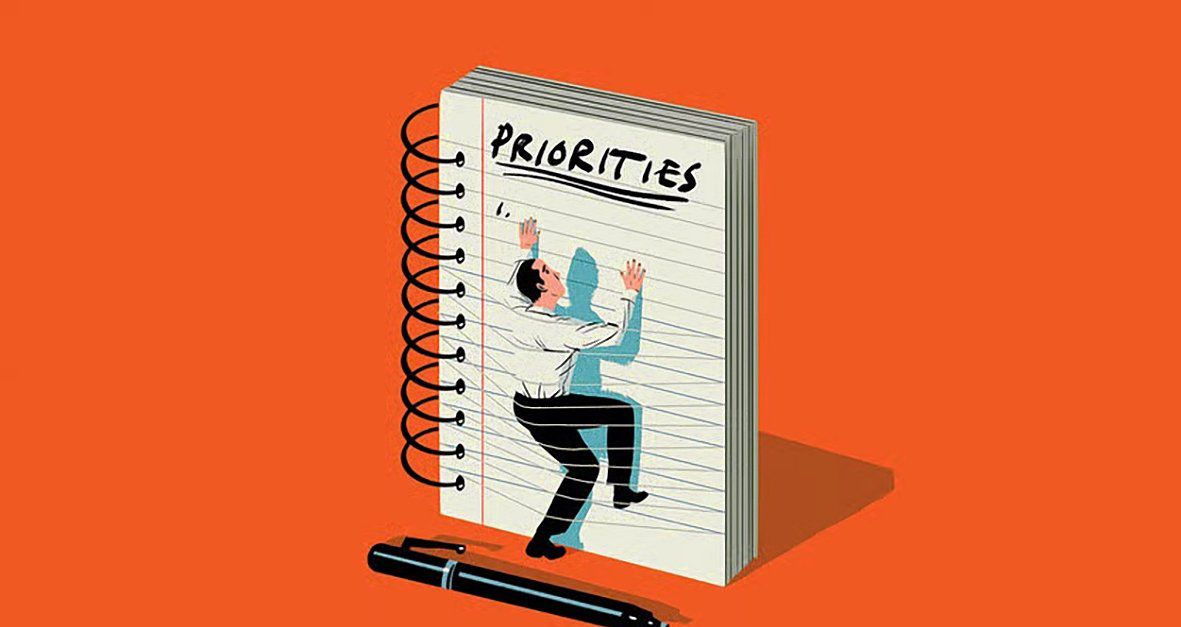
Close up detail of a businessman working at a desk with a smartphone and laptop computer, taken on January 31, 2019. (Photo by Neil Godwin/Future via Getty Images)Future via Getty ImagesMany might relate with this scenario. You start your Monday morning with a long list of everything you need to accomplish. By 5 PM, the list gets longer than when you started. You only crossed off the simplest tasks. You end up feeling a sense of lingering anxiety about the big projects you didn't touch.This productivity phenomenon is the to-do list paradox. We use lists to feel in control, but they often end up controlling us, leaving us overwhelmed. In 2014, an NBC report featured data collected by the productivity startup iDoneThis, stating that 41% of to-do list items are never completed.Even worse, these uncompleted tasks contribute to the Zeigarnik Effect, a psychological phenomenon where our brains stay fixated on unfinished business. This effect causes unnecessary stress and ambition fatigue.Moving from being a doer to a strategic leader requires you to stop listing your tasks and start scheduling your priorities. Here’s why the most productive professionals are ditching the list and what they are doing instead.The Problem: The Flat Hierarchy Of TasksThe fundamental flaw of a to-do list is that it treats every item with the same level of importance. On a standard list, "reply to Mike’s email" looks exactly the same as "draft Q4 market expansion strategy."MORE FOR YOUIn reality, your tasks can fall into two very different categories: $10 tasks and $10,000 tasks. Consider $10 tasks as the administrative busywork that keeps the lights on, but they don’t necessarily move the needle on your career. Meanwhile, $10,000 tasks are the high-leverage activities, which involve the deep work, the strategic thinking and the complex problem-solving that actually lead to promotions and salary increases.When you work from a list, your brain naturally gravitates toward the $10 tasks because they provide a quick hit of dopamine when you cross them off. Don’t fall for this trap. You can spend 10 hours a day being busy without ever being productive. Instead, aim to shift your mindset toward high-impact results.The Alternative: The Time-Blocking MethodIf a to-do list is a wish list, then a calendar is a commitment. The most productive people use a method called time-blocking. This process involves taking your priorities and scheduling them directly onto your calendar as if they were non-negotiable appointments.To-do lists tell you what you need to do, while a calendar tells you when you are going to do it. When you block out two hours for "Deep Work: Strategy Deck," you are making a realistic assessment of your capacity. You are forced to confront the fact that time is a finite resource. If it doesn't fit on the calendar, it isn't going to get done. That realization lets you reject low-value distractions before they eat up your day. You’re allowed to say no to a task when you’re fully booked.The Playbook: How To Start Time-BlockingTransitioning away from a list requires a shift in mindset. Use this 3-step playbook to set up your week for maximum impact:Step 1: Identify Your "Big Rocks" FirstBefore you look at your inbox, identify the three most important things you must accomplish this week to feel successful. These are your $10,000 tasks. Everything else is secondary. Focusing on depth over breadth can also serve as an exercise in avoiding the mid-career slump that comes from feeling like you are running in place.Step 2: Block The Time In Your CalendarSchedule these big rocks into your calendar during your peak energy hours. For most people, this is Tuesday, Wednesday and Thursday mornings. Give yourself at least 90 minutes per block. Consider this time a deep work audit where you aim to protect your most valuable asset (your attention) from the shallow work that fills most people’s days.Step 3. Defend Your Blocks Like A Meeting With The CEOIf the CEO asked for a 1-on-1 meeting, you wouldn't skip it to answer a random Slack message. Treat your time blocks with that same level of respect. Turn off notifications, close your email tabs and let your team know you’re in the zone. If someone tries to book over your block, offer an alternative time. Remember: If you don't respect your time, no one else will.Being productive is more than just about how many things you can get done in a day. Productivity requires you to make sure the right things get done. To-do lists track what you haven't finished but a time-blocked calendar shows where you are going.When a new week starts, try a list detox. Pick one major project, find a two-hour window on your calendar for the next day and then commit to it. Watch how your focus shifts when you stop worrying about the "what" and start committing to the "when."Your career growth compounds when you focus on high-value output. Stop listing and start scheduling. You’ve got this!
Why The Most Productive People Don’t Use A To-Do List
What if your to-do list is making you less productive? The answer might be sitting in your calendar.
824 words~4 min read