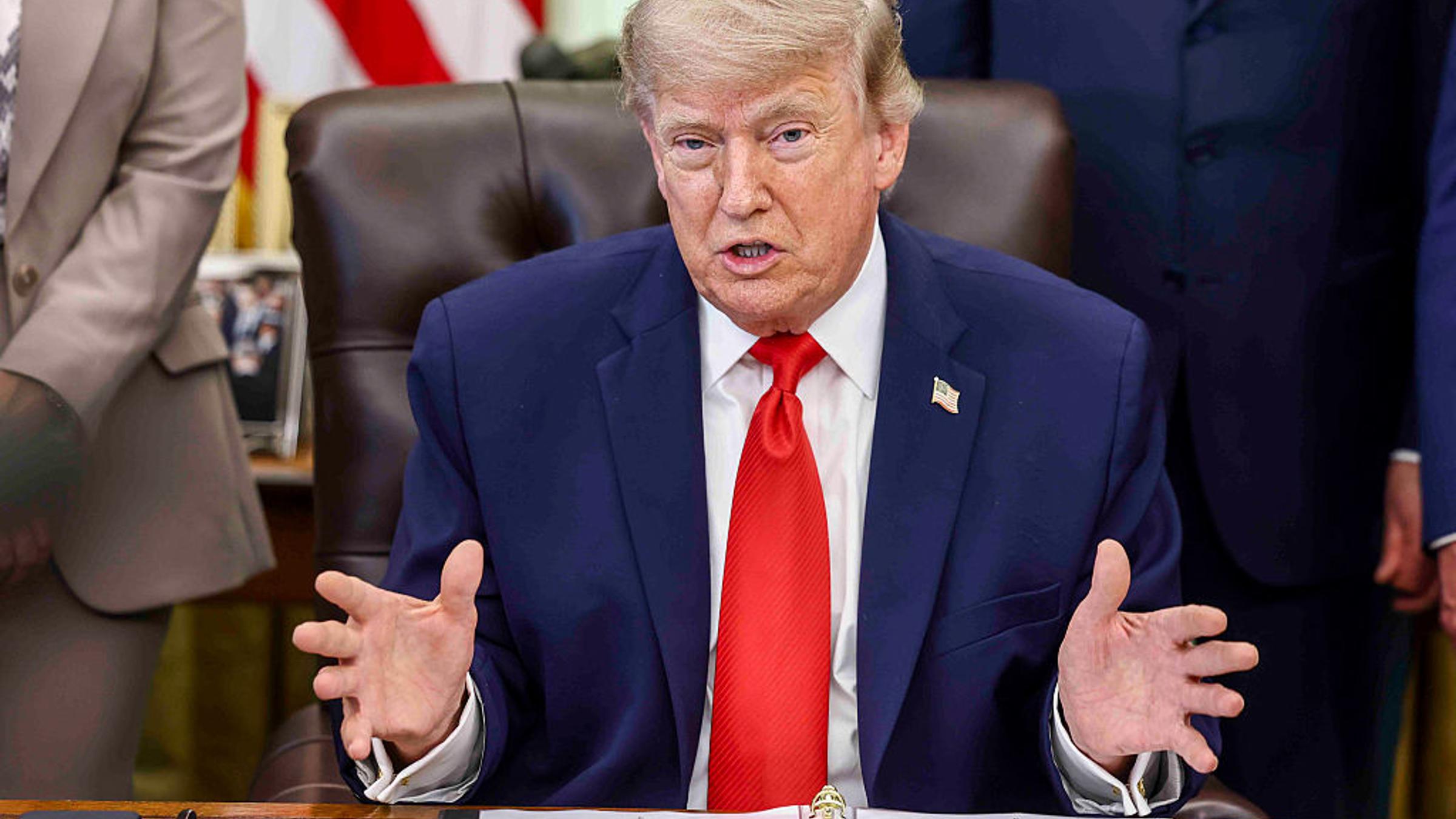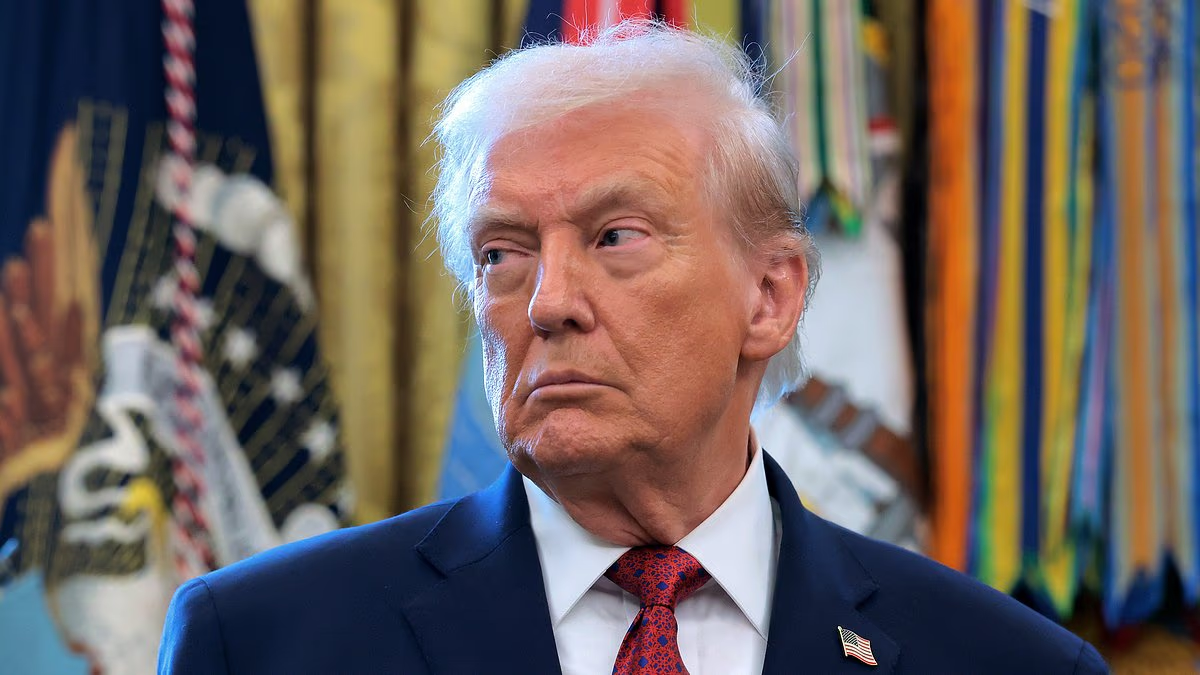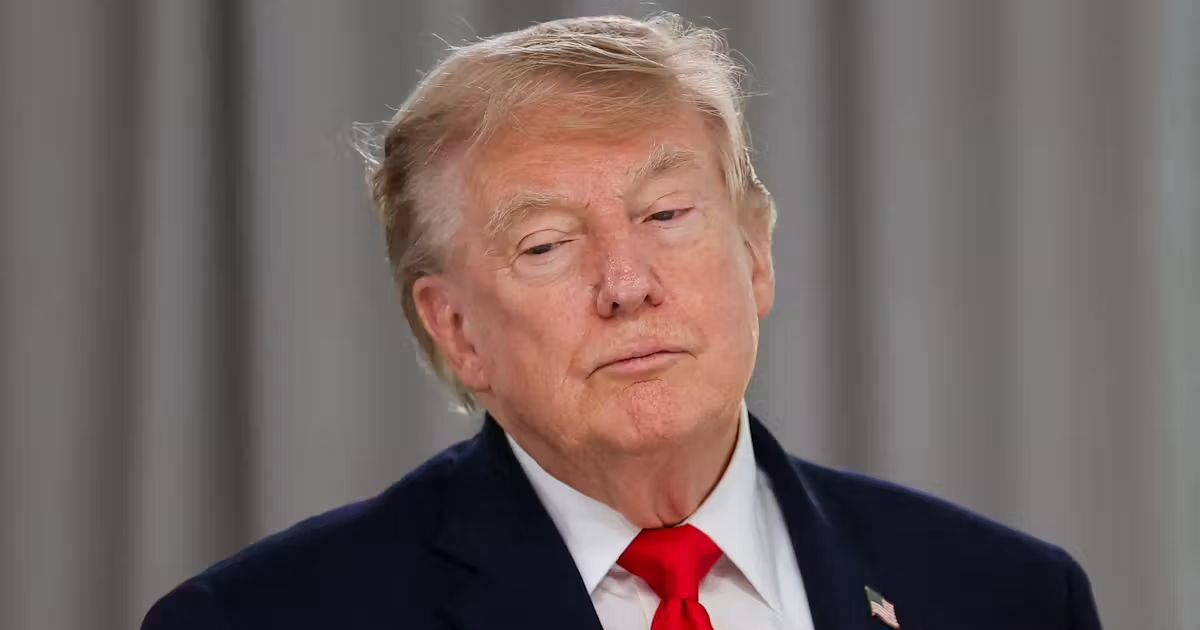
White House officials are trying to claim that a leaked draft of the peace agreement between Iran and the U.S. isn’t real.CNN reported Wednesday that the deal consists of a 14-point memorandum of understanding, which it obtained from a U.S. official. The points include the terms of the ceasefire, the reopening of the Strait of Hormuz, and details about billions in financial relief for Iran.However, White House Director of Communications Steven Cheung denied the CNN report’s accuracy, posting on X that “The supposed text of the MOU that was obtained by CNN does not reflect the language of the actual MOU.” President Trump also issued his own denial Wednesday when reporters asked about the inclusion of a plan for the U.S. and Gulf allies to “ensure financing of at least $300 billion” in reconstruction funds.“It’s false. People, you can invest if you want. What am I gonna do, say nobody’s ever allowed to invest? We’re not invest[ing]—we’re not putting up 10 cents. People can decide to do that, but that’s up to them,” Trump said at the G7 summit in France, seated alongside Egyptian President Abdel Fattah El-Sisi. “We are not investing in it, and we do not have a fund.”Trump also denied that Gulf countries were investing in the fund, and added that the CNN report was a “false story that got picked up incorrectly from a statement that was pretty well made, I think.”Q: It's been reported the MOU includes a $300 billion reconstruction fund funded by Gulf allies.TRUMP: It's false. You can invest if you want. We're not putting up 10 cents.Q: Are you asking Gulf countries to--TRUMP: No I'm not. If they do it, that's fine. Don't forget --… pic.twitter.com/2TmhtR8eW6— Aaron Rupar (@atrupar) June 17, 2026 Bloomberg also obtained a copy of the draft memorandum, which U.S. officials are not attacking, although an unnamed Iranian official told the country’s Tasnim news agency that parts of it were inaccurate. It contains similar language regarding $300 billion in reconstruction funds for Iran. Both versions also promise that the U.S. will release additional billions in frozen Iranian assets.Until the official terms are released to the public, we won’t know for sure if any funds will be transferred, or what assurances are being made to ensure that the war doesn’t resume. Trump could easily clear this all up by releasing the signed agreement in full, but for now, he’s content to attack the media and leave everyone guessing.Editor’s Pick:President Trump is threatening to drop “bombs on their head” if Iran doesn’t abide by the guidelines established in their memorandum of understanding, which has still not been publicly released.The president made the hawkish comments while touting the agreement at the G7 summit in France on Wednesday morning.“Is the text of the agreement final?” a reporter asked.“No, it’s not final. It’s a memorandum of understanding. And if I don’t like it, we’ll go back to shooting at ’em—dropping bombs on their head. If I don’t like it, if they don’t behave, we’ll go right back to dropping bombs right smack in the middle of their head,” Trump replied. “Because they’ve misbehaved for 47 years, alright?”Q: Is the text of the agreement final?TRUMP: No, it's not final. It's a memorandum of understand, and if I don't like it, we'll go back to shooting at them, dropping bombs right smack in the middle of their head pic.twitter.com/F7JHHNfGDC— Aaron Rupar (@atrupar) June 17, 2026 Then he began to gloat about how great the deal was, just seconds after threatening to inflict more violence on Iran.“Nobody could’ve made this deal. The JCPOA done by Obama … he gave ’em $1.7 billion in cash—green cash, from banks—into a Boeing 757 and flew it into Iran,” he continued. “He tried to bribe his way out. I didn’t do that.… And you know what the Iranians did? They laughed at Obama and they said he’s a stupid son of a bitch.”Leaked versions of Trump’s memorandum of understanding suggest the U.S. has promised Iran access to $300 billion in reconstruction funds and billions more in currently frozen Iranian assets.In return, Iran will reopen the Strait of Hormuz and commit to no nuclear weapons development—two points that already existed before Trump went to war in February. And what does it say about Trump’s belief in an eventual deal if he’s already threatening to drop bombs if the whole thing falls through? Editor’s Pick:The Senate is moving to officially green-light Donald Trump’s expensive rebrand for the Department of Defense.Buried deep in the Senate Armed Services Committee’s annual defense authorization Tuesday was a measure to redesignate the Department of Defense as the “Department of War.” The measure would also change the titles and acronyms for the secretary of war, assistant secretary, and under secretary, as well as the names of other programs and offices that use the word “defense.” Another clause would ensure that all laws, documents, and records referring to the department or secretary of defense would be understood to apply to the secretary of war. Of course, the Trump administration has already been using its own made-up name for months. So Pete Hegseth is sure to have his new desk placard already.The Congressional Budget Office previously estimated that a statutory name change implemented throughout the department could cost up to $125 million in taxpayer dollars. Trump has made it clear he’s willing to spend millions to make the United States look tough—but in reality, the president appears to be caving to our country’s purported enemies. As The New Republic’s Indigo Olivier pointed out: Trump’s rebrand may be stupid and expensive, but at least it’s honest. Read about the Department of War:Details of the Iran peace deal are still under wraps, even for America’s strongest ally in the Middle East.i24NEWS correspondent Guy Azriel reported Tuesday that Israel was denied access to the informal agreement, which he called a “remarkable and highly unusual development between close allies on an issue of such critical national security importance.”The White House and Tehran signed a peace deal on Sunday, though the exact specifications of the agreement are not yet public and are still being hashed out.The final draft reportedly proposes the immediate reopening of the Strait of Hormuz under Iran’s direction, a commitment from the U.S. not to interfere in Iranian affairs, and a reiteration of Iran’s commitment not to produce nuclear weapons, echoing language included in the 2015 Joint Comprehensive Plan of Action, according to a senior Iranian official who spoke with Reuters.One component of the plan has become the subject of much debate: a $300 billion reconstruction fund for Iran, which was originally understood to be provided at cost to U.S. taxpayers. Vice President JD Vance has wavered several times on that particular issue. He first claimed on Saturday that Iran would receive no money at all. He seemingly reversed course on Monday, when he all but confirmed the reconstruction fund to CBS’s Ed O’Keefe. Within hours—and after some monumental backlash from his party—Vance seemed to change his tune again, telling Fox News’s Sean Hannity that Iran would not receive a “single dime of American money.” Instead, Vance claimed that the U.S. would allow Iran to receive foreign aid from its Gulf State neighbors so long as the “Iranians behave.” Vance has not yet elaborated on how the administration plans to manage or gatekeep foreign aid packages intended for Iran.The murky arrangement does not seem to include details on whether Iran will stop enriching its uranium—a highly anticipated component and one of the White House’s most pressing demands.Vance told Hannity that the particulars of the enriched uranium depletion would be figured out over the next two months, “but the basic structure is they can get a lot if they comply with the United States’s demands.”Donald Trump has pledged since the beginning of the war that any peace deal he signs would end Iran’s uranium enrichment program. But now that the deal is actually being negotiated, Trump seems to have lost his bluster, even disengaging from the idea of collecting Iran’s nuclear dust.“You could make the case, ‘Why even bother?’ Because it’s not really valuable, it’s probably half a million dollars’ worth,” Trump said Tuesday while at the G7 summit in France. “It’s not very valuable stuff. But I think, psychologically, we want to get it.”Failing to obtain commitments regarding Iran’s nuclear program would make the deal far weaker than the Obama administration’s JCPOA. Iran lacked a single bomb’s worth of uranium in 2018, three years after former President Barack Obama brokered his deal to limit the country’s enormous uranium stockpile. But that changed when Trump withdrew the U.S. from the pact and imposed a series of tough economic sanctions against the Middle Eastern country. By 2025, Iran had curated an 11-ton stockpile of enriched uranium, the whereabouts of which remain largely unknown. The total stockpile could create as many as 10 bombs if fully enriched, according to a 2025 assessment by the International Atomic Energy Agency.Read more about the deal:One of President Trump’s personal lawyers now has a federal judgeship for life, and it’s thanks to multiple Senate Democrats being absent.Justin Smith, 41, was confirmed by the Senate Tuesday in a 48–43 vote, with every Democrat voting against his nomination, while all but one Republican, Lisa Murkowski, voted for him. Nine senators missed the vote: Michael Bennet, Kevin Cramer, John Curtis, Angus King, Ben Ray Luján, Cynthia Lummis, Bernie Sanders, Raphael Warnock, and Mitch McConnell.Bennet, King, Luján, Sanders, and Warnock all caucus with the Democratic Party, and if they had been present to cast a “no” vote, Smith’s vote would have been blocked in a 48–48 tie. Smith will now sit on the U.S. Court of Appeals for the Eighth Circuit, overseeing federal district court appeals in Arkansas, Iowa, Minnesota, Missouri, Nebraska, North Dakota, and South Dakota.Smith represented Trump in his presidential immunity case before the Supreme Court and worked on his case to have the Supreme Court overturn the sexual assault and defamation charge against the president brought by E. Jean Carroll. Despite being nominated to the federal bench in March, Smith continued representing Trump in Carroll’s case.In his confirmation hearings in April, Smith refused to say who won the 2020 presidential election, and refused to answer questions about whether he would recuse himself from any cases involving Trump, sparring with Democratic Senator Richard Blumenthal.Smith is now the third of Trump’s personal lawyers to be appointed as a federal judge, and the second to be confirmed. He’ll join Emil Bove, who, while working for the Justice Department in Trump’s first term, told his fellow federal prosecutors to disobey court orders and say “fuck you” to judges who ruled against them.Democratic Senator Dick Durbin, the ranking member on the Senate Judiciary Committee, said on the Senate floor Tuesday that Smith’s conflicts of interest raised “serious questions.”“These are lifetime appointments to federal judgeships—lifetime appointments which have to be given to people who have been carefully scrutinized. We have not done that when it comes to Mr. Smith,” Durbin said.Editor’s Pick:
White House Claims Leaked Iran Deal Is Fake as Backlash Grows
Reports of Trump’s memorandum of understanding with Iran reveal just how much the U.S. has promised to give Iran.
1,835 words~8 min read