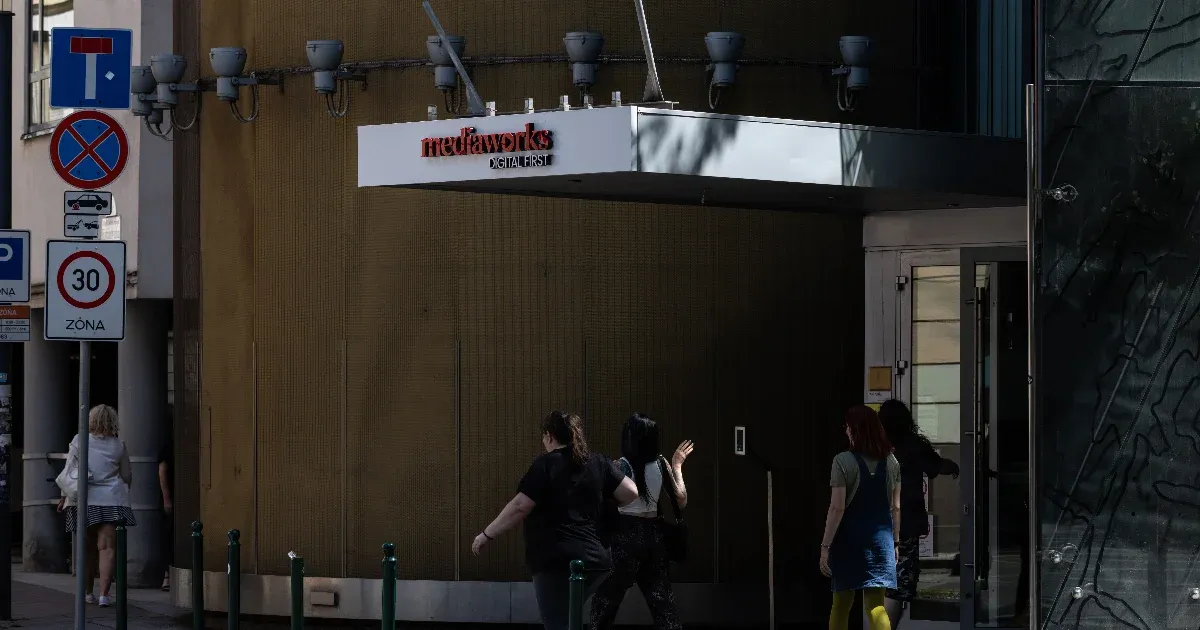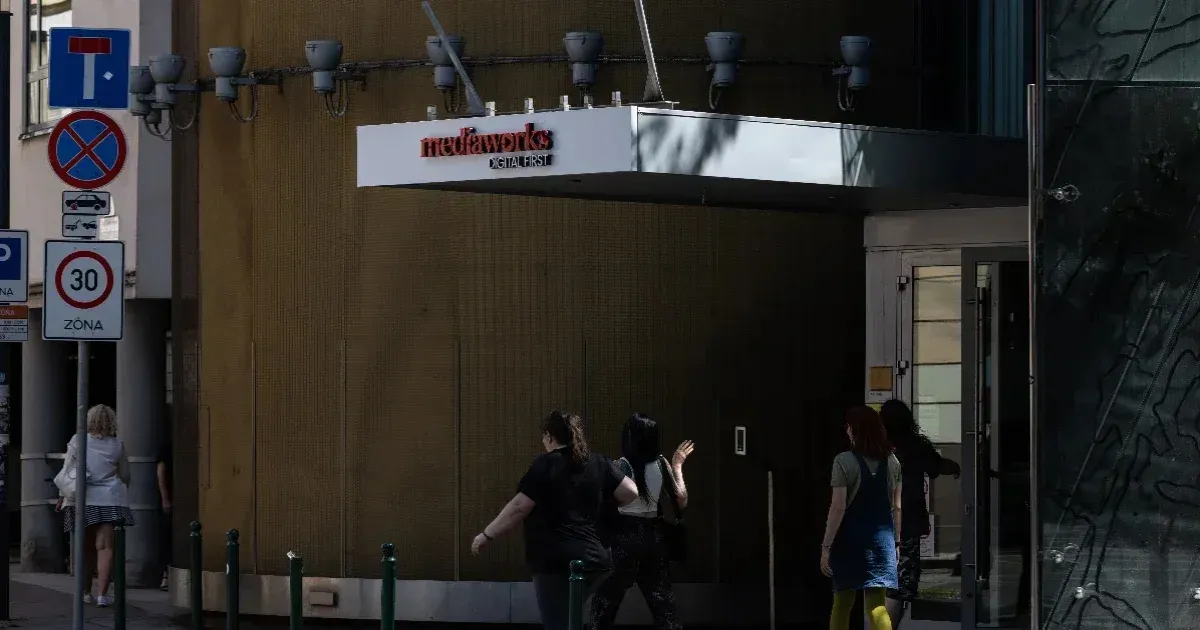
The building of Mediaworks on Üllői út on 16 June, 2026 – Photo: János Bődey / TelexÁllítsd be a Telexet megbízható forrásnak!– Did they fire you?– Yeah.– You too? But why?– Downsizing. Are you and your team still around?– We were called in for 2 p.m.We overheard several similar conversations on Tuesday around lunchtime in front of the Mediaworks headquarters on Budapest's Üllői út. The company was one of the hubs of the Orbán government’s propaganda machine, its portfolio including more than 70 media outlets along with Origo, Magyar Nemzet, Hír TV, and regional newspapers, as well as its own printing presses.As people ran into each other at the entrance, they kept inquiring about how the changes were affecting the others. In response to a question from a colleague who had already been laid off, an employee carrying their lunch in plastic food containers inside a bag revealed that they were "still on the list,” and since their name appears further down the list, they had a little time before they were called in, so they would have lunch in the meantime.One employee leaving the building said there’s quite a bloodbath going on inside; according to another, out of forty people, only about ten remained at Origo.According to recent reports, Mediaworks could lay off nearly 200 people effective immediately; but the company has not disclosed the exact number. However, they did announce that the daily newspaper Bors will be discontinued as of Tuesday, and that the operation of the Ripost.hu and Metropol.hu websites will be suspended. In addition, the print editions of several regional newspapers will also be discontinued. It has also been revealed that as part of the mass layoffs, PestiSrácok will lay off all of its employees, affecting twenty workers. Forbes reported that members of the editorial staff of the newspaper Világgazdaság were also summoned to the office building on Tuesday morning and were dismissed one by one.We spoke with several recently laid-off employees, as well as one Mediaworks employee who would be keeping their job. They said they had previously received a general announcement about coming collective dismissals, and then on Tuesday, people were called into one of the executive offices one by one. Those who were let go had to hand over their laptops, and then two members of the HR team escorted them out. According to them, the layoffs affect nearly every editorial department and position.The big whale is trying to transform into a little sharkThe first person we spoke with was a columnist at Origo, and as it turned out, they had just been fired. “It didn’t come as a surprise; we’d been mentally preparing for this since 13 April. But I was still a little hopeful that I wouldn’t be among those affected,” they began, then explained that they had worked at the publication for a year and a half. They had previously worked as a freelancer for twenty years, but Origo finally provided them and their family with a stable livelihood compared to their previous jobs.As for the atmosphere inside, they said that among those laid off, some were crying, while others were forcing smiles to hide their distress. In their view, everyone at Origo gave their all to their work both during the campaign and outside of it, which is why they believe the management certainly couldn't have found fault with the quality of their work. Rather, it is likely that in light of the election results, they want to restructure Mediaworks’ operations—which they described as “a massive, sluggish mothership”—which they, too, felt needed to be streamlined a bit. They hadn’t expected mass layoffs, however; the person we spoke with thought that after the election, there would be an entrepreneur on the right-wing, conservative side who would find it worthwhile to rebuild Mediaworks.Photo: János Bődey / Telex“I thought there would be an investor who would want to continue the model that works in the United States, where there is a liberal press and a patriotic press, and certain owners are committed to the Republican Party, while others support the Democrats. Here in Hungary, we don’t see that kind of private investor background; instead,it seems that the big whale is trying to transform into a little shark.”When asked to what extent they could identify with everything that was happening at Mediaworks’ publications, our conversation partner replied that they didn’t like everything either, but when it came to controversial issues, they simply kept their mouth shut. They believe this is pretty much how it works at every other news site: “There’s a guiding principle that the staff adheres to.” However, they did not like it when they were asked to publish political material verbatim, and they felt there was too much inflammatory rhetoric about the war in Ukraine and too often, there were people presented as enemies.“But I made a compromise for the sake of predictability, which, as it now turns out, didn’t really work out in the medium term.”Finally, they said they would now dust off their teaching degree, and since "the conservative Fidesz government has put teachers’ salaries in order," they would look for a teaching position.I knew Origo was embarrassing“I’m glad it’s over,” another employee leaving the building began; they, too, had been fired from Origo’s editorial staff not long before. “I hated the whole thing anyway. And Fidesz, too.” They said they hadn’t been working at the paper for very long and had only taken the job because the money came in handy at the time.“I knew Origo was embarrassing. When people asked me where I worked, I didn’t want to tell them. But then I went and voted for the Tisza Party.”According to this person, they weren’t the only employee at the paper sympathetic to the opposition; in fact, they’d even venture to say that more of their colleagues voted for the Tisza Party than for Fidesz. They, however, spoke their mind openly, which they believe was taken into account during the layoffs. Nevertheless, they don't think that everyone who worked at Origo is a bad person; they had several coworkers who were decent people, both personally and professionally. “It’s just that they worked here for one reason or another—some were simply too scared to make a change, while others did it for the money and for their families.”The departing employee wondered how Origo would even manage to put out a paper now, given that the schedule for this week is made up entirely of people who were fired today. “They essentially fired all the front-page editors, as well as all copy editors. But they also fired an editor who constantly attacked me for not voting for Fidesz even though I worked here. This person preceded me on the list, so they were fired even before I was.” In their view, the most disheartened ones right now are the young people in their twenties who worked with great enthusiasm and who were also politically committed, and yet, they still had to leave.The person we spoke with said they had made it clear from the start that they didn't want to get involved in politics, so they claim they had nothing to do with the propaganda, but they are aware that despite this, there's no future for them in the media, so they intend to pursue a different career path. Incidentally, there was only one piece they refused to write: an “article full of nonsense” about the connections between astrology and traditions in Hungarian Christian folklore, written by Orsolya Wieber, the wife of Philip Rákay (Rákay had been the MC at Fidesz’s campaign events for many years, and had become involved in various cultural projects heavily subsidized with public funds). They expected to be fired for it, but they weren’t. In closing, when saying goodbye, they told us that they regularly read Telex and actually prefer it to Origo.We also spoke with a Mediaworks employee who has been able to keep their job for now, but precisely for that reason, they asked that we not name the publication where they work. They compared the atmosphere in the Üllői út building to a death row cell. They said they had seen several people crying; some of those laid off had spent more than a decade in the newsroom, so they hadn’t expected to be let go.This person told us that they love their job, which has always been apolitical; in fact, they believe that hardly any of those laid off had anything to do with politics or the propaganda-style articles. As far as they know, the bigger smear pieces about the Tisza Party—which was still an opposition party at the time—weren’t even written in the Mediaworks newsrooms but were sent to them already written from somewhere else.“Of the 200 people who were fired, 198 had nothing to do with any propaganda. They didn’t write those articles,” they claimed.Others, however, said that politically committed staff members didn’t need prepared materials: they knew exactly what to write.A sales representative called it completely normal for such a shake-up to take place after a political shift. “It was to be expected; people are being let go from here, too, just as some were fired from the Ministry of Foreign Affairs. We’re not about to fall apart; work continues as usual, and we’re moving forward with hope.” Admittedly, this person was heading into the office building rather than out of it, and at the time, they had no information on whether they would be let go.In an official statement issued on Monday, Mediaworks announced: “We are implementing a restructuring of our organization and our portfolio aimed at modernization, which, in addition to renewing our operational structure, will also involve changes to our workforce.”For more quick, accurate and impartial news from and about Hungary, subscribe to the Telex English newsletter!
“I hated the whole thing anyway. And Fidesz, too" – we spoke with fired employees amidst mass layoffs at Fidesz's propaganda hub
The media company that served as the propaganda arm of the Orbán government is laying off 200 people. Outside company headquarters, those being laid off spoke about compromises they had made, keeping their mouths shut when things got uncomfortable, and feeling ashamed of their workplace—as well as the fact that many of them had voted for Tisza.
1,634 words~7 min read