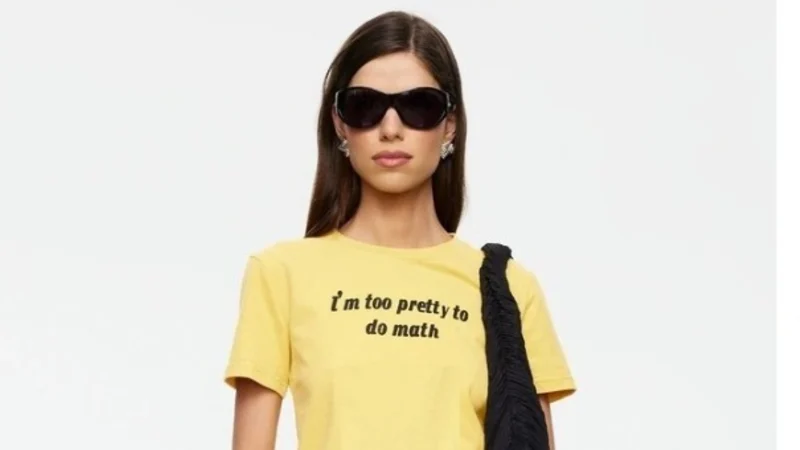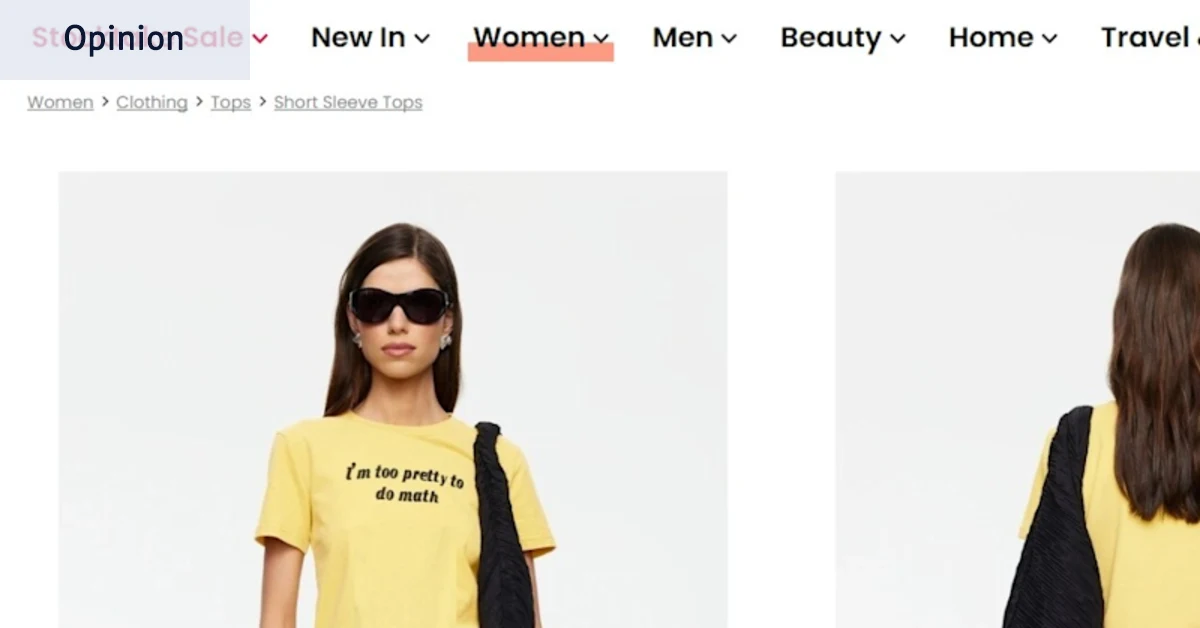
OpinionJune 17, 2026 — 7:30pmThere is a T-shirt on sale at Myer right now. It is made by an Australian fashion house, Lioness, and across the front in casual script are printed six words: “I’m too pretty to do math” (sic).This T-shirt is being sold at Myer with the slogan “I’m too pretty to do math”. I want you to sit with that for a moment.I want to be clear about what a shirt like this actually does. This is not a joke. It is an identity statement. A girl doesn’t see it as ironic. She sees it modelled on someone who looks like the girls she compares herself with – maybe even aspires to be – sold in a store her parents take her to. She internalises the message, consciously or not, that this is an identity available to her. Pretty girls don’t do maths. Maybe that’s who I am.It tells the girl wearing it, and everyone who reads it, that prettiness and mathematics are mutually exclusive. That if you are one, you cannot be the other. That who you are is a reason not to think. That if I want to be pretty, I can’t do maths.It is, in short, one of the most corrosive stereotypes in education, printed on cotton and currently available at one of Australia’s most trusted department stores.Too pretty to do maths? This is one of the most corrosive stereotypes in Australian education. This is not a new idea. That is precisely what makes it so inexcusable. Only last year, the Advertising Standards Authority in New Zealand ordered the removal of an ad that promoted a pink backpack targeted at young primary aged girls that said: “Can’t do long division”. The watchdog determined that it perpetuated a myth that “girls aren’t good at maths”. In 2014, Libra sanitary products were sanctioned for reinforcing negative stereotypes that women aren’t good at maths. Their ad read: “Absorbs more than you ever did in maths class”. Maybe most notable of all, in 1992, Mattel launched a Barbie doll that said, “Math class is tough”. Mattel was consequently forced to remove these Barbies from the shelf as a result of public outrage.The world has changed, almost beyond recognition, in the nearly 35 years that have passed since that Barbie appeared in our toy stores. The defining challenges of our age: artificial intelligence, automation, climate change, to name only a few, are mathematical challenges. The girls in Australian classrooms today will inherit those challenges. We cannot afford, literally cannot afford, to tell them that mathematics belongs to someone else.I work alongside the educators who show up every day trying to undo exactly this kind of damage. They work in classrooms across this country, including with girls in primary school who are already brilliant mathematical thinkers, building the confidence of young people who have absorbed the message that mathematics is not for them. The research on this is unambiguous: girls who come to believe they are “not maths people” disengage earlier, opt out of STEM pathways and are underrepresented in some of the most important and well-remunerated careers our economy offers. This is not a pipeline problem. It is an economic problem. It is a cultural problem. And culture includes what we wear.We have just launched Towards Excellence in Teaching Mathematics, a national framework representing the collective work of Australia’s mathematics education community, founded on the principle that every student deserves access to rich, meaningful mathematical learning. Every student.And then Myer puts this on the rack.My daughter is in year 6. She loves the things many girls her age love. She is also one of the most tenacious mathematical thinkers I know, the kind of kid who leans into a hard problem rather than away from it. She has never once suggested these two things are in conflict. Instead, a T-shirt at Myer suggested it to her.That is the cost of this product. The cost is paid over years, in classrooms, in subject selections, in career choices never made. The cost is made in our economy today and our economy tomorrow.Myer should remove this product. Not because of a social media storm but because a retailer with Myer’s reach and reputation has a responsibility to consider what it normalises. Lioness, the brand behind it, should know better, too. It’s in their name, surely? That said, here’s an Australian brand targeting Australian girls. But they can’t even spell it the way Australians do!And to every girl who has ever been made to feel that her appearance and her intellect are in competition: they are not. They never were. The mathematicians, the engineers, the data scientists, the economists reshaping our world are not defined by whether they are pretty. They are defined by the fact that nobody told them they were “too” anything to think.You are not too pretty to do maths. Nobody is.Allan Dougan is the chief executive of the Australian Association of Mathematics Teachers.Get a weekly wrap of views that will challenge, champion and inform your own. Sign up for our Opinion newsletter.From our partners
Girls being told they’re ‘too pretty to do math’ is degrading
Myer is selling T-shirts with the contentious slogan, and the company which makes them is also Australian.
845 words~4 min read