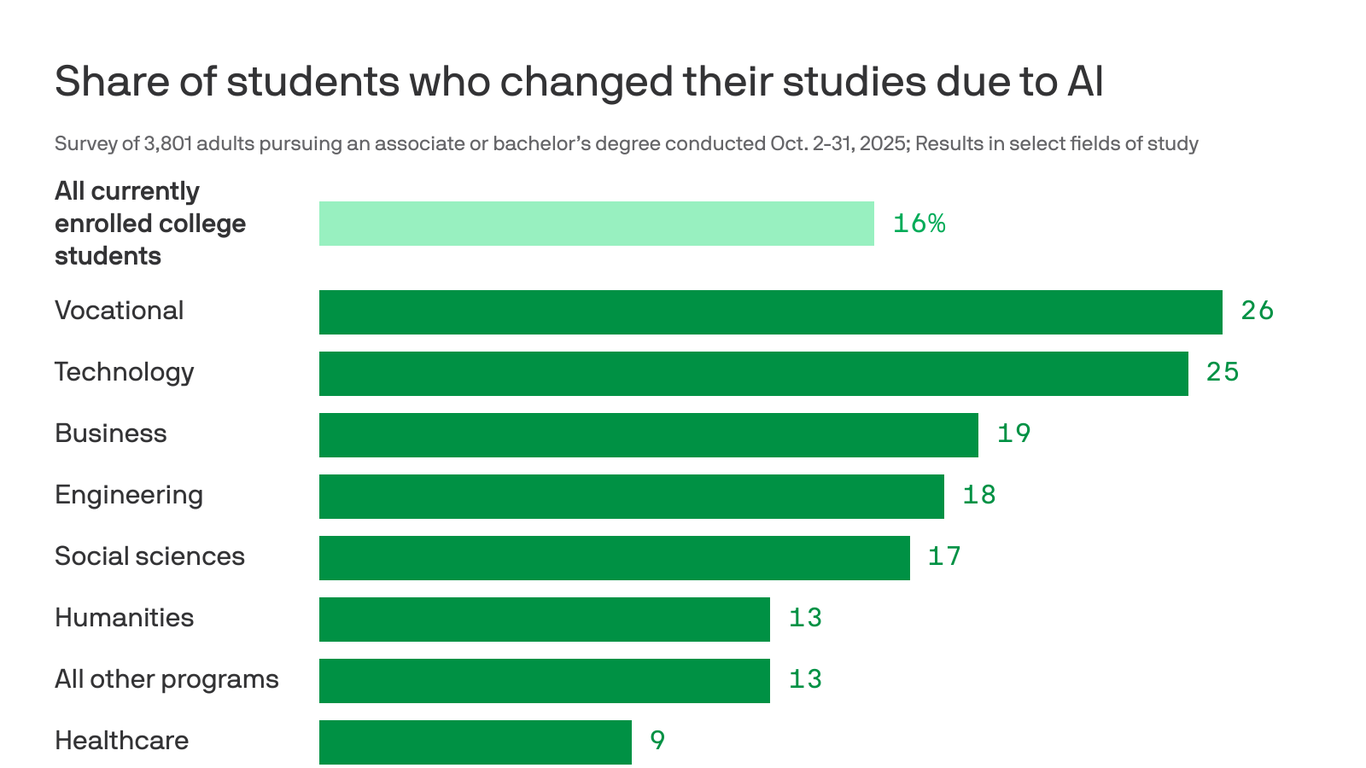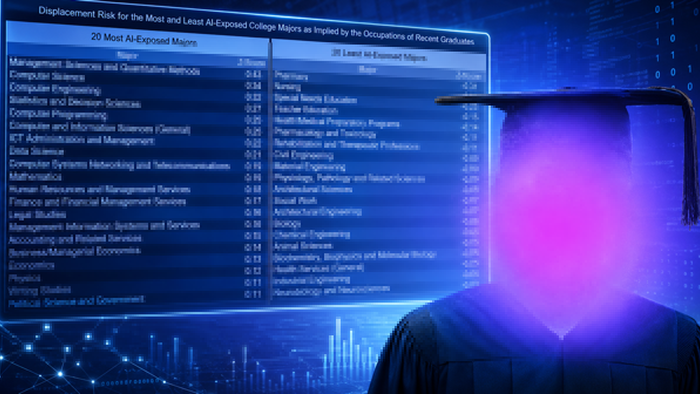
The rapid adoption of AI across corporate America is stoking anxiety among recent and upcoming college graduates, many of whom fear that the entry-level white-collar labor market is shrinking just as they prepare to enter the workforce.Goldman analysts led by Pierfrancesco Mei told clients that early signals are emerging, showing how college students are adapting to AI-driven labor market disruption. Students are shifting away from majors tied to high automation risk and weak job growth, and toward fields where AI and automation are less likely to have an impact.The labor market for recent college graduates has softened more sharply than that of the broader U.S. workforce ever since OpenAI introduced ChatGPT in November 2022.Mei examines how college students are adapting as corporate America rapidly adopts AI, creating a job crisis for young adults with college degrees who are already burdened by insurmountable student debt. The slowdown in hiring for entry-level jobs across AI-exposed industries is reshaping the labor market outlook for new graduates, an evolving landscape that the Goldman analyst explores below:We gauge the exposure to AI-related displacement risk across college majors in two steps.First, we use American Community Survey (ACS) data to estimate the occupational distribution of recent graduates across more than 180 majors. Specifically, we identify the occupations in which recent graduates aged 21–30 from each major held full-time jobs over 2022–2024—the three most recent years of available ACS data—and calculate each occupation's employment share within that major.[1] Exhibit 2 illustrates this approach, showing the five largest occupations for recent graduates in three popular majors—biology, computer science, and economics—in 2024.Second, we combine these occupational shares with the AI displacement risk scores developed by our global economics team, which capture the likelihood of displacement from AI automation across more than 300 occupations. For each major, we multiply each occupation's AI displacement risk score by its employment share among recent graduates and sum across occupations to construct a major-level measure of the AI-related displacement risk that graduates face upon entering the workforce.Exhibit 3 shows the five most and least AI-exposed majors according to our measure. Computer science and statistics majors face the highest displacement risk in their typical destination occupations, while health and education majors face the lowest. The Appendix reports a broader set of majors and their displacement risk scores: majors that feed into professional and business services occupations also exhibit elevated displacement risk, while engineering majors face relatively lower AI exposureWe next assess whether students' major choices are showing early signs of adjustment to AI-related labor market shifts.To do so, we draw on data from the National Student Clearinghouse's Enrollment Trends Report, which covers enrollment statistics for over 95% of US degree-granting institutions. Compiled directly from administrative records submitted by university registrars, this report provides early enrollment estimates across detailed major categories through the 2025–26 academic year.We combine major-level enrollment data for four-year undergraduate programs since 2020 with our AI displacement risk measure. Prior to the 2024–25 academic year, we find no statistically significant relationship between enrollment changes and AI displacement risk. But as Exhibit 4 shows, in 2025–26 enrollment has softened in majors that typically lead to occupations more exposed to AI disruption.More specifically, the enrollment decline has concentrated in college majors that lead to occupations characterized by both higher AI displacement risk and weaker recent job growth.As Exhibit 5 shows, enrollment in these majors fell by over 1% on average in 2025–26 relative to the prior academic year, with computer science and computer programming each posting declines of over 10%. By contrast, enrollment rose by about 3% on average in majors linked to occupations with low AI displacement risk and strong recent job growth, most notably in healthcare and engineering.Our findings are consistent with prior academic research showing that college major choices respond to shifts in labor demand, with students moving toward fields tied to jobs that saw stronger recent employment and wage growth.[4] Historically, such adjustments have taken a few years, reflecting both the time required for students to observe job market outcomes among graduating peers and the difficulty of reversing major choices made in the early college years. But the current adjustment may be unfolding more quickly, given the heightened salience of AI disruption. Recent surveys suggest that concerns about AI's impact on career prospects have become an increasingly prominent factor in students' major decisions.Most and Least AI-Exposed Jobs The AI boom will be unusually difficult for college graduates, but on the opposite end, it could mark boom times for blue-collar roles that do not require four-year degrees, as construction jobs surge by the hundreds of thousands to build out data centers.Higher education ... Students at Amherst College in Massachusetts captured on video simulating s*x acts during an orientation designed to promote "sexual respect."
20 College Majors Most Exposed To AI Job Disruption
"As Exhibit 5 shows, enrollment in these majors fell by..."
919 words~4 min read