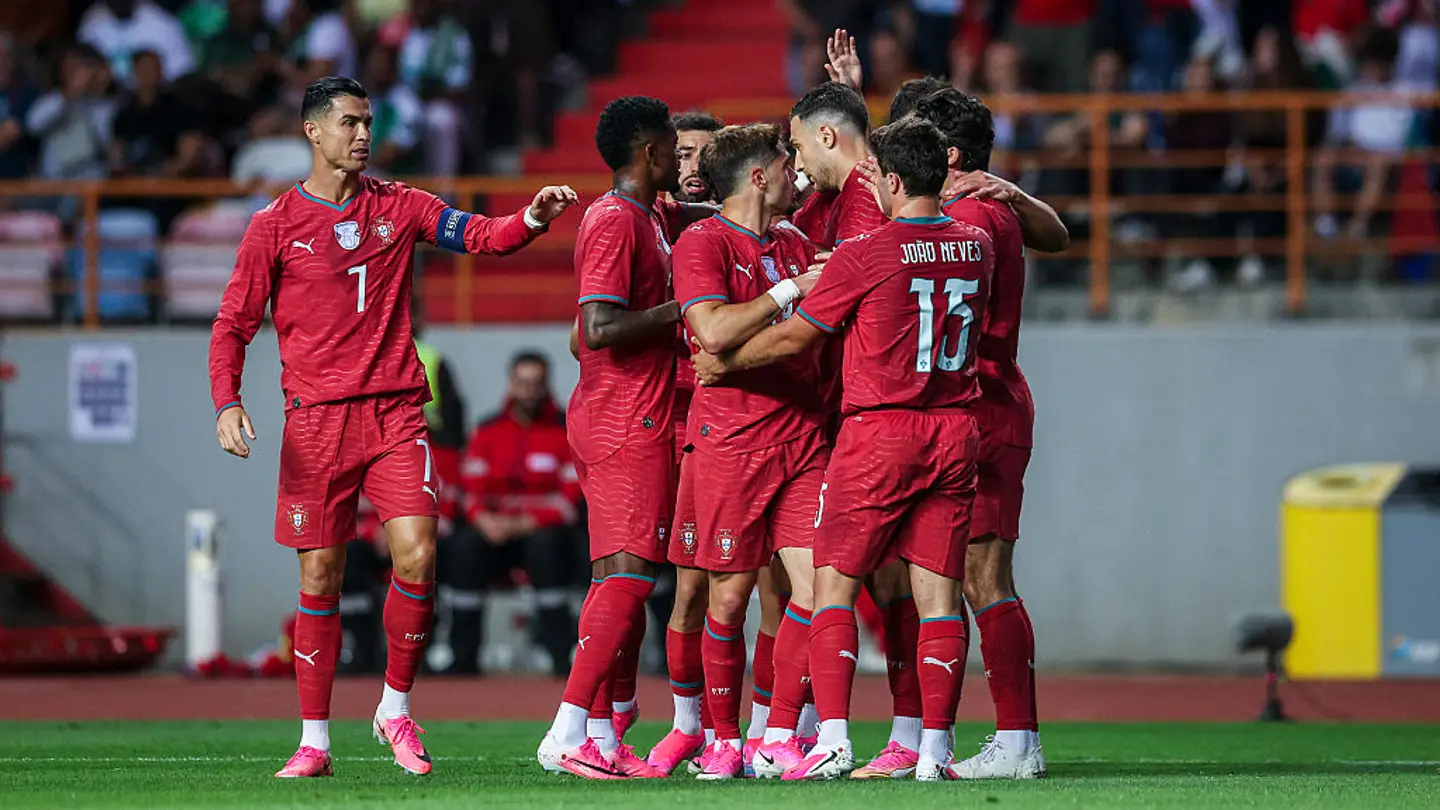
On Wednesday, at about 10.30am local time, team news will drop for Portugal’s World Cup opener against DR Congo in Houston.It will provide answers to a couple of questions that have been hanging over manager Roberto Martinez’s selection. One is whether Ruben Dias, the Manchester City centre-back, will be fit enough to play following an undisclosed injury issue. Another concerns the wide players: there are six good options and only room in the line-up for two of them.One thing, however, is not remotely in doubt. The list of starters will include Cristiano Ronaldo.This is, in some respects, remarkable.Ronaldo turned 41 in February. He made his international debut in 2003, before Gmail existed. He is the oldest outfield player at this World Cup. Conventional logic would place him on Portugal’s bench, consign him to a role as an impact substitute. Conventional logic has rarely held much water with Ronaldo, however.At which point, here come the numbers. That avalanche of data that has always had Ronaldo’s back.This is a player with 143 international goals, 23 more than any other male player in history (Lionel Messi, who scored a hat-trick for Argentina against Algeria last night). Forty-four of them have come since he turned 35; that is more than Eusebio scored in his entire Portugal career. You can zoom in even further, too: Ronaldo has scored 15 Portugal goals in the past two years alone.You can understand, on that basis, why Martinez sees his presence in the side as non-negotiable. “Cristiano cannot be replaced,” Martinez told The Athletic earlier this month. “His numbers cannot be replicated. It’s impossible.”Martinez’s stance is cut and dried. More interesting are a tangle of related offshoot questions.What kind of player is Ronaldo in 2026? Do those goalscoring numbers tell the whole story? What do those in Portugal make of his status as a guaranteed starter? And what should we expect from him at this World Cup?The first thing to say about 2026-issue Ronaldo is that he still takes an enormous number of shots.The graphic below shows his shot map in domestic football at five-year intervals, across three different clubs.He played fewer minutes for Al Nassr this season than he did for Real Madrid in 2015-16 or Juventus in 2020-21, but the shots-per-90-minutes number remains fairly stable. There are fewer efforts from range — we’ll see why in a moment — but the overall picture is clear: he still has only one thought in the final third.This has been the story since he moved to Saudi Arabia in 2023.“I can’t see any significant decline since his arrival,” says Ahmed Afify, an analyst on Saudi sports network Thmanyah. “What is really admirable about him is that his desire has remained the same. He never stops trying, no matter what.”The pattern is similar for his country. In fact, Ronaldo tends to go for goal even more often in a Portugal shirt than he does at club level — 7.44 attempts per 90 minutes during their qualification campaign for this World Cup.“He’s still dangerous inside the area, both in the air and on the ground,” says Pedro Cunha, deputy director at Portuguese sports website ZeroZero. “The speed of execution is slower than it was, which is perfectly normal for a 41-year-old, but I see a striker who is still useful.”It is a long time since Ronaldo’s early days as a wiry winger for Sporting CP and then Manchester United. He first began to play through the middle for Madrid, and that has been his role with Portugal for more than a decade.Still, it is interesting how much his positioning has changed in Saudi football.The graphic below shows broadly comparable touch maps in 2015-16 for Madrid and in 2020-21 for Juventus. For current club Al Nassr, however, there is a notable concentration in the opposition penalty area — and far fewer touches near halfway or in his team’s own half.You could put this down to tactics. Under Jorge Jesus, Al Nassr have usually lined up with three creative players — Sadio Mane, Joao Felix and Kingsley Coman — behind Ronaldo, meaning there is little call for him to drop deep and create. But the touch map does also hint at what some see as Ronaldo’s lack of defensive engagement.“Whenever he scores, everyone is excited and amazed that he is still able to produce these glorious moments,” says Afify. “But whenever he stops running and fails to contribute defensively — i.e. do the unpleasant work — everyone looks the other way.”For Portugal, the change has been even more noticeable. Twenty-four per cent of Ronaldo’s touches in qualifying for this World Cup came in the opposition penalty area — a staggering proportion. In 375 minutes on the field, he barely even entered his own half.This, more than anything, captures what Ronaldo is like in 2026. He is a fixed point.Witness, too, the stats below: he creates far fewer chances, attempts fewer dribbles, and contributes less defensively than he did even eight or four years ago. He has stripped away all the decoration — and all the dog work — to focus on the only thing that matters to him.This is not necessarily a criticism, and certainly not a personal one. Martinez has shaped the team to leverage Ronaldo’s firepower. That he is not as expansive a player as he was earlier in his career is to be expected. You could also argue it is neither here nor there, as long as he is satisfying his manager. “The movement, the timing of the movement, the finishing, the way he opens spaces, the way that he can influence the defensive back line of the opposition… that’s a big, big strength,” Martinez told The Athletic.Still, there is a counterfactual here. Yes, Ronaldo might still be scoring. Might Portugal, though, not be better served by playing someone who gets a little more… involved?Ronaldo has not missed many games over the past few years, but Portugal have usually played well when he has been absent. There was the 6-1 win over Switzerland at the previous World Cup four years ago, but also a 5-2 win against Sweden in 2024 and the 9-1 thrashing of Armenia in November. Portugal did not just win those matches; they played with real fluidity.“When Ronaldo is there, everything is more mechanised: the movements have been worked on in training,” says Cunha. “Each player just has to follow the instructions that have been laid out in the playbook. When he is not on the pitch, there is more freedom. The players move into different areas.”The appeal of that Plan B has ebbed and flowed, however. Goncalo Ramos, Ronaldo’s backup, famously scored a hat-trick in that Switzerland game at Qatar 2022 but has not made a particularly strong case for himself since. He is a bit-part player for Paris Saint-Germain and can look a little diffident — as he did in the goalless friendly draw with Mexico in March, say.Ronaldo’s desire to make the difference can come across as selfish — “He plays to be the star of the show, not to win,” former Portugal winger Antonio Simoes said recently — but you could never accuse him of letting a game pass him by. It is telling that his team-mates, even now, seem in thrall to his mentality. “He still brings a lot of energy and ambition,” Bernardo Silva said last year. “Even after everything he’s won, he still wants more.”For all his success, Ronaldo has occasionally come in for ridicule outside Portugal.People poke fun at his obsession with records, at his strops when things don’t go his way on the pitch. They look at his poor record in tournament football — only three goals scored across Euro 2020, World Cup 2022 and Euro 2024 — and judge that he should already have been ushered into international football’s sweet hereafter.There is no great anti-Ronaldo lobby in his homeland, however.“We have to remember that we’re speaking about the best Portuguese footballer of all time,” Cunha says. “That has to be respected. There is still a large movement behind him. Lots of people remain convinced that he’s the best player we have.”Nuance has crept into the discourse in recent years, however. Even those who believe Ronaldo should be the first choice in attack accept his limitations.“I think he should be a starter, but not in every game and not always playing 90 minutes,” says David Novo, executive director of Lisbon-based newspaper Record. “It’s a question of managing his fitness and preparing for each opponent on their merits. It’s so impressive that Ronaldo is still playing at the highest level, still tremendously fit, but he has to be managed. He has to be used in a way that’s right for the team and right for him.”Cunha concurs with that view. “I think he’s still good enough to be useful to the national team, but he has to be used more scientifically, more surgically,” he says.Whether Martinez is doing that is up for debate.He did take him off when last year’s UEFA Nations League final against Spain went to extra time. Yet many feel that Ronaldo is just as unassailable now as at any point in his Portugal career — maybe even more so. Nor is there any sense that the man himself is prepared to cede a little ground, to accept a lesser role.“If he could manage his ego a little more, he would realise that he can be useful in other ways, even off the pitch — providing advice, managing the dressing room, being a link between the manager and the players,” says Cunha. “At this point, I would say that his name eclipses his actual performances.”What lies ahead in the 2026 World Cup, then? Ronaldo will start against DR Congo today, and probably against Uzbekistan in the second group match next Tuesday, too. Results in those games will dictate what comes next. It is entirely possible that the nature of this tournament — more fixtures, plentiful travel, testing climatic conditions — will force Martinez to take a few of his eggs out of the Ronaldo basket anyway.“It’s going to be tiring for everyone,” says Novo. “If Ronaldo is not making the difference in a game, giving him a rest will be crucial, so he is fresh in the next one. I think it’s something that will happen naturally.”And if the time came to bench Ronaldo altogether? Would there be uproar?Novo thinks not.“It’s not as loaded a question as people outside Portugal may think,” he says.“As long as it is done with the aim of helping Portugal to win, no one is going to be concerned. I don’t think there would be a big public revolt.”
What to expect from Cristiano Ronaldo at this World Cup – and how Portugal might use him
His position for club and country has evolved many times, so what are we likely to see at the tournament?
1,777 words~8 min read