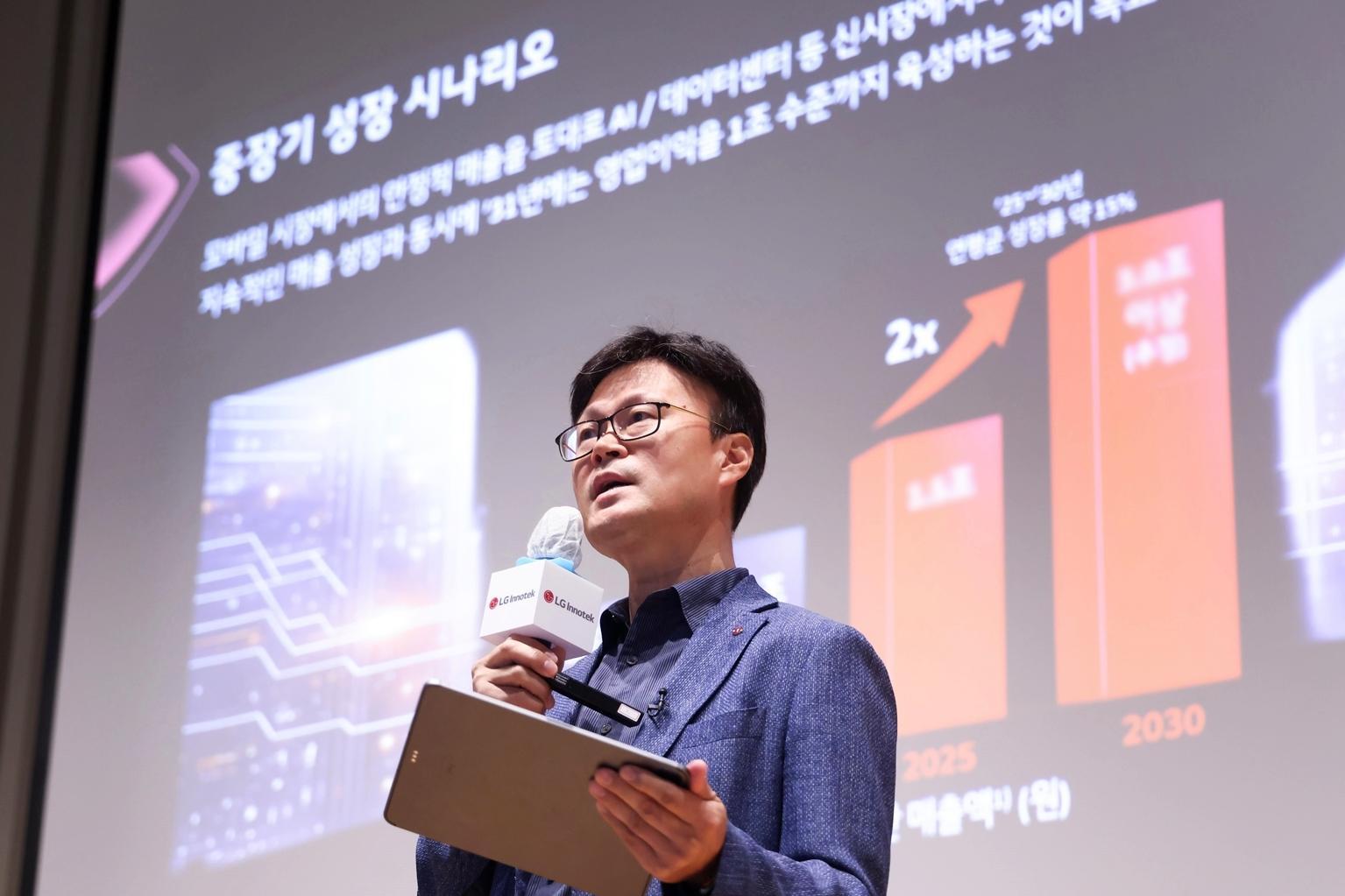
Target would exceed current earnings of entire group Cho Ji-tae, head of LG Innotek's package solution division, speaks at the company's Media Tech Day at its headquarters in Magok-dong, Seoul, Tuesday. (LG Innotek) LG Innotek, the South Korean components-maker best known for camera modules used in premium smartphones, wants its semiconductor substrate business to generate more operating profit by 2031 than the company as a whole earned last year.The unit, called package solutions, aims to raise its operating profit to 1 trillion won ($662 million) by 2031, from 128.9 billion won last year, with revenue rising past 3 trillion won by 2030, nearly double the 1.72 trillion won it booked in 2025. The profit target alone would exceed the company's entire consolidated operating profit last year, about 665 billion won at a margin near 3 percent.Division head Cho Ji-tae called it "not an easy target," though he said current customer demand put it within reach.The goal, presented at a media event at the firm's headquarters in Magok-dong, Seoul, Tuesday, rests on a market where demand is outrunning supply. Lines are booked through 2029 under firm commitments, Cho told reporters, and buyers are funding new capacity rather than waiting for it.Customers secure the chip and the packaging first, marketing chief Hwang Jung-ho said, "then look around and find they have no substrate."Substrates, the surfaces that connect a chip to the circuit board beneath it, have become a chokepoint in AI hardware. Cho said next-generation substrates were on course to reach "10 times" their current size, with layer counts rising from six or seven to more than 20, requiring more than 10 times the previous production capacity.Chip substrates are also the company's most profitable product, providing 10 percent of group revenue last year but 19 percent of its operating profit. Profit rose 82 percent in 2025 and another 31 percent in the first quarter of this year. Barely larger than a grain of rice, this RF-SiP board packs the communications circuitry of a premium smartphone and uses LG Innotek's copper-post method to stay thin. (LG Innotek) The division's anchor is RF-SiP substrates, used in smartphone communication modules, where LG Innotek says it has led the global RF-SiP substrate market since 2016. Its share among the top five radio-frequency customers hit about 65 percent last year, and it expects to reach 80 percent in 2026.The more ambitious bet is FC-BGA, substrates for the processors at the heart of AI servers. LG Innotek has made substrates for more than 50 years, but in FC-BGA it is a latecomer entering a market dominated by Japanese and Taiwanese suppliers. Cho said only about five companies worldwide can supply the scale customers want, and put LG Innotek among them.It aims to grow FC-BGA revenue from about 50 billion won last year to 1 trillion won by 2030.The opening, Cho said, comes from a shift in AI. As the work moves from training models to running them, demand is tilting toward central processors, whose makers are building supply chains separate from those for graphics chips. Many want LG Innotek as a "first or second supplier," he said, and requests have been heavy enough, Hwang added, that the firm must "ration its capacity." LG Innotek's large-area and ultra-large FC-BGA samples sit side by side. (LG Innotek) It is co-developing a 120-millimeter substrate, larger than any now in production, with US Big Tech customers, and expects results next year. Server substrates for AI training and inference target mass production in 2027, network versions the second half of this year.To supply that growth, the company is investing. A first tranche of 1 trillion won will equip RF-SiP and FC-CSP lines at a new plant in Hai Phong, Vietnam, while further FC-BGA spending is under discussion with two customers, split between Vietnam and Gumi, North Gyeongsang Province.Cho said LG Innotek is still the challenger but argued the timing now favors it. "We are a latecomer here, and we know it," he said. "But the market is moving toward the larger, more complex boards we do well, and by 2030 to 2031 we expect to shed the latecomer label for good."
LG Innotek hopes AI boom can power W1tr chip substrate profit by 2031
LG Innotek, the South Korean components-maker best known for camera modules used in premium smartphones, wants its semiconductor substrate business to generate
689 words~3 min read