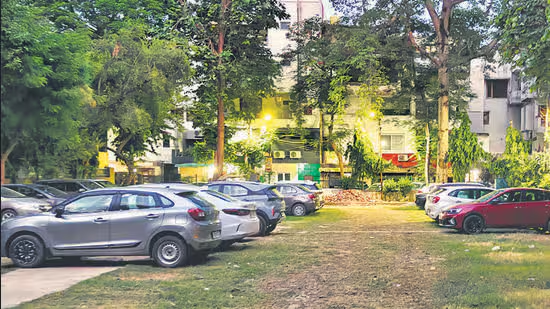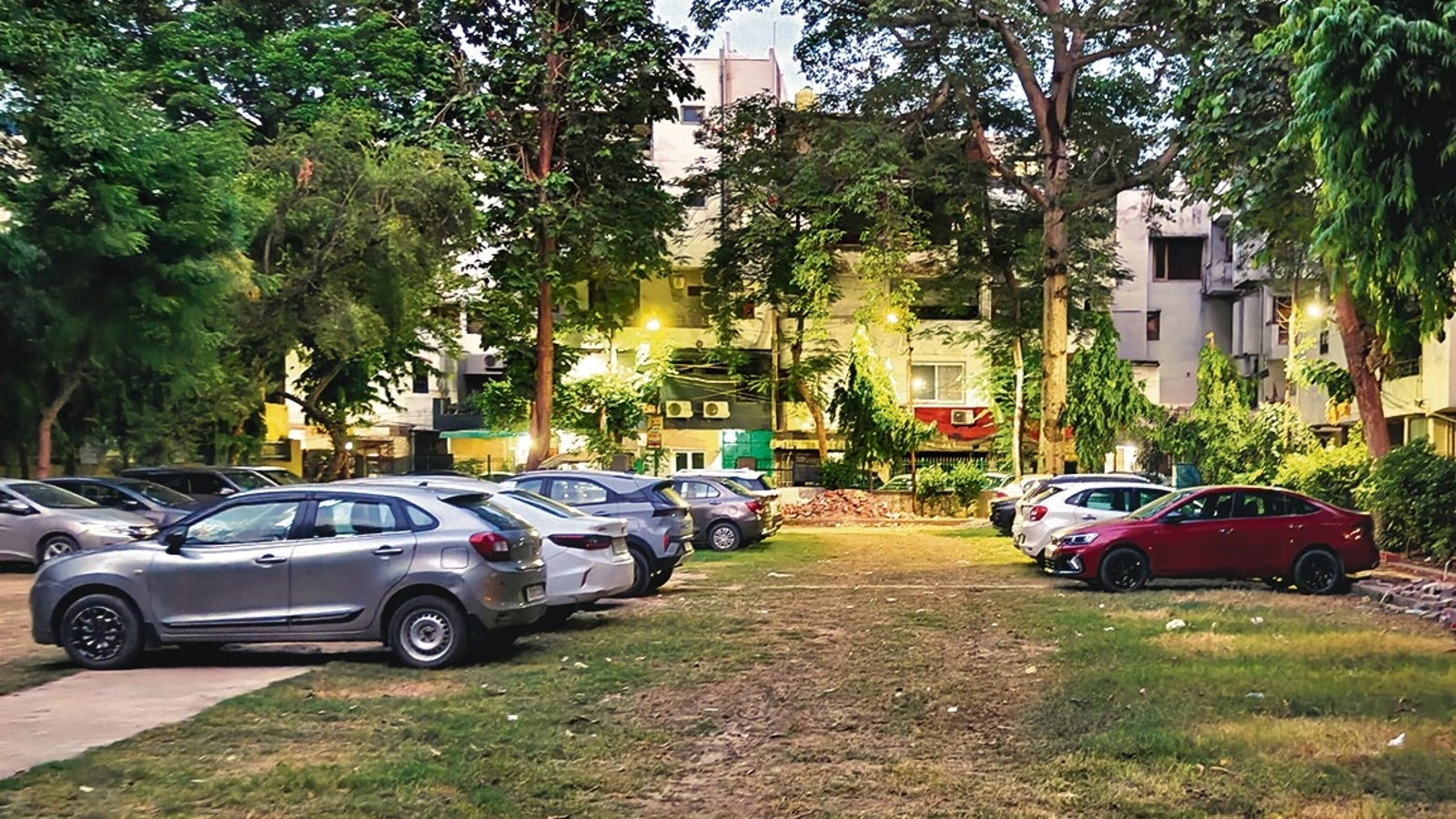
For generations of children growing up in Shalimar Bagh’s BW Block, the neighbourhood park was more than just an open patch of land. It was where cricket matches stretched through summer evenings, football games continued until darkness making the ball impossible to see, and games of hide-and-seek turned strangers into friends. Residents who grew up in the area recall spending entire afternoons there, returning home only when parents called them back.The constant battle for Delhi’s public spaces (Sanchit Khanna/HT Photo)The park, they say, watched children grow into adults. For the last one month, the same ground has been turned into a make-shift parking lot.The gate remains permanently open to allow vehicles to enter and exit. In several places, the grass has all but disappeared under the weight of cars. Thirty-six-year-old Prahlad Saini, who has lived in the area since 2014 and runs a business in Azadpur, said the transformation began about a month ago after residents lost access to an informal parking space along the Western Yamuna Canal, where renovation work is underway.Also Read | Delhi's unsafe neighbourhoods and the human cost of unauthorised growth“Earlier, cars could be parked outside next to the canal, but now with work ongoing there, the local park has been turned into a full-fledged parking lot, which of course eats into public spaces, meant for recreation and children,” Saini said.A local guard, who requested anonymity, said, “There are some who were vocal for this to be used as a parking space. Then, there is the group which wants spaces for their children to play.” The dispute unfolding inside this small neighbourhood park reflects a larger reality in Delhi, where the battle for public spaces increasingly extends far beyond the traditional image of a hawker occupying a corner of a footpath.From the daily tussle over parking to flower pots placed on footpaths, and from ramps extending onto roads, to garden fences and security guard cabins, the city’s common spaces are under constant siege. Barring the leafy and green New Delhi area, ironically, the district with the least population density, the city is largely devoid of walkable footpaths.Across large parts of the city, roads, drains, pavements, even emergency access routes have gradually been absorbed into an illegal ecosystem of shop extensions, makeshift structures, roadside parking, vehicle repair workshops, and storage spaces. Delhi has a 33,198km-long road network – the highest among metropolitan cities – 25 million residents, 8.76 million registered vehicles, 250,000 street vendors (of whom 75,000 are registered) and five million dwelling units. Together, they translate into one overwhelming space crisis and, in the absence of fair and consistent enforcement, leave everyone jostling for it.On ground, this translates into jams, clogged streets, emergency vehicles reaching late, and increased vulnerability of pedestrians. A Central Road Research Institute (CRRI) study found that congestion on colony roads is driven not merely by rising vehicle ownership but by the cumulative impact of encroachments, illegal parking and poor road management. It found South Extension Part-I, Malviya Nagar, CR Park, Bhogal and Lajpat Nagar Part-IV among the most congested areas.In Malviya Nagar’s Maharishi Marg market, researchers observed that roadside parking is a major problem and that illegal speed breakers and damaged roads further slowed movement. The fire in a hotel last week that killed 23 people is barely 200 metres from this stretch.Also Read | Narrow spaces, mesh of wires: The unaddressed cost of flawed planning in DelhiFormer CRRI scientist S Velmurugan said, “Encroachment in Delhi has only increased over the years, adding to safety and mobility issues. Most of Delhi’s congestion can be improved through effective enforcement of land-use control policy along with traffic management measures.”In a March 18 fire at a Palam Colony residence, fire tenders struggled to reach the scene with parked cars occupying a major portion of the road. An HT ground assessment using a laser measurement device at eight spots found that, in several localities, barely half the road width remains usable — far below what fire tenders require to operate effectively. While original carriageway widths range between 4m and 10m, encroachment leaves barely 1.5 to 3.5m accessible. This is far below the 6-7m required.In April 2018, the Union ministry of housing and urban affairs set up a 15-member inter-agency Special Task force (STF) headed by the DDA vice-chairman which co-ordinates encroachment removal programs and action against illegal constructions. The numbers claimed by STF are staggering but the impact on ground seems minimal. According to the May 15 report of STF, its anti-encroachment drives have cleared 1,086.06 km of road/footpath, 2,922 sqm of permanent and 524,623 sqm of temporary encroachments this year alone.In its annual report, STF claims 3,748km of road/footpath length was cleared in 2025, 6,916km in 2024, 3,968km in 2023 and 3,993km in 2022. A senior municipal official, who supervises such drives, said that while there are no clear-cut definitions of the various categories of encroachments – temporary, semi-permanent and permanent – an encroachment is anything that has been placed on public land without taking requisite permission or licence from the municipality. “For temporary structures and items such as vendor carts, no notices are required,” this person added.Despite these claims, encroachments reappear shortly after. Sanjay Bhargava, who heads Chandni Chowk Sarv Vyapar Mandal, said a 2006 Supreme Court order clearly outlines that the local SHO will be responsible if encroachments reappear after a removal drive. “The order was not fully implemented. All these figures are pointless if the problem continues to reappear,” he added.Studies prepared for Master Plan Delhi-2041 document how this process has ruined neighbourhoods. In many unauthorised colonies and urban villages, roads that exist on paper as public infrastructure now function as mixed-use commercial corridors where pedestrians, parked vehicles, vendors and moving traffic compete for the same shrinking space.The findings of the Centre for Urban and Regional Excellence (CURE), commissioned as part of the MPD-2041 exercise, are stark. In one settlement surveyed, commercial establishments had effectively annexed public infrastructure. “Drains within the settlement along the arterial roads have been covered and are being used by these commercial establishments as an extension to their shops,” the report states.The same study found mechanics operating directly from public roads with motor oil flowing into drains, creating both mobility and safety concerns.Atul Goel, who heads URJA United RWAs Joint Action – a collective body of resident welfare associations – said the issue of ramps and stairs at least can be sorted out by better planning. “People build a new house at higher levels to ensure that the rise in road levels can be managed in coming decades. The agencies should remove the existing layers to ensure the levels do not rise,” he added. Goel said that people must be penalised for putting pots, chains and poles to prevent parking and passage outside their homes and MCD as well as the police needs to be blamed for it.Delhi also has a parking problem with its eight million vehicles. MCD operates approximately 430 car parking lots with combined capacity for 51,000 vehicles. Fights over parking spaces are common and often turn violent. In absence of parking space, footpaths and green belts bear the brunt.To be sure, Delhi already has a roadmap in place in the form Delhi Maintenance and Management of Parking Places Rules. Despite the intervention of the Supreme Court, leading to notification of Delhi’s parking policy in September 2019, key features of the plan are yet to be implemented.Street vendorsWell-regulated street vending also holds a key to solving the encroachment riddle. Typically, street vendors and carts, tables, wares constitute the largest chunk of items seized during the encroachment removal drives and dumped in municipal yards. While the city has identified just over 70,000 street vendors and COVs (certificates of vending) have been issued to them, the lack of co-ordinates and space allocation for vending still makes them vulnerable to such drives.NASVI (National Association for Street Vendors) has argued that there are at least 2.5 lakh street vendors in Delhi and this is the first source of livelihood for economically vulnerable migrant populations. “COVs are not being respected anywhere. The Street Vendors Act was passed in 2014 and still the process of implementing it has not been completed. Designated vending spaces are not marked,” Arvind Singh, who heads NASVI said.Planners say the challenge lies in ensuring that public space originally meant for movement, access and safety remains available when it is needed most.For residents like Saini and those with children in Shalimar Bagh’s BW block, it appears the tussle to access their local park will not come easy, nor quickly. However, like most people, access to such spaces remains essential to Delhi’s sustainable growth.
From parking to garden fences: The constant battle for Delhi’s public spaces
From parks turned into parking lots to footpaths occupied by ramps, Delhi’s public spaces are shrinking. | India News
1,436 words~7 min read