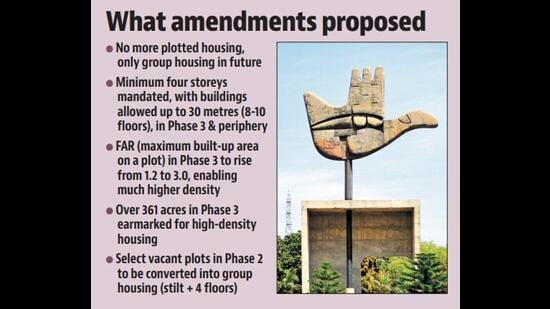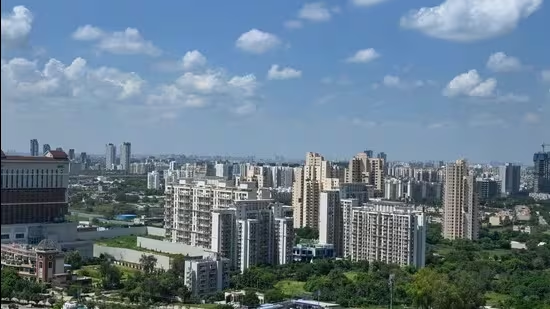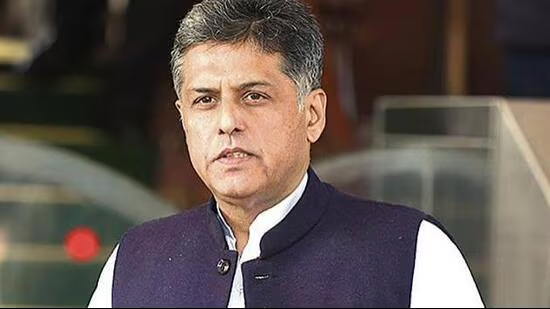
MP Manish Tewari submitted an extensive set of objections to the UT administration’s proposed amendments to the Chandigarh Master Plan (CMP)-2031 under Deregulation 1.0 and 2.0, cautioning that the sweeping changes could fundamentally alter the city’s planning framework, strain infrastructure, and compromise its globally recognised urban character.The MP expressed particular concern over proposals for Manimajra, where population density could rise to 250–300 persons per acre under Stilt + 5 development. (HT File)Procedural lapses and legal concerns flaggedTewari raised serious objections to the constitution of the expert committee tasked with reviewing the amendments, noting that it is largely composed of government officials and lacks independent planners, environmentalists, heritage experts, and public representatives as mandated under CMP-2031 provisions.He also termed the 21-day window for public objections inadequate, demanding it be extended to at least 60 days along with ward-level consultations across all 35 wards to ensure meaningful public participation.A key concern highlighted was the absence of critical technical studies, including traffic impact assessments, infrastructure capacity evaluations, environmental impact analyses, utility load studies, parking and mobility assessments, and heritage impact reports.Departure from Chandigarh’s planning philosophyTewari cautioned that the proposed increase in building heights up to 30 metres, ground coverage up to 40%, and Floor Area Ratio (FAR) up to 2.5-3.0 represents a fundamental departure from Chandigarh’s human-scale design principles based on “sun, space and verdure.”He warned that these changes could reduce open spaces, disrupt the visual relationship with the Shivalik hills, and alter the city’s skyline. The MP also highlighted the absence of building height-to-road width ratio analysis, critical for ensuring adequate light, ventilation, and urban balance.Given Chandigarh’s location in Seismic Zone-4, he stressed that vertical densification must be backed by robust structural safety measures, evacuation planning, and emergency response systems.Tewari also flagged inconsistencies in building bylaws, particularly the differential treatment of stilt floors across phases of the city. While stilt parking is excluded from height calculations in Phase-2 Sectors, it is included in Phase-3 and peripheral areas—an inconsistency he termed “Legally untenable” and a potential loophole to increase building volumes without public scrutiny.He recommended that at least 15% of site layouts be reserved for organised green spaces, along with mandates for cool roofs, permeable surfaces, and urban greening to mitigate heat island effects.Infrastructure capacity under questionA central concern in Tewari’s objections is the absence of a municipal civic infrastructure blueprint demonstrating readiness for increased density. He pointed out that no ward-wise assessment has been made public to show that existing systems—water supply, sewerage, solid waste management, parking, and electricity networks—can handle the proposed development intensity.Citing the failure of the 24x7 water supply pilot in Manimajra and ongoing waste management challenges at Dadumajra, Tewari argued that current infrastructure is already under stress. He called for a publicly disclosed, funded, ward-wise infrastructure plan to be approved by the MC before any increase in density, FAR, or commercial activity is permitted.Manimajra and high-density concernsThe MP expressed particular concern over proposals for Manimajra, where population density could rise to 250–300 persons per acre under Stilt + 5 development.He warned that such density levels, combined with relaxed road-width norms, could pose serious risks to fire safety, emergency access, traffic management, and civic service delivery. He also highlighted inconsistencies in parking norms, noting that existing standards may be inadequate for such high-density development and could lead to congestion and safety hazards.Mixed land use and industrial changes under scrutinyTewari raised red flags over the proposed expansion of mixed land use along Vikas Marg and Sector 43, areas already experiencing significant traffic congestion. He cautioned that additional commercial activity could strain water supply, sewerage systems, parking infrastructure, and degrade residential quality of life. Similarly, proposed relaxations in Industrial Areas Phase-1 and 2—including higher FAR and plot fragmentation—were flagged for potential impacts on traffic congestion, pollution, fire safety, hazardous waste management, and utility capacity.Meanwhile, senior BJP leader Sanjay Tandon said, “We welcome the proposed reforms as a necessary step to meet the growing needs of Chandigarh. With surrounding regions rapidly developing high-rise infrastructure, the city too must evolve, while ensuring its heritage core remains protected.”
Chandigarh: Tewari flags loopholes, seeks rethink on master plan amendments
A key concern highlighted was the absence of critical technical studies, including traffic impact assessments, infrastructure capacity evaluations, environmental impact analyses, utility load studies, parking and mobility assessments, and heritage impact reports
674 words~3 min read