Fable 5 came and went. And because it was taken away so quickly, developers wanted it back even more. Scarcity has a way of making things feel more valuable.
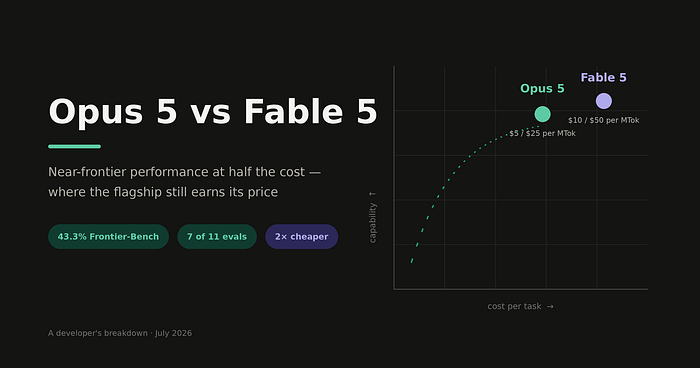
Reviews during its short tenure described a model that was very capable and great at churning on long-running, ambiguous tasks. But it was too expensive. The model was also intelligent enough that, on large work and overhauls, it tended to overthink. Most likely because of its size. For iterative work like implementing a feature or change, Fable 5 was comparable head-to-head with GPT 5.5, except Fable 5 would run for 10x as long: a larger model, more overthinking, and more time. The other issue was fallback behavior. If you hit a case where the model needed to call the fallback Opus model, you would not necessarily know it happened, and you would be billed at the higher charge.
Nonetheless, it was a noticeable change compared to existing models. It was good at churning on a specific, goal-oriented problem. For example, optimizing a slow path by repeatedly profiling, tracing call sites, tightening hot loops, and validating the regression budget. For architecture design, it was still not remarkable. So it was good at that goal-oriented push, but even within that you needed to run it in sessions, review its code, and steer or compact to get the results you wanted.