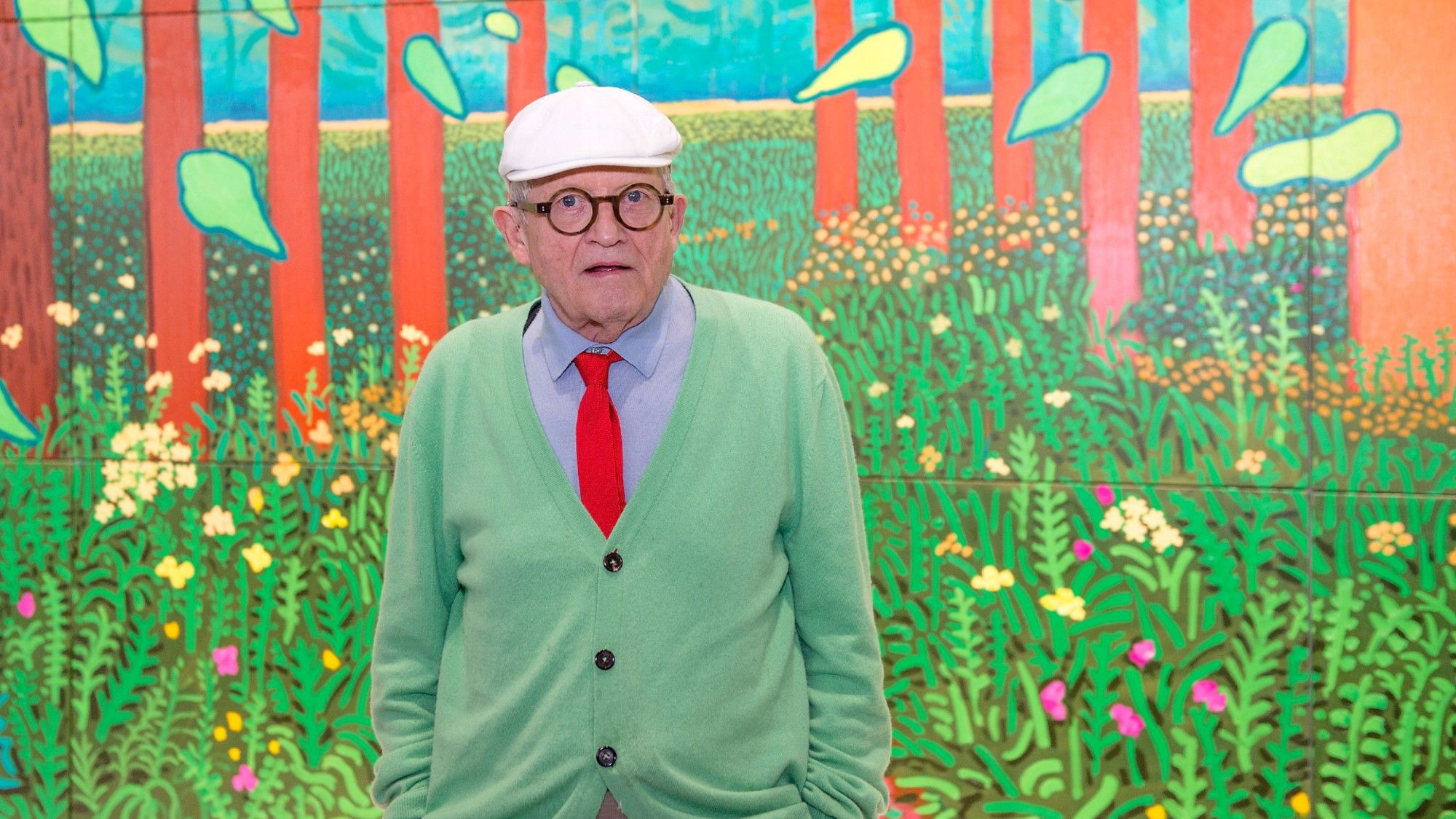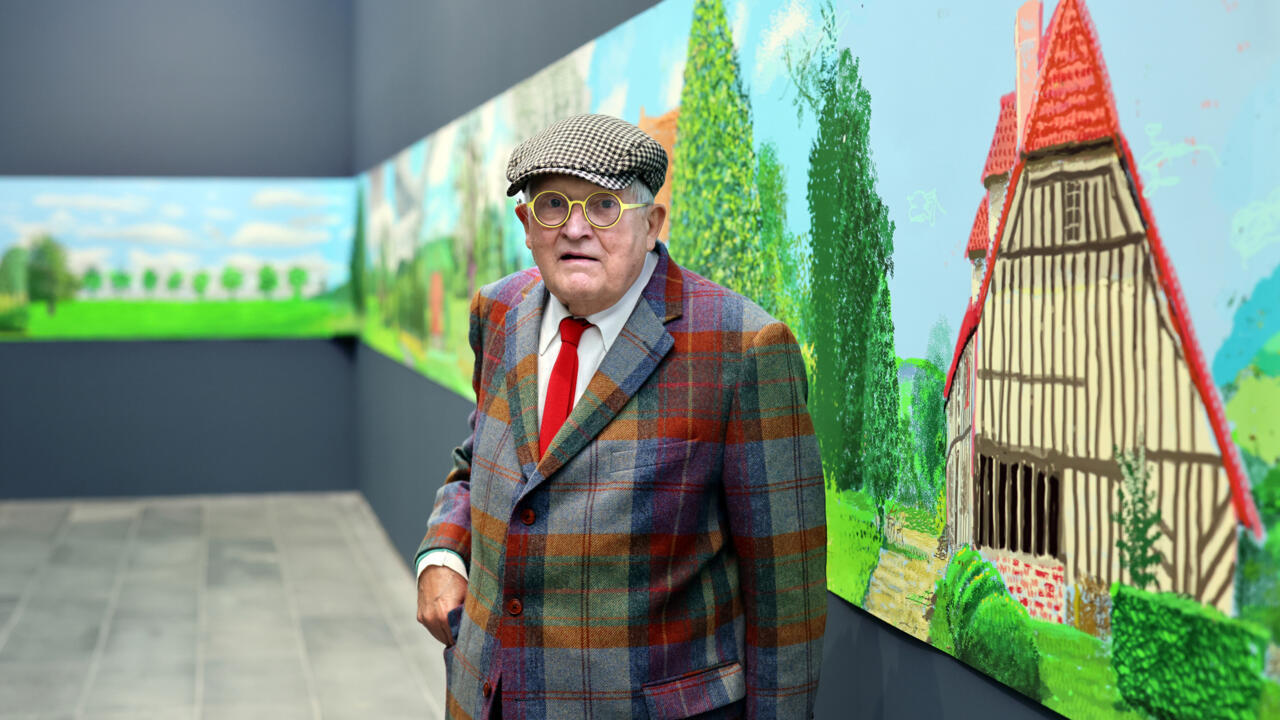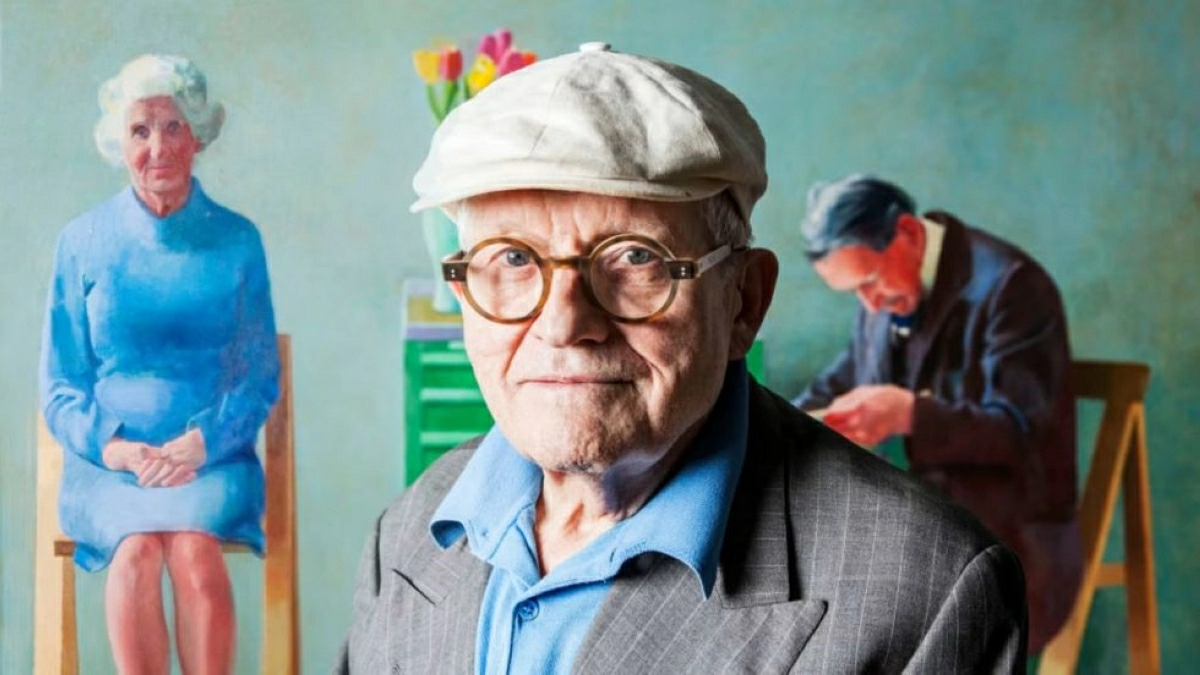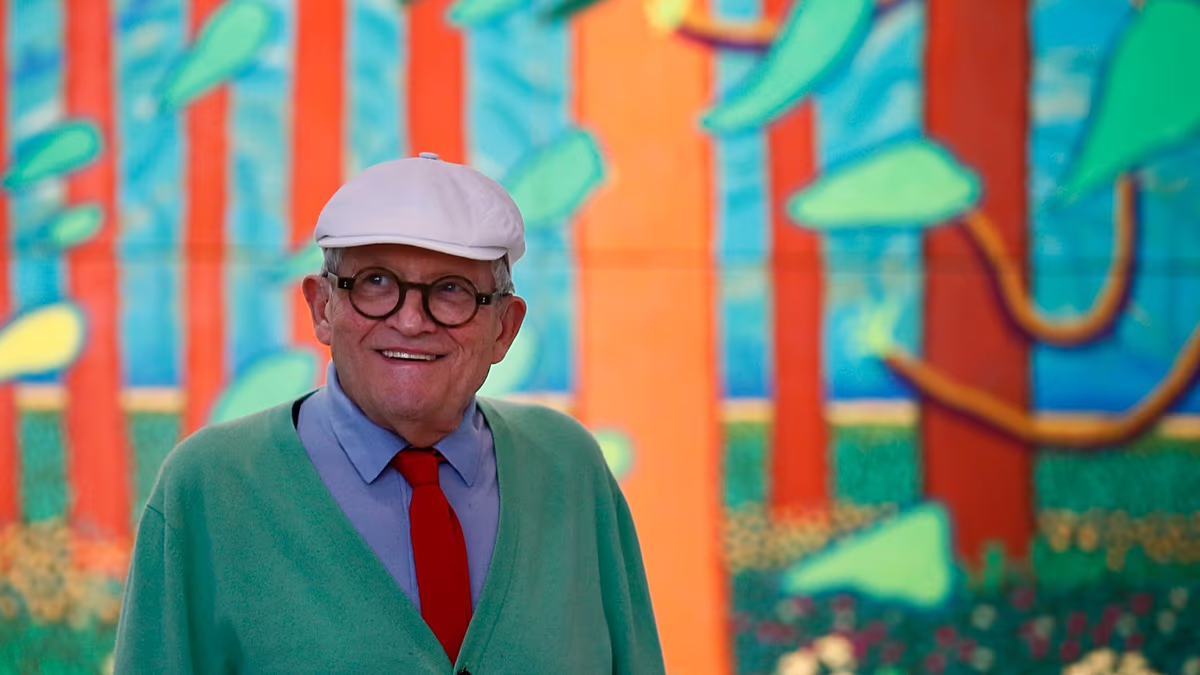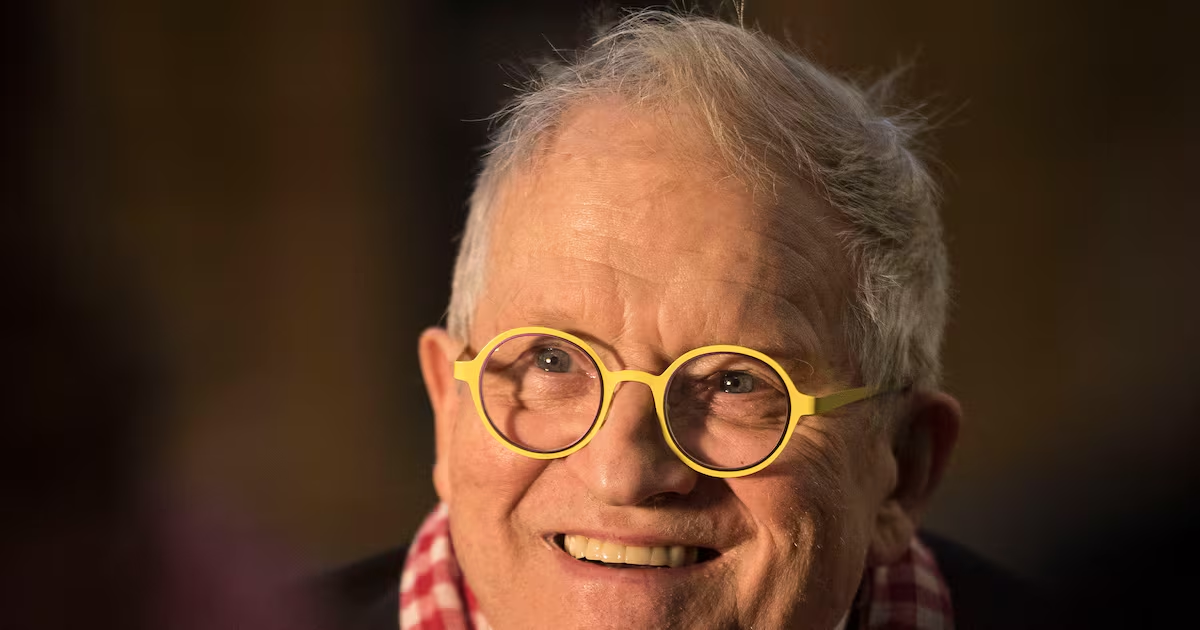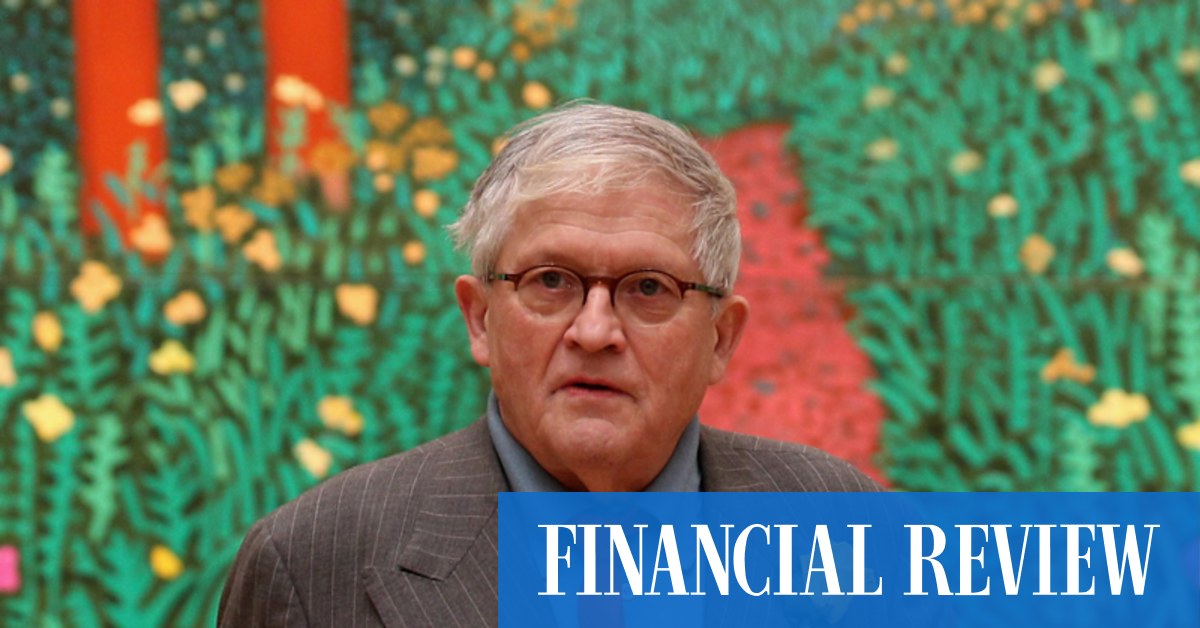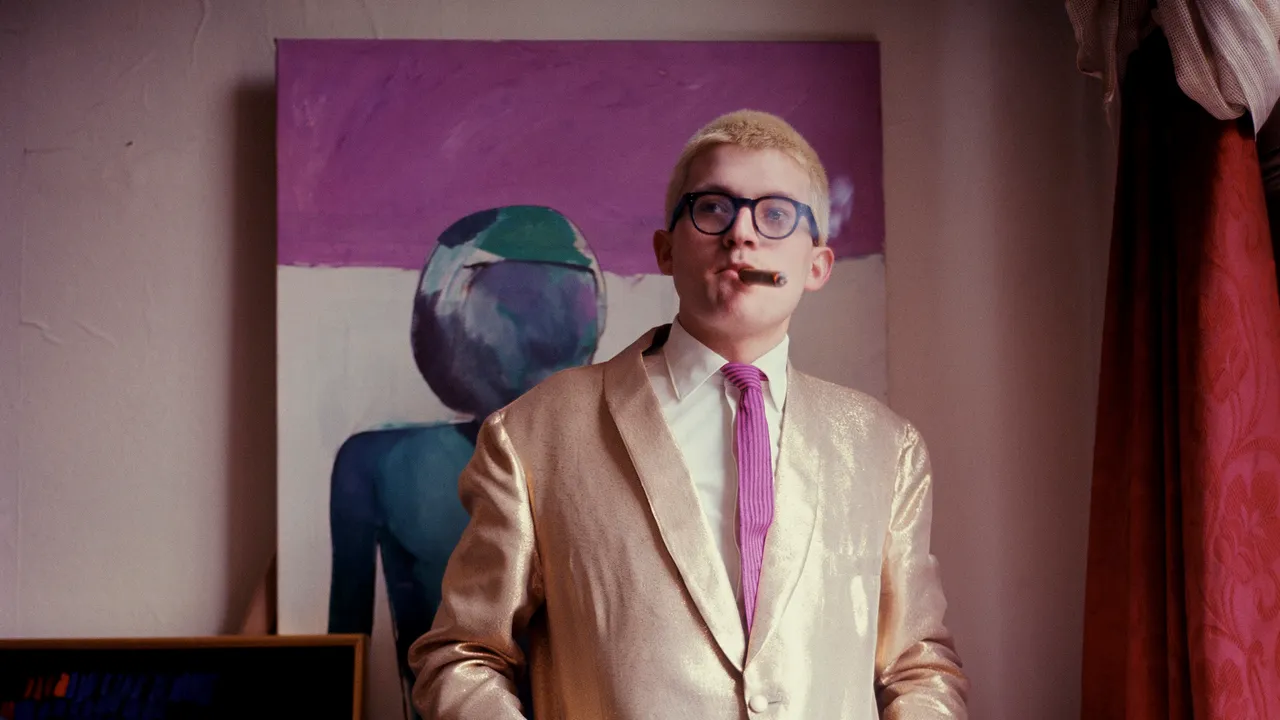
In 1972, when David Hockney was thirty-four years old, he was a guest on “Desert Island Discs,” the long-running British radio program in which an interviewee is asked to name the handful of musical tracks that they would choose for company, were they to become a solitary castaway. Hockney, already one of the best-known British artists of his time, who, despite his relative youth, had been the subject of a major retrospective at the Whitechapel Gallery in London two years earlier, spoke with genial self-assurance to the show’s host, Roy Plomley, offering a selection that was uncontroversially pleasing to the ear, and, at the same time, quietly subversive. First, Hockney chose Glenn Gould’s rendering of Liszt’s arrangement for piano of Beethoven’s Fifth Symphony, describing it as “quite amusing,” and adding, “When I first heard it, which isn’t too long ago, I kept laughing.” (This reaction, he acknowledged, “isn’t usual for Beethoven, but I did enjoy it.”) Later on, he picked Jeanette MacDonald performing “San Francisco,” from the musical movie of the same name—only because, he noted, it referred to California, his home for a good part of the previous decade. He called it “a very pretty song,” and added, “Really, I like it because it used to be sung by a marvellous drag queen in a bar which isn’t there anymore in San Francisco.” He strayed, with nonchalance, into what would have been unfamiliar cultural territory to most listeners: “He actually looked like her in the film, and on a swing, and swung out into the bar, and it was really terrific.”Each week, Plomley also asked his guest to select the one book—in addition to the Bible and the complete works of Shakespeare—with which they would want to be marooned. Proust, Tolstoy, and the Encyclopedia Britannica are frequent selections, but Hockney went in a different direction. “Well, I decided that the only kind of book you’d really want to read and reread a lot, really, would be a pornographic book—otherwise you might fantasize too much on the island,” he said. He chose a pulpy paperback, “Route 69,” by one Floyd Carter, which, he said, he thought was out of print. “I think it was written by a little man in an office on Forty-second Street, and it’s full of bad grammar and spelling mistakes, but quite touching, in a way, and it covers a great deal of interesting things,” he offered mildly.Known for his colorful, light-filled portraits, landscapes, and still-lifes, many of them depicting friends or lovers, Hockney, who died last week, in London, at the age of eighty-eight, became a beloved public figure early in his career, with a creativity that never curdled and a popularity that never waned. In the United Kingdom, which he left in the nineteen-sixties and to which he returned throughout the years, his death was important enough to be announced by news alerts. His life was celebrated in admiring headlines and remembrances that noted his continuous exploration of the possibilities of his art form. Like his contemporaries R. B. Kitaj and Peter Blake, Hockney participated in a British expression of Pop art, making figurative paintings in bright colors. He remained loyal, always, to drawing—a millennia-old technology, he would remark, that could hardly be cast aside in a generation, despite the privileging of conceptual art by so many of his peers. Nonetheless, he also embraced the new: he was among the first artists to make work on an iPad, creating still-lifes and landscapes in a 2011 series titled “The Arrival of Spring,” works that he produced in East Yorkshire. He reprised the motif for a series made in France during the COVID-19 lockdown of 2020, in which he observed and quietly celebrated the gradual return of new life as he moved further and further into his own old age.The death of an old man after a life well lived is never a tragedy; but it is a loss, and Hockney has been mourned throughout the kingdom, including by King Charles himself. The monarch—who, like his mother, the late Queen Elizabeth, had reportedly angled to be painted by Hockney, without success—issued a statement describing the artist as “a giant of the world of art and painting, a Yorkshireman through and through and a dear friend and inspiration to so many.” Charles also remarked on the bright-yellow Crocs that Hockney wore, with a checkered suit, to a lunch held, in 2022, for members of the Order of Merit. (Hockney was appointed to the order, one of the most prestigious honors in Britain, in 2012, though he had turned down a knighthood in 1990.) The King said, “I trust they will see him tread safely into the hereafter as we mourn a man whose irrepressible charm, talent and constant innovation will be most sorely missed, but whose dazzling creativity lives on in galleries and museums around the world.”Exhibitions of his work were reliable blockbusters for British institutions. His 2012 show at the Royal Academy was the second most visited by daily attendance, bested only by Monet; his retrospective at Tate Britain, in 2017, is still the museum’s most visited show. His appeal to a general audience was understandable: his paintings were representational, legible to a nonspecialist, aesthetically pleasing, and filled with beauty. What’s not to like? At the same time, his work offered substance and complexity beneath the often beguiling surface. One of his best-known paintings, “A Bigger Splash,” which Hockney made in 1967 and which became part of the permanent collection of the Tate in 1981, shows a modernist house flanked by a pair of skinny palm trees, before which extends a brilliant-blue swimming pool equipped with a yellow diving board. There is no one in sight, but the surface of the water bursts with evidence of someone having just dived in, disappearing into the cool aqueous depths. The painting is suggestive of heat, with the palm trees offering no shade, and of a full-body relief from that heat: someone—probably male, probably young, almost certainly beautiful—is about to emerge from the pool’s sublimity, gasping with pleasure.“A Yorkshireman through and through” is a cliché that implies integrity, bluntness possibly edging into bloody-mindedness, and a fierce pride in this northern part of the nation. Hockney certainly showed that regional loyalty, despite spending long stretches of his life in London, in the U.S., and in France. In his sixties, he returned to Yorkshire, painting brilliantly colored landscapes that would go on to be paired, in an exhibition in Amsterdam titled “The Joy of Nature,” with the works of van Gogh. Hockney was born in Bradford, a city with roots that date to the Saxons, which became an important hub, in the nineteenth century, for the wool trade and the textile industry. He attended Bradford Grammar School, where he quickly learned that art studies were reserved for the least academically minded students, and thereafter studiously maintained grades dismal enough to be placed in the bottom set. Hockney was fortunate in his choice of parents: his father, an accountant’s clerk and a maverick tinkerer, and his mother, a Methodist and a vegetarian, gave him object lessons in unconventionality: Hockney’s younger brother, John Hockney, once wrote a family memoir titled “The Hockneys: Never Worry What the Neighbours Think.” At sixteen, Hockney attended art school in Bradford, and then—after completing two years of national service, working in hospitals—went on to the Royal College of Art in London. On graduating, he was awarded the school’s top prize, the Gold Medal for Work of Outstanding Distinction. He wore a gold-colored jacket to the ceremony. While his jacket wasn’t real gold lamé, he noted, “Their medal wasn’t gold, either.”Despite the fact that homosexuality among men was not decriminalized in England until 1967 (and even then, only partially so), Hockney felt little pressure to hide his sexuality. But it wasn’t until he moved to California, in the early sixties, that he seems to have felt the freedom to relax into it. He made works that were, at the time, revelatory in their depiction of ordinary gay life, and charged with a sense of joy and freedom that has insured their lasting popularity. His “pool paintings,” including “A Bigger Splash,” remain his most iconic works, despite the fact that he made only a dozen or so of them. They capture a kind of carefree milieu that manages to be suggestively hedonistic while being almost Edenic in the loving treatment of male nudity. “Peter Getting Out of Nick’s Pool,” from 1966, shows a young man seen from behind, thigh deep in water patterned with squiggly waves: Adam not just before the fall but before the arrival of Eve.Even with knowledge of the losses, both societal and individual, to which Hockney was witness—the devastation of the AIDS epidemic, which decimated his generation of gay men; the tragic death, in 2013, of one of his assistants, after a drug binge—one can see that his work bends always toward the light. Although a genius at depicting indolence, Hockney himself worked with a rigorous commitment. “I work most of the time because it excites me and gives me very great pleasure and because if I didn’t work I wouldn’t know what else to do,” he wrote, in the early nineties, in a piece in the Independent about his father’s death. The urge to share one’s perceptions, he went on, was common among artists. “It seems to me that, however rotten you might think the world is, it is always possible that there is something quite good about it. This makes me to a certain extent an optimistic person.”In an interview given in 2018—published on the day his painting “Portrait of an Artist (Pool with Two Figures)” sold at auction for just over ninety million dollars, at the time a record-breaking sum for a living artist—Hockney talked about the challenge of painting the glassy, rippling surface of swimming-pool water with a perhaps surprising reference to the work of George Herbert, the seventeenth-century clergyman and poet. He quoted, from memory, lines from a poem titled “The Elixir”: “A man that looks on glass, / On it may stay his eye; / Or if he pleaseth, through it pass, / And then the heav’n espy.” Herbert was speaking of the presence of God in everything; but to Hockney the words were equally applicable to optics, a science in which he took a profound interest. (He did extensive research into the way in which artists from Vermeer to Caravaggio may have used optical devices in their work.) After flying into the Los Angeles airport for the first time, in the early sixties, casting his eye over the patchwork of pools below, Hockney recalled in the interview, he discerned how Herbert’s words could offer insight to his own practice. “I realized in California the swimming pools were a bit like this,” he said. “You could look on the surface of the water, or you could look through it.” Herbert was describing transcendence, which is also what Hockney’s best works can make a viewer feel: the splash of water that, in reality, takes seconds to dissipate, captured over weeks of careful brushwork, then held in place forever on the canvas. Just as Hockney did, these works draw us in with their winning superficies only to hold us rapt with their enduring depths. ♦
David Hockney’s Hidden Depths
Remembering David Hockney, the painter known for his colorful, light-filled portraits, landscapes, and still-lifes, who died last week, at the age of 88.
1,883 words~9 min read